Born in 1874, Shahu Maharaj (also known as Chhatrapati Shahu) was the ruler of the princely state of Kolhapur from 1894 to 1922. In 1902, he passed one of India’s first affirmative action policies (Wikipedia, “Shahu of Kolhapur”). In this biography, we cover the life and policies of Shahu Maharaj, his educational initiatives, his connection to Dr. Ambedkar, and his legacy. We identify varying accounts and cover what sources lack. Our Biographies on Phule and Ambedkar cover the social reformer and politician Shahu Maharaj supported, respectively.
Shahu of Kolhapur: early life and reign
Born Yeshwantrao Ghatge on June 26, 1874, Shahu Maharaj introduced many social welfare policies during his 28 years of reign over Kolhapur (1894-1922) (Wikipedia). He is also known as Rajarshi Shahu Maharaj (Wikipedia). One memorial website mentions the cause of his death to be heart illness (Shubh Darshika, “Rajarshi Chhatrapati Shahu Maharaj Punyadin”). During this website’s time of reconstruction, one of the links pertained to Wikipedia’s article on Shahu Maharaj (as of February 2021).
Shahu Maharaj reservation: the 1902 order
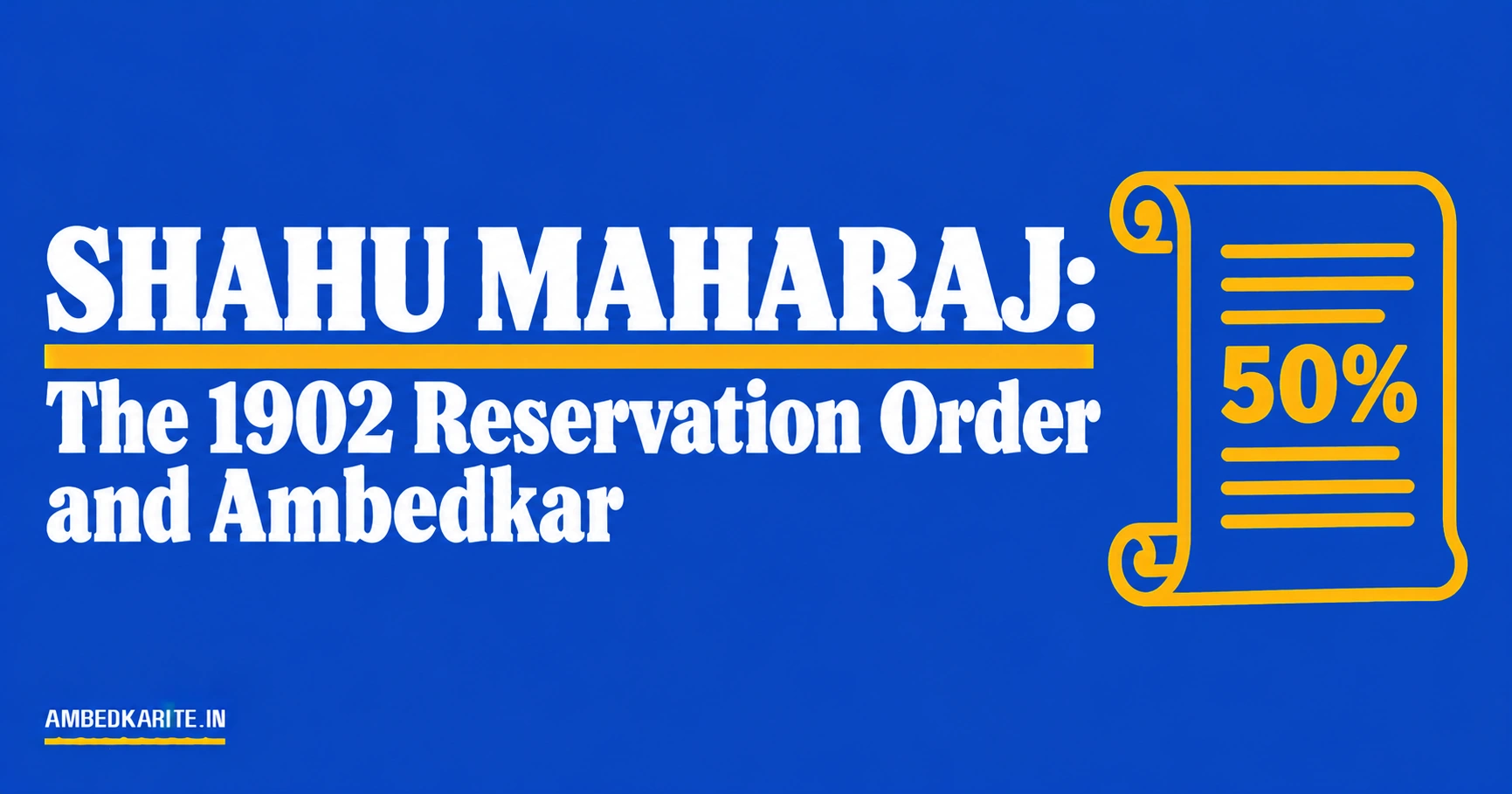
On July 26, 1902, the administration of Shahu Maharaj issued an order to reserve 50% of government jobs for members of the backward classes (Wikipedia; Shubh Darshika). According to Wikipedia, the order covered the field of government jobs and education. The memorial site states that the order covers government employment in the princely state of Kolhapur (Wikipedia; Shubh Darshika). Both sources agree that the order is one of the earliest reservation orders in India and that at that time, most of the administrative positions in Kolhapur were occupied by upper castes (Shubh Darshika). Only the princely state of Kolhapur was affected by the order; British India was not. For the definition of backward classes in the order, please see the log. For information on the Quota system in current India, see our “Caste Reservations in India” Article. For more information on the Backward Classes, see our article on the same. For more on the Mandal Commission, see our article on it.
Education and social reform
Shahu Maharaj established Vedic schools to teach scriptures to students irrespective of their caste and class (Wikipedia). He was committed to social reconstruction and to uplifting the fallen and marginalized (Wikipedia, “Bhaurao Patil”). An example is Bhaurao Patil, a student who was coached by him, and was granted by him the means to study at Kolhapur palace, from where he launched Rayat Shikshan Sanstha in 1919 (Wikipedia, “Bhaurao Patil”). Bhaurao Patil worked for the Satyashodhak Samaj (Wikipedia). Our article on Bahujan provides more information about the Satyashodhak movement.
Shahu Maharaj and Ambedkar
In 1920, Shahu Maharaj aided the financing of Mooknaik, the first publishing venture of Ambedkar (Shubh Darshika). I did not come across any reliable source to corroborate the amount involved in the grant, nor did I come across any reliable source to corroborate the meetings between Shahu Maharaj and Ambedkar. Therefore, this article does not consider them. Our article on Dalit History Month and Ambedkar Jayanti gives more information about figures supported by the Ambedkarite Calendar. According to this article, voicing one’s opinion in the print media is important and blogging and online journalism is supported by the AEP for ₹297 ($ 3.84).
“Rajarshi” Shahu Maharaj: how he is remembered
Shahu Maharaj’s (1874-1922) full title was “Shrimant Maharaj Raj Rajeshwar Shahu Sahib.” The name, “Rajarshi,” a title of respect, comes from his association with various social and educational reform movements. His death anniversary, on May 6, is observed every year. His son succeeded him in 1922 and became Rajaram III. He reigned till 1940 (Wikipedia, “Rajaram III”). Our article on Periyar provides more information on another contemporary anti-caste leader, also from South India, who supported the cause of communal representation.
What the sources disagree on
- There is no unanimity among sources on the scope of the 1902 Order- whether it was confined to jobs alone, or to jobs and education both.
- There is no concensus among sources on Shahu Maharaj’s age at the time of his death. Some claim he was 47 (Wikipedia) while others say he was 48 (a memorial site).
- The phrase “first” reservation has been used to describe the order, in two different ways- either to identify the first time reservation was implemented in India, or the first time a princely state issued an order for reservation. Depending on the interpretation, the first two of these statements are correct (Wikipedia).
Takeaway
Shahu ji ruled Kolhapur from 1894. In 1902, he ordered that 50% of all jobs in his state be set aside for the members of the backward classes. There is information on Shahu Maharaj and his involvement with education, reform and the Press. The Order issued by Shahu Maharaj remains controversial, and has been the subject of extensive research.
Frequently Asked Questions
Shahu Maharaj was the ruler of Kolhapur from 1894-1922, where he is credited for issuing the first reservation order in India in 1902.
What is the 1902 Reservation Order?
The order was issued on 26th July 1902 and provided for the reservation of 50 percent of the state’s government jobs for the backward classes. As per some accounts, it also included reservation in state funded education.
Was it the first reservation order in India?
Considering that it was implemented in his state only, it is deemed to be one of the first reservation orders in India.
What is the connection between Shahu Maharaj and Dr. B.R. Ambedkar?
As per some accounts, he supported Dr. Ambedkar’s weekly magazine, Mooknayak (1920) through a grant.
What is his date of death?
Shahu Maharaj passed away on 6th May 1922 in Bombay.
SOURCES
- Wikipedia, “Shahu of Kolhapur”
- Wikipedia, “Bhaurao Patil”
- Wikipedia, “Rajaram III”
- Shubh Darshika, “Rajarshi Chhatrapati Shahu Maharaj Punyadin”
- The Kolhapur State order of July 26, 1902 (please add the text and a reference)
- Dhananjay Keer, Shahu Chhatrapati: A Royal Revolutionary (1976) (please add page references)