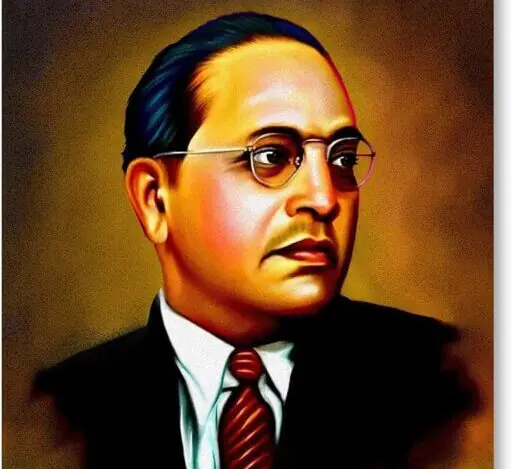
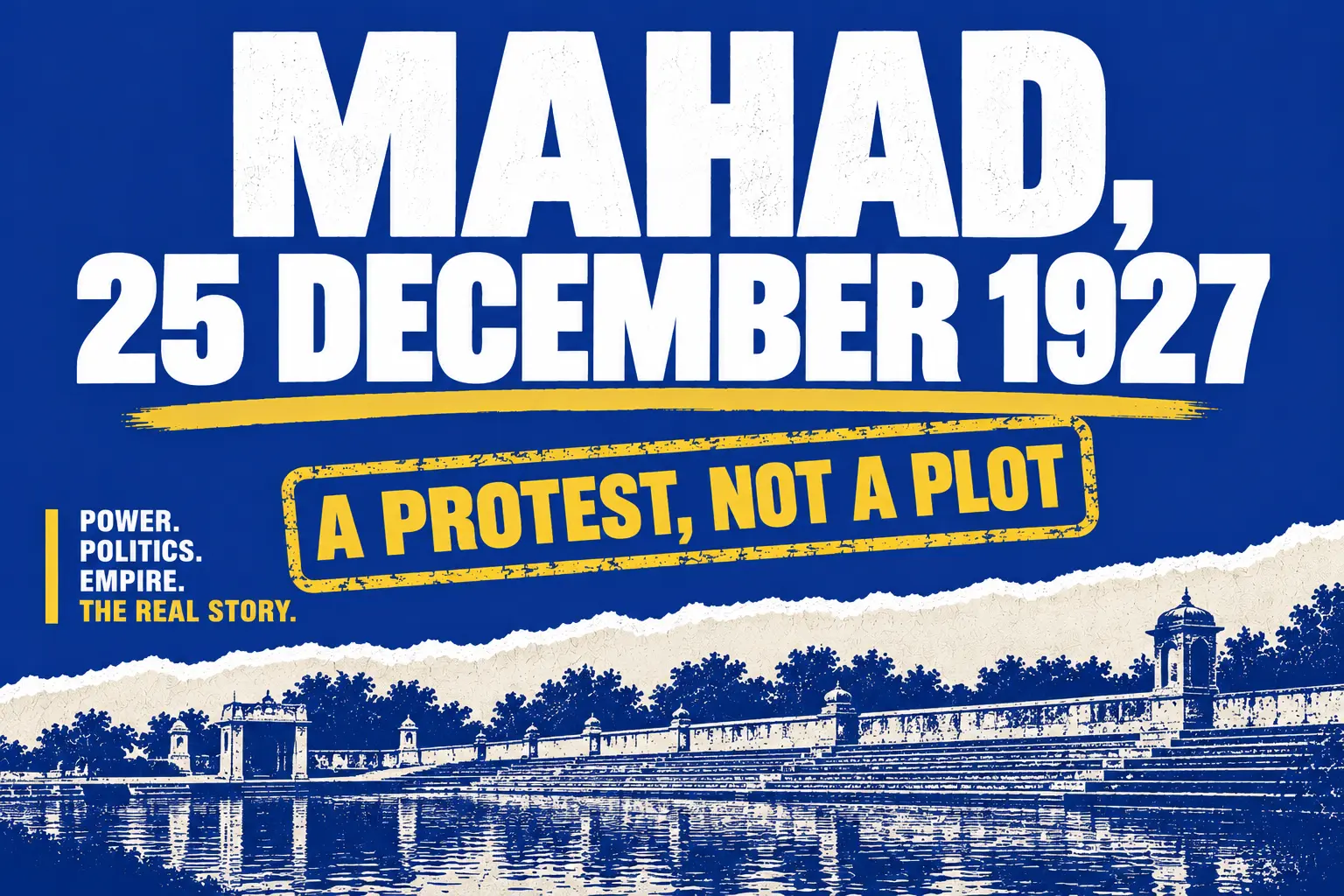
Poster-style graphic for Manusmriti Dahan Din: Mahad, 25 December 1927, and why it was a protest | मनुस्मृति दहन दिवस पर नेवी-ब्लू पोस्टर स्टाइल ग्राफिक: महाड़, 25 दिसंबर 1927, एक विरोध, साज़िश नहीं
Manusmriti Dahan Din: Why Ambedkar Burned It in 1927
Every year on 25 December, Manusmriti Dahan Din returns, along with the claim that the burning was a colonial ploy. Let’s review the evidence.
Manusmriti Dahan Din is observed on the 1927 date when a copy of Manusmriti was burned during a conference in Mahad (Sabrang India, 2017, quoting M.S. Gore). The post examines the event, provides an analysis, offers an interpretation, and makes a criticism of a legal text. It does not attack any community.
The satyagraha in Mahad was initiated to gain the right for Dalits to drink water from the Chavdar tank (Sabrang India, 2017, quoting M.S. Gore). The Bombay Legislative Council passed a resolution in 1923 permitting access to public water. In 1927, Ambedkar and his followers, to test the resolution, drank water from the public tank.
Thereafter, as a result of the interference of upper caste Hindus, a stay was granted by a local court (Sabrang India, 2017). A civil court in Mahad barred the use of the Chavdar Tank for the Conference by an injunction on 14 December 1927 (Anantam IAS). A local Muslim land owner, Fattekhan provided his private land for the Conference (Sabrang India, 2017).
On the night of December 25th, 1927, the conference voted to resolve to burn a copy of the Manusmriti. The motion was made by Gangadhar Neelkanth Sahastrabuddhe, an upper-caste Brahmin associate of Ambedkar, and was seconded by a Dalit leader named P. N. Rajbhoj (SabrangIndia, 2017). Sahastrabuddhe, along with 5-6 Dalit sadhus, then burned Manusmriti on a pyre that was set in front of the pandal (SabrangIndia, 2017). The banners at the crematorium read “Crematorium for Manusmruti”, “Destroy Untouchability”, and “Bury Brahmanism” (SabrangIndia, 2017).
The Reason Behind the Burning of Manusmriti
In his Presidential speech, Ambedkar said that the goal was not water or temple entry. His goal was to bring about the destruction of the varna system which he said was the foundation of social inequality (SabrangIndia, 2017). He then requested the upper varnas to let the “social revolution” occur peacefully (SabrangIndia, 2017).
Later, he elucidated his point of view in his article, Bahishkrit Bharat, which was published on 3 February 1928. He said that he had studied Manusmriti and came to the conclusion that there was no support for equality whatsoever in the text (SabrangIndia, 2017). He said that burning something was expressing protest against the ideology which the thing supported (SabrangIndia, 2017). He also gave the example of Gandhi’s movement against foreign cloth, in which he urged the people to burn foreign cloth in protest (SabrangIndia, 2017).
The strongest version of the colonial conspiracy claim gives the British credit where credit is due. In 1772, Warren Hastings employed eleven pandits to compile a digest of Hindu law for the Company’s courts (Hinduism Today, 2001). In 1794, Sir William Jones translated the Manusmriti as the Institutes of Hindu Law, or the Ordinances of Manu. In 1800, a digest of Hindu law under Colebrooke was also based on Manu’s ordinances (Encyclopaedia Britannica, 8th ed., 1860). In 2001, Hinduism Today summarized the argument of how the British bestowed on the Manusmriti its uncontestable status (Hinduism Today, 2001).
Second, the colonial state was also obstructive. In a satyagraha to oppose a government notification preventing untouchables from bathing in a tank, the judge issued an interim order restraining the satyagraha, halting it (Anantam IAS). Ambedkar also wrote untouchables were stuck between caste Hindus and the government (SabrangIndia, 2017).
Third, Dalit leaders and a Brahmin associate were the ones behind the burning, and not colonial officials (SabrangIndia, 2017). A newspaper even called Ambedkar “Bheemaasura” for it (SabrangIndia, 2017). That is domestic backlash.
Fourth, his other reasons were his personal reading of the text, and a protest method Indian nationalists used (SabrangIndia, 2017). So the British codified and elevated the Manusmriti in law. They did not script the Mahad burning.
Why the “manusmriti dahan colonial conspiracy” claim keeps coming back
It is based in truth and stretches from there. British courts used Manu, and “the British gave it importance” slides into “the British made it up” (Hinduism Today, 2001). It allows people to dodge the content of the text, and the question then becomes who published it, and not what does it mandate.
Manusmriti Dahan Din is observed to remember the fight at Mahad on 25 December 1927 (SabrangIndia, 2017). The British empowered the text and codified it in law, and that much of the claim is true (Indian Culture Portal; Encyclopaedia Britannica, 1860). They did not create the text, caste or the burning (BAWS Vol 1, p. 16; SabrangIndia, 2017).
Babasaheb gave us three words: Educate. Agitate. Organize.
Reading is Educate. Agitate and Organize start when you share a sourced page, not a screenshot.
X bans accounts. Reels get shadowbanned. WhatsApp groups get reported. Thus, Bahujans need their own spaces: emails, blogs, websites, and AIs.
The Ambedkarite Educational Program offers all of that for ₹297 ($3.69) for life, with a bunch of other stuff for free: Prompt Engineering, Google AI, Website Building, Email Marketing, Blogging/SEO, Canva, and anything else they offer.
You can also join the movement for free and start with the email list.
Frequently Asked Questions
What is Manusmriti Dahan Din? It is celebrated on 25 December to mark the burning of a copy of Manusmriti at the Mahad Conference in 1927. (Sabrang India, 2017)
Who burned Manusmriti at Mahad? Ambedkar’s contemporary and Brahmin associate, Gangadhar Neelkanth Sahastrabuddhe, along with a few Dalit sadhus, burned it. P. N. Rajbhoj seconded the resolution. (Sabrang India, 2017)
Why did Ambedkar burn Manusmriti? A reading of the text by Ambedkar showed to him that it supported inequality. Hence, he burned it to protest against it. (Sabrang India, 2017)
Was Manusmriti burning a colonial conspiracy? No, the British adding legal sanction to the text does not mean it supported it. A colonial court injunction stayed the Mahad satyagraha. (Indian Culture portal, Anantam IAS)
Where was Manusmriti burning done? It was done in Mahad, in the Konkan region of Maharashtra, after the Chavdar Tank satyagraha. (Sabrang India, 2017)