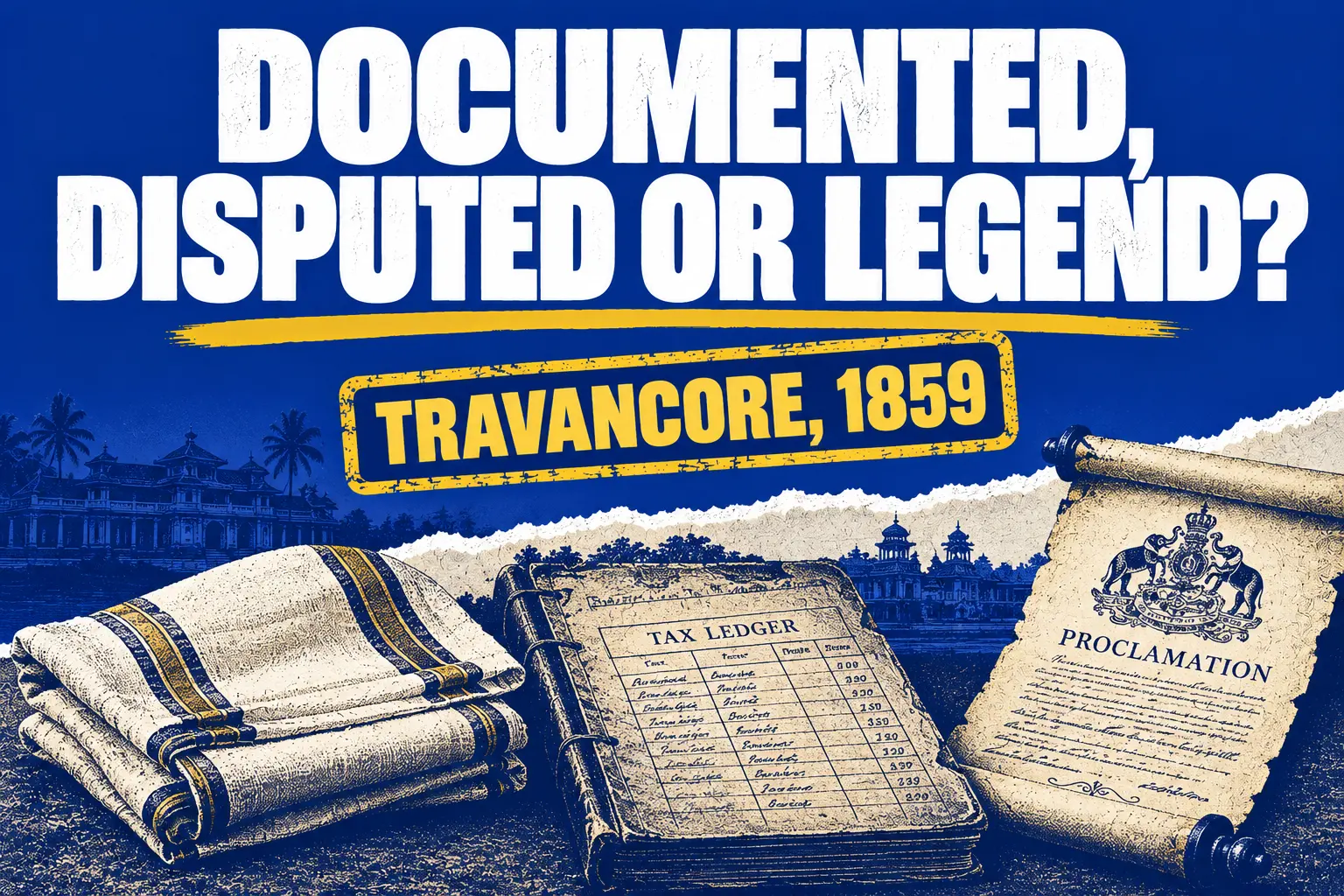
Poster-style graphic on the breast tax in Travancore: what is documented, disputed and legend | त्रावणकोर में ब्रेस्ट टैक्स पर पोस्टर: क्या दर्ज है, क्या विवादित है और क्या किंवदंती
Breast Tax in Travancore: What the Record Really Shows
There are two prominent stories about the breast tax, neither of which provide evidence. What follows is a breakdown of the two, with the evidence provided wherever possible.
The story of the breast tax is one of the most popular stories from Travancore, now part of the state of Kerala. Some have called it a established fact. Others have called it a hoax. Evidence does not support either fully (The News Minute 2023). This post will evaluate each statement as documented, disputed, or legend. It talks about a caste based law of a Princely state, and doesn’t target any community now.
The word Mulakkaram, literally “breast tax” in Malayalam, is used to describe the 19th century poll tax of the state of Travancore. Men paid a poll tax known as Talakkaram, and women paid Mulakkaram (NewsClick 2019, an excerpt from Manu S. Pillai). One source says upper-caste women were exempt (Boing Boing 2026).
The historians who have written about this are split on the meaning of the phrase (The News Minute 2023). That is the crux of the disagreement.
Breast tax: the popular version, steel-manned
The popular tale says lower-caste women were taxed if they wanted to cover their breasts (Open magazine). One version of the tale says that a protest by a women named Nangeli in the early 1800’s resulted in the tax being abolished (Open magazine, Boing Boing 2026). The wider audience was the 2016 BBC article by Divya Arya about the Nangeli paintings by the artist Murali T (Boing Boing 2026).
Malavika Binny from Kannur University states that whether the tax was on women’s labor or on clothing, both are examples of discrimination against women (The News Minute, 2023).
Breast tax: what historians say
Since historians hold different opinions, they are presented here together.
Who
Their view
Their reasoning
Manu S. Pillai
A poll tax. The name has no relation to covering the breasts.
In Talakkaram, men paid, while in Mulakkaram, women paid. It was not based on size (NewsClick, 2019; Open magazine).
Rajan Gurukkal
Animal husbandry tax.
”Thala” was the headcount of slaves, and the landowner paid (The News Minute, 2023).
Malavika Binny
Possibly a tax on breast coverings.
If there was a tax on men for a moustache, a symbol of masculinity, would it not be called a “Moustache Tax”? She, too, doesn’t find enough evidence to support either hypothesis (The News Minute, 2023).
Malayinkeezhu Gopalakrishnan
Not documented.
He also could not locate Nangeli or the breast tax in the Mathilakam Records (Open magazine).
Pillai says, while Nangeli is an oral history, all oral history is not to be rejected (Open magazine). Two other historians, Stalin Rajangam and K. A. Manikumar, also ask why people accept or reject this history, and state it is because of identity and politics (The News Minute, 2023).
Let’s see what we can say. Separately, a tax on women is reported, and the exact nature of the tax is debated. None of the historians above deny the existence of rules related to dress based on caste.
What is documented: the upper cloth rules, and the Channar revolt
The best-documented part of this story is not the tax. It is the fight over clothing.
A letter printed on 16 July 1859 says the “ancient laws of Travancore” prescribed a style of dress for each caste (a British periodical of 1859 via the NCSE archive). It says the cloth prescribed for the Shanar and other inferior classes was a coarse one tied at the waist and worn alike by men and women (NCSE archive). The same letter says the Shanar women were told they were breaking a law of the country by wearing the upper cloth (NCSE archive). The text in that archive is machine-read and may contain errors.
EARLY 1800s
Nadar (Shanar) women who converted to Christianity began to wear tailored blouses. British dewan, Colonel John Munro, allowed covered dressing for Christian women. The king’s council revoked the order.
Under pressure from the Madras Governor, Charles Trevelyan, the king issued an order allowing upper body coverings.
The News Minute, 2023; The Mooknayak
October 1859
Shanar women were attacked for covering their upper body at a marketplace, and the covering was stripped. An order was issued allowing a jacket or coverings “in any manner whatever,” but not “like the women of high caste.”
HuffPost India, 2016
The same movement is called the Channar revolt, Nadar Lahala, Maru Marakkal Samaram and Thol Seelai Porattam (The News Minute, 2023). The communities that led the movement is also contested. The News Minute states that Channar is a surname used by Ezhava people, while other accounts relate the movement to Nadar women (The News Minute, 2023; The Mooknayak).
There is also dispute on the role of missionaries. The 1859 letter states that missionaries had never encouraged Shanar women to wear the upper cloth (NCSE archive). The textbook states that converts, influenced by missionaries, began to wear blouses (HuffPost India, 2016). Both accounts should be included in the historical account.
It is important to state the 1859 permission was also conditioned. It stipulated that they could not dress “like the women of high caste” (HuffPost India, 2016). Therefore, the conflict was not for equality, but a limited form of it.
For another example of a social custom reinforced by state law, look up our post on the Peshwas.
Nangeli: Legend, Not Record
Nangeli is absent from written history of Kerala and Travancore (Open magazine). Gopalakrishnan could not find her in the Mathilakam records (Open magazine). As Boing Boing (2026) states, it is Pillai’s opinion that her story is in oral history, and was later reformulated to be a struggle for female dignity. He reads her protest as a revolt against an oppressive and humiliating taxation system on the lower castes.
Malavika Binny states the Archive does not account for the many Dalit women who participated in the uprising. Many risked their lives in the struggle but only a few are recorded by name (The News Minute, 2023). Just because a name is not present in the archives does not mean a person did not exist, and vice versa. In this post, we treat Nangeli as a legend, and do not describe the act for which it is legend.
Why is the breast tax debate so emotional?
People attach different levels of importance to it. Rajangam says history matters to caste groups less than how others see them, and some groups prefer to avoid a past of oppression (The News Minute, 2023). Manikumar says history is invoked to protect hard-earned rights (The News Minute, 2023).
The part in the CBSE textbook on the Nadar women’s struggle, called “Caste Conflict and Dress Change,” was removed in 2016 (HuffPost India, 2016). Subsequently, it received a lot of attention.
We can say with certainty
(a) There are recorded instances of
Caste-specific dress rules
The 1822 attacks
The 1829 order
The 26th July 1859 proclamation and the conditions attached to it.
(b) What mulakkaram meant,
Whether priests adhered to the same rules,
Whether the Namboodiri women engaged in the same act as the Ezhava women
To what extent Nair women gained freedom
Why the “breast tax” claims keep coming back
There are two bad versions, and each stretches the evidence. The viral version states the legend as fact, with a size-based tax and a single act that ended it (Open magazine). The dismissive version says that if the tax was not about breasts, nothing happened. That ignores the documented dress rules and the violence of the 1820s (HuffPost India, 2016).
Weighing sources like this is the habit the Ambedkarite Educational Program trains: Blogging & SEO, Website Building and Google AI.
Takeaway
The breast tax is disputed in its details, and the caste dress rules behind it are documented (The News Minute, 2023; HuffPost India, 2016). Nangeli is a legend (Open magazine). Say what you can show, and mark the rest as disputed.
Babasaheb gave us three words: Educate. Agitate. Organize.
Reading is Educate. Agitate and Organize start when you share a sourced page, not a screenshot.
Today, X bans accounts. Reels get shadowbanned. WhatsApp groups get reported. So Bahujans need their own platforms: emails, blogs, websites, AI tools.
The Ambedkarite Educational Program is made for exactly this. ₹297 lifetime, includes Prompt Engineering, Google AI, Website Building, Email Marketing, Blogging & SEO, Canva, plus all future courses free.
What was the breast tax? Mulakkaram was the tax paid by women in Travancore’s poll-tax system, as the counterpart of talakkaram paid by men. What the name meant is disputed (NewsClick, 2019; The News Minute, 2023).
Did the breast tax really exist? A separately named tax on women is reported, and historians dispute whether it was tied to covering the breasts. One historian found no mention in the Mathilakam Records (Open magazine; The News Minute, 2023).
Who was Nangeli? Nangeli is a legendary woman of Cherthala. She is not in the written history of Travancore (Open magazine).
What was the Channar revolt? It was the long struggle of lower-caste women in Travancore for the right to cover their upper bodies, in the early 1800s up to 1859 (The News Minute, 2023).
When were women allowed to cover their upper bodies? A proclamation of 26 July 1859 allowed it, and a later order permitted covering “but not like the women of high caste” (The News Minute, 2023; HuffPost India, 2016).
Dress rules applied to dominant castes in some places too. Nair women could cover the chest, except before Brahmins, royalty or inside a temple (The News Minute). A journal article says Nair women removed the upper layer of clothing inside temples (Shanlax Journals). Janata Weekly says dominant-caste women could not cover the upper body inside temples, as a mark of respect to the deity, until the early 20th century (Janata Weekly). Ordinary Brahmins also had to take off the upper cloth before the king (Open magazine). So the rule was about rank and place, and lower-caste women were barred from covering in public before upper castes (The News Minute).
Was the breast tax based on breast size? Pillai says no. He says it was a standard rate charged to women (NewsClick, 2019).
Sources
“A look at the history of the Channar Revolt,” The News Minute, 7 March 2023 (views of Rajan Gurukkal, Malavika Binny, Stalin Rajangam and K. A. Manikumar).
Manu S. Pillai, excerpt from The Courtesan, the Mahatma and the Italian Brahmin (Context, 2019), NewsClick.
“The Legend of Nangeli,” Open magazine (views of Manu S. Pillai and Malayinkeezhu Gopalakrishnan).
“The legend of India’s breast-tax and the woman who defied it,” Boing Boing, 27 July 2026 (a summary of the legend and Pillai’s view).
“Section on Nadar women’s struggle expunged from CBSE textbook,” HuffPost India, 20 December 2016 (textbook quotations).
“Nangeli’s Sacrifice & Channar Revolt,” The Mooknayak.
Further reading (not read for this post): Robin Jeffrey, The Decline of Nair Dominance; Samuel Mateer, Native Life in Travancore (1883); the Mathilakam Records; Nagam Aiya, Travancore State Manual.
What’s your take? Drop a comment below and share this article with someone who still believes the myth.