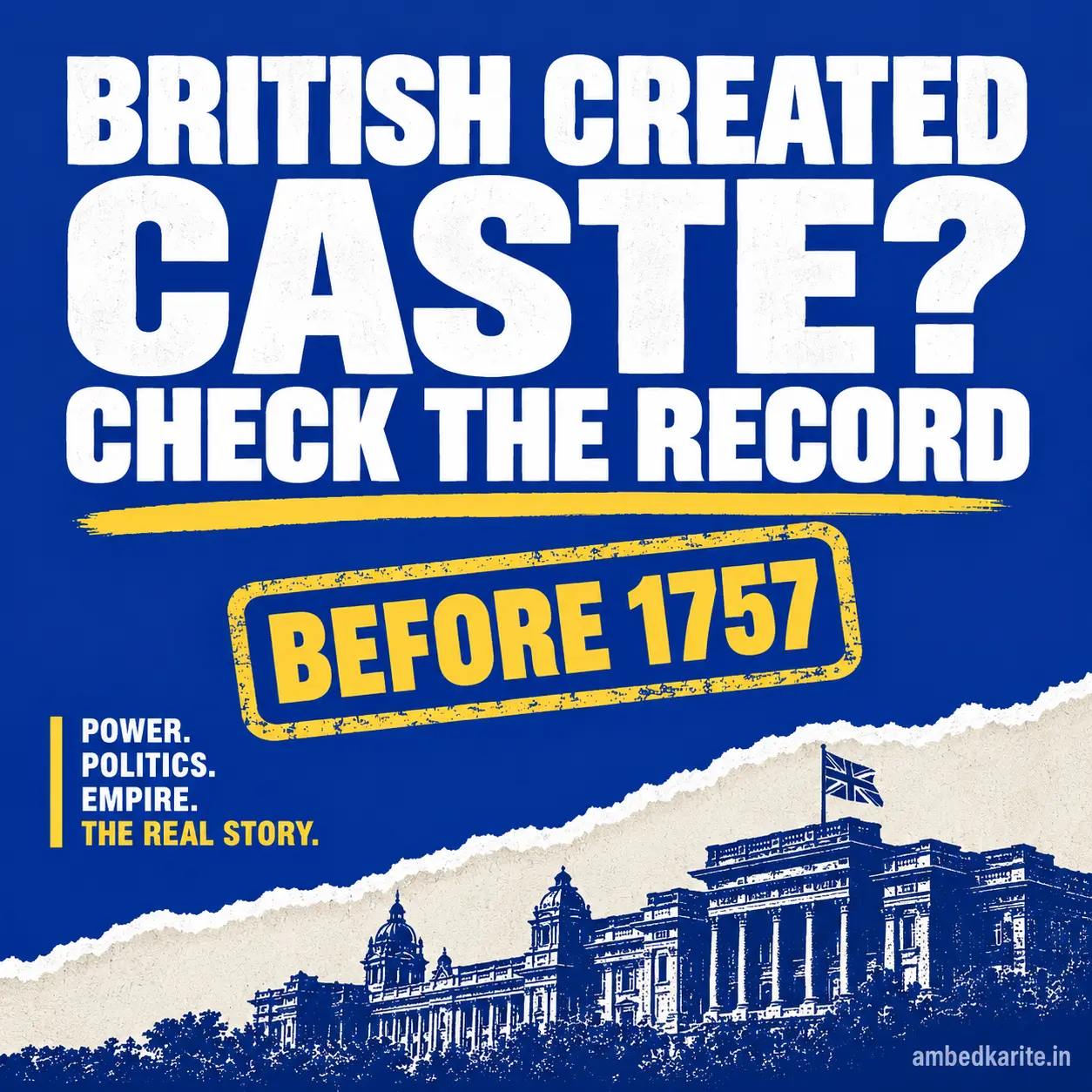
Poster-style graphic on the origin of caste in India: did the British create caste? The record says no | जाति व्यवस्था का इतिहास: क्या अंग्रेज़ों ने जाति बनाई? सोर्स वाला नेवी-ब्लू पोस्टर स्टाइल ग्राफिक
Origin of Caste in India: Did the British Create It?
What is the earliest origin of caste in India is a contentious question. It is relatively easy to verify the British created it. There are accounts of caste by foreign visitors even before the East India Company was established. However, some historians believe that colonial rule, as it is the case with many other parts of the world, formalized and hardened caste into a single and uniform system. So let’s take the two parts of this sentence separately.
Nicholas Dirks is among the more prominent scholars to take this position and argues in Castes of Mind (2001) that, “it was through the institutions of colonialism that many of the features of what we now think of as ‘caste’…crystallized.” (Project MUSE review). The same review says Dirks doesn’t argue the British created it (Project MUSE review). The summary published by the Princeton University Press adds that with British rule, caste became the uniform social term to cover the diverse social identities (Princeton UP summary via the 1947 Partition Archive).
The foundation of this argument is with Bernard Cohn and his study of the census. The Wire reports Cohn showed how the census codified jati, which was particular to British rule because the bureaucratic tool was new. (The Wire). In the 1901 census, Herbert Risley classified caste as a ranking by social precedence and race (UCLA South Asia). Cohn described it as Risley’s, “theoretical axe to grind” (UCLA South Asia).
The scholarly claim is narrow. The colonial census and ethnography hardened and re-ranked caste. The myth stretches it to “the British created caste.” The Wire calls that stretched version “a poisoned gift of the British.”
Ambedkar cites some older historical references, before the British
From 305 BCE, Megasthenes noted an Indian social order divided into seven classes, where members of each class did not inter-marry and also did not change their vocation (BAWS Vol 5, ch. 16, pp. 145-147). Alberuni, in 1030, noted the castes as being “from the very beginning only four” (BAWS Vol 5, ch. 16, p. 147).
Alberuni also noted other classes/groups which were below the four castes and did menial and polluting jobs, like the Hadi, Doma and Candala (BAWS Vol 5, ch. 16, pp. 147-148). Around 1500-1517, the Portuguese official Duarte Barbosa noted that the 18 castes of Malabar forbade their members to marry or even touch one another (BAWS Vol 5, ch. 16, pp. 155-156).
Ambedkar, in his reading, mentioned that Megasthenes and Alberuni saw different social orders of India from the one portrayed by the Portuguese (BAWS Vol 5, ch. 16, p. 156). On this basis, Ambedkar suggests that caste was, and is, inherent in India.
Pointing in the same direction are records of the Peshwa era. A 1968 study indicates the Maratha state intervened actively in caste matters. In 1798, the court of Bajirao II wrote to officials of eight talukas to prohibit bride-price among Brahmins (O’Hanlon, Oxford ORA). The medieval origins of the baluta system, which tied Mahars to a village, is also well known (Mandloi, 2019-20, p. 104). Please refer to our Peshwa caste article and the baluta system and Mahar watan article for more details.
Changes in the caste system during the British era
First, there was a shift in the enumeration of caste in the census. In the 1891 census of India, the leading idea of classification was Denzil Ibbetson’s suggestion to rank caste groups by their occupation (UCLA South Asia). In 1901, the new idea of classification was “Classification by Social Precedence as recognized by Native Public Opinion” (BAWS Vol 5, “Untouchables: Their Numbers”) along with race theory of Risley. With the endorsement of the state, this provided a state sanctioned caste hierarchy. (UCLA South Asia).
Second, with the enactment of the Bombay Hereditary Offices Act of 1874, the state, for the first time, wrote some caste-linked village offices into law. The Act defined ‘hereditary office’ and included Mahars among such village officers (Mandloi, p. 110). However, as Mandloi points out, the British rule did not bestow any special rights to the Watandars which they did not already possess (Mandloi, p. 104). Thus, the 1874 Act, at best, recorded an old office. It did not create a new office.
Third, the state used caste lines in its own policy.
Ambedkar wrote that Mahar officers petitioned against orders issued in 1892 that banned Mahar recruitment (BAWS Vol 1, Ranade, Gandhi and Jinnah). For how caste counting played out after the British, see our caste census post.
For now, let’s just say the British: ranked, counted and policed caste with state power. That is “hardened”, not “created”.
Caste system created by British: claim vs. record
Now let’s look at the “British created the caste system” claim and how it sort of correlates with the sources.
Reverse
Evidence
Conclusion
The British invented caste
Megasthenes, Alberuni and Barbosa recorded caste rules before 1757; the Peshwa state also intervened in caste matters
Myth
The census stiffened caste into official categories
Risley’s 1901 ‘social precedence’ ranking; Cohn and Dirks
Endorsed by scholars
The British Parliament legalized caste-linked appointments
The 1874 Hereditary Offices Act; older watan appointments
Proven by codification
Caste was flexible and loose prior to British rule
Alberuni describes eating rules and outcastes; Ambedkar argues caste changed form through time
Debated
The reason for enduring ‘British invented caste’ myth
It’s an easier story. The Wire essay argues blaming colonialism allows the current beneficiaries of the caste system to go unpunished (The Wire). The essay also states that the effects of colonialism on caste were complicated and directly impacted lower castes (The Wire).
The myth also grows out of a real-life incident that got condensed. Scholars state that colonialism hardened caste, and a one-line version drops the word ‘hardened’ (Project MUSE review). Receipts matter, and a page number beats a slogan. That is the habit the Ambedkarite Educational Program trains: Blogging & SEO, Website building and Google AI.
Takeaway
The sources show that caste exists around 1030 (BAWS Vol. 5, ch. 16). The British census and laws hardened and ranked caste (UCLA South Asia; Mandloi, p. 110). Both facts are true, so do not let either side flatten them.
Babasaheb gave us three words: Educate. Agitate. Organize.
Reading is Educate. Agitate and Organize start when you share a sourced page, not a screenshot.
Today, on social media, X bans accounts. Reels get shadowbanned. WhatsApp groups get reported. So, Bahujans need their own: emails, blogs, websites, and AI tools.
The Ambedkarite Educational Program is tailor-made for this. It is ₹297 for life, and includes Prompt Engineering, Google AI, Website building, Email Marketing, Blogging & SEO, Canva, and all future courses free. You can also get it for free as part of the Movement.
Frequently Asked Questions
Did the British create the caste system? No. Foreign observers recorded caste rules long before British rule, and scholars like Dirks argue the British hardened caste, not invented it (BAWS Vol 5, ch. 16; Project MUSE review).
What is the origin of caste in India? There is no single agreed answer. The earliest outside accounts, by Megasthenes and Alberuni, already describe caste rules (BAWS Vol 5, ch. 16, pp. 145–148).
What did the 1901 census do to caste? It ranked castes by “social precedence,” and Risley tied the ranking to race theory (BAWS Vol 5, “Untouchables: Their Numbers”; UCLA South Asia).
Who recorded caste before the British? Megasthenes around 305 BCE, Alberuni around 1030 and Duarte Barbosa in 1500–1517, as cited by Ambedkar (BAWS Vol 5, ch. 16).
Who are Nicholas Dirks and Bernard Cohn? They are historians and anthropologists whose work argues the colonial census and ethnography shaped modern caste (Project MUSE review; The Wire).