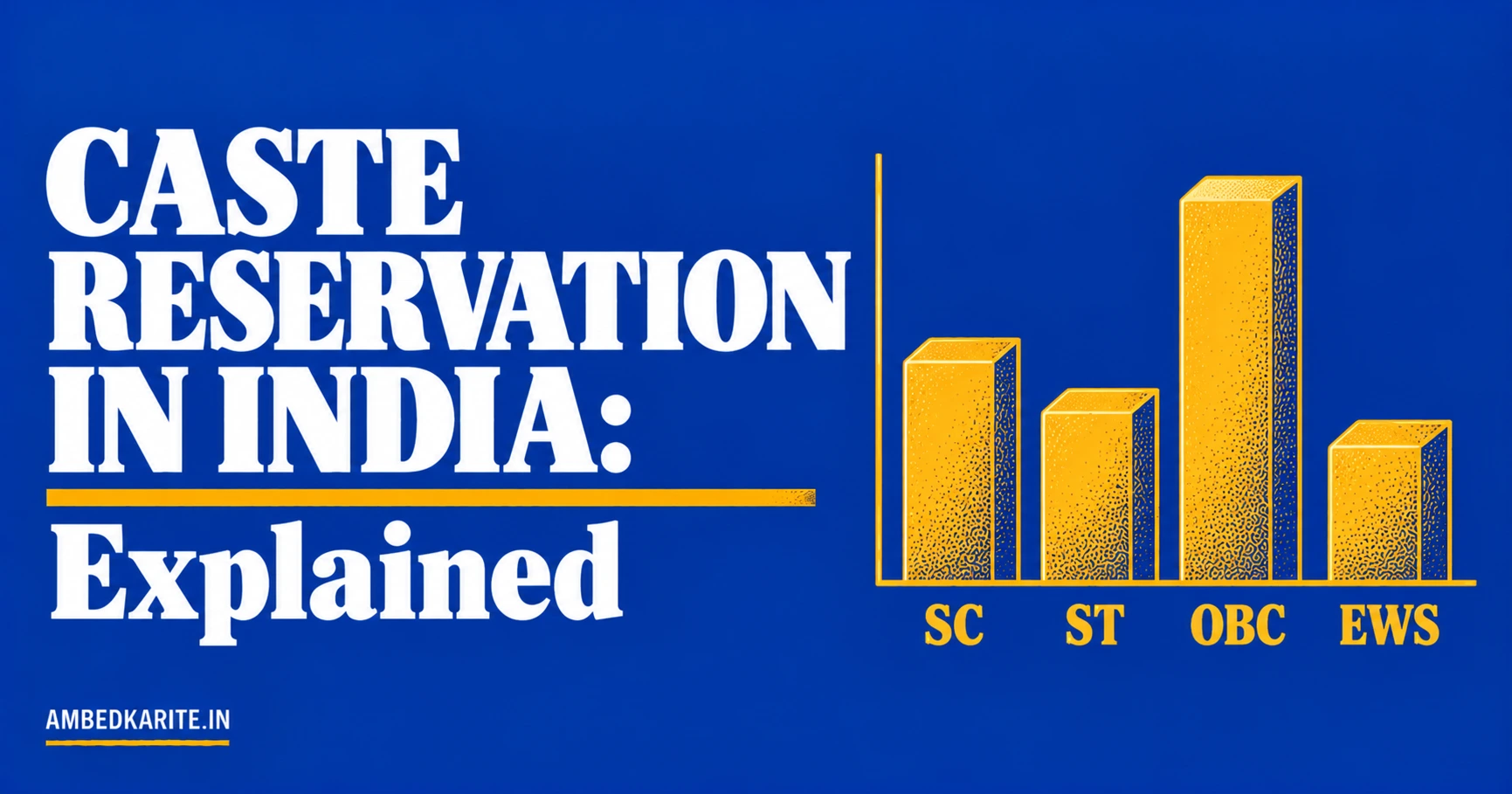
This article will define and explain caste reservation in India, along with providing specific information on the percentages, court cases and how it relates to affirmative action in the U.S.
What is Caste Reservation?
It means that a portion of the seats or jobs in a given area has to be allotted to members of a particular caste. The castes involved are Scheduled Castes (SC) and Scheduled Tribes (ST), with Other Backward Classes (OBC) being the third. The EWS (Economically Weaker Sections) are also reserved. This article will also explain the rankings of SC, ST and OBC in relation to caste and who Dalits are.
Historically, Untouchability led to the exclusion of Dalits from access to schools and employment. Also, Dalits were not allowed to enter places of worship. The Constitution of India, through article 17, declared Untouchability to be unconstitutional and outlawed it. Reservation is to help with the underrepresentation of those who were affected by the historical exclusion.
ST, SC, and OBC Reservation
At the center, the reservation percentages are the following:
| Category | Reservation | Basis |
|---|---|---|
| Scheduled Castes (SC) | 15% | Articles 15(4), 16(4) |
| Scheduled Tribes (ST) | 7.5% | Articles 15(4), 16(4) |
| Other Backward Classes (OBC) | 27% | The Mandal Commission, Article 16(4) |
| Economically Weaker Sections (EWS) | 10% | Articles 15(6), 16(6) |
( Testbook, “Reservation in India”; Vajiram & Ravi, “Reservation in India”). Together these add up to 59.5% at the center (IAS Express, “Reservation System in India (2026)”). States have the freedom to set their own quotas, and some are higher than the center. For example, Tamil Nadu’s quota is 69%, and is protected by the Ninth Schedule (IAS Express).
What the Constitution says
Articles 15(4) and 16(4) of the Constitution of India permit the state to provide special provisions for backward classes, SCs and STs in the field of education and public employment (Vajiram & Ravi).
Article 16(4A) amended by the 77th Amendment, 1995 permits the state to provide reservations in promotions for SCs and STs (Testbook). Article 16(4B) amended by the 81st Amendment, 2000, permits the state to carry over the unfilled SCs and STs vacancies to the next year (Vajiram & Ravi).
The Economic quota is different. The 103rd Amendment of 2019, added Articles 15(6) and 16(6) which provide 10% reservation for the Economically Weaker Sections (EWS) in the General Category (Vajiram & Ravi). The quota is based on Economic Backwardness and the SC, ST and OBC quota is based on Social and Educational Backwardness (Testbook).
The Mandal Commission and the 1992 ruling
The Mandal Commission was appointed in 1978 to estimate the OBC population and suggested a 27% quota (People’s Archive of Rural India, Report of the Backward Classes Commission). In 1990, the then Prime Minister V.P. Singh implemented the recommendations of the Mandal Commission (Vajiram & Ravi).
The Supreme Court of India in its judgment of the Indra Sawhney case (1992) upheld the 27% OBC quota and suggested that the total reservation should not exceed 50% except in rare and extraordinary situations (Sanskriti IAS; Vajiram & Ravi). The Court also referred to the ‘creamy layer’ concept to exclude the affluent sections of the OBCs (Sanskriti IAS; Vajiram & Ravi). It also held that reservation was not to be provided in case of promotions. (Testbook).
The judgment of 2022
The Supreme Court in its verdict in the Janhit Abhiyan (2022) case upheld the 10% EWS quota and held that going beyond the 50% quota did not violate the Constitution’s basic structure (IAS Express).
In State of Punjab v. Davinder Singh, a seven-judge bench ruled six to one in favor of allowing sub-classifications within Scheduled Castes and Scheduled Tribes (State of Punjab v. Davinder Singh, 2024 INSC 562). This ruling reversed the 2004 E.V. Chinnaiah judgment, which treated Scheduled Castes as a single group and which could not be divided (Constitutional Law and Philosophy, guest post). Sub-classification would be justified only if a group is inadequately represented because of its backwardness (Vision IAS).
Separately, four judges said the creamy layer principle should apply to Scheduled Castes and Scheduled Tribes, but this was not a direction as the issue did not directly arise in the case (Vision IAS). The Court has earlier adopted the creamy layer test for Scheduled Castes and Scheduled Tribes’ promotions in Jarnail Singh (2018) (IAS Express). For inconsistencies in the interpretation of sources, see the log.
Reservation vs affirmative action
Both India and the US employ group-based policies to address historic exclusion, but in contrasting ways.
- Where it is written: The Indian Constitution contains specific provisions for special help in articles 15(3) to 15(6) and 16(4) to 16(6). The US Constitution’s Equal Protection Clause is mute on special help (Digitally Learn, “Right to Equality”).
- Current US law: The 2023 ruling by the US Supreme Court in Students for Fair Admissions v. Harvard upheld the majority of race-based affirmative action in college admissions, but ruled against the use of race in other contexts (Digitally Learn).
Log: Please see the log for the parts of this comparison that I could not verify. Our posts on caste in America and caste laws worldwide explain how Western laws treat caste.
The debate
Proponents of the reservation system say it makes up for past inequalities by giving underrepresented groups a voice and creates a system that advantages them. Opponents say that because the benefits are typically given to the more privileged members of the community, it fails to address the needs of the least privileged members of the group, which is the creamy layer problem. The Court has said that reservation cannot be permanent. It will perpetuate backwardness. (Note on IIT policy, (Wikipedia, “Reservation policy in Indian Institutes of Technology”).
There are various myths related to reservation. Our post on the ten-year reservation claim addresses one of them. Our post on the anti-quota movement addresses an organized campaign against the reservation system. The role of the Constituent Assembly in drafting these provisions is addressed in our post on how the Constitution of India was drafted. The role of Ambedkar in drafting the Constitution is addressed in our biography page.
(For communities capturing this history, blogging, AI tools and email marketing are important skills. The Ambedkarite Educational Program (AEP) teaches these skills.)
Takeaway
Caste-based reservation means reserving a certain percentage of education, government jobs and legislative seats for SCs, STs and OBCs, plus a new 10% economically weaker quota at the central level which is 15%, 7.5%, 27% and 10% respectively. In 1992, the Supreme Court placed a cap of 50% on reservation. It also introduced the creamy layer for OBCs, and in 2024 allowed states to make within SCs and STs. Unlike the US affirmative action, the provisions in India are constitutional. The system is debated and figures keep changing in different states.
Frequently Asked Questions
What is reservation in India?
It is a system that sets aside a fixed share of seats in education, government jobs and legislatures for SC, ST and OBC groups, and a separate quota for economically weaker sections.
What are the SC, ST and OBC reservation percentages?
At the central level, SC 15%, ST 7.5%, OBC 27% and EWS 10%. States set their own quotas, and some are higher.
Is there a limit on reservation?
In Indra Sawhney (1992) the Supreme Court set a 50% ceiling, with exceptions for extraordinary situations. The 10% EWS quota, upheld in 2022, takes the central total to about 59.5%.
What is the creamy layer?
It is the idea that advanced members of a backward group should be excluded from the quota. It has applied to OBCs since 1992, and in 2024 four judges urged extending it to SCs and STs, without making it a direction.
How is reservation different from US affirmative action?
India’s reservation is written into its Constitution and sets fixed shares. In the US, race-based affirmative action in most college admissions was held unconstitutional in 2023.
Understanding caste is step one. Building digital independence is step two.
Ambedkarite communities around the world are using AI tools, blogging and email marketing to document their experiences, challenge discrimination and build platforms that cannot be silenced.
The Ambedkarite Educational Program teaches exactly these skills: AI tools, website building, email marketing, blogging and Google AI. Lifetime access is ₹297 (~$4 USD). All future courses are included free.
Or join the Movement free to start learning today.
SOURCES
- Testbook, “Reservation in India”
- Vajiram & Ravi, “Reservation in India, Category Wise, Percentage, Provisions”
- Vajiram & Ravi, “Reservation – Part I”
- IAS Express, “Reservation System in India (2026)”
- Sanskriti IAS, “What is Reservation?”
- People’s Archive of Rural India, Report of the Backward Classes Commission
- Wikipedia, “State of Punjab v. Davinder Singh”
- Constitutional Law and Philosophy, guest post on the sub-classification judgment, August 2024
- Vision IAS, “Sub-Classification of Scheduled Castes”
- Digitally Learn, “Right to Equality: Articles 14, 15, 16, 17 and 18 Explained”
- Wikipedia, “Reservation policy in Indian Institutes of Technology”
- Constitution of India, Articles 15 and 16 (link: legislative.gov.in)
- Add before publishing: Indra Sawhney v. Union of India on Indian Kanoon (URL needed)