Did Ambedkar want reservation for 10 years? The Truth Hiding in the Constitution
Here’s a fun fact that ruins everyone’s argument 👇
In November 2022, a sitting judge of the Supreme Court of India said in open court that Babasaheb Ambedkar wanted reservation for only 10 years. The receipts say otherwise. And the receipts are sitting in the Constituent Assembly Debates, free to read for anyone who actually cares.
The claim that won’t die
The line came from Justice J.B. Pardiwala in the Janhit Abhiyan v Union of India case, where the court upheld the EWS quota by a 3:2 majority. He said Ambedkar’s idea was to bring social harmony by introducing reservation for only ten years, but it has continued past seven decades. Justice Bela Trivedi made similar parting remarks in her separate judgment in the same case. Sambad English + 3
This was not a new line. It was a recycled one. In 2015, while at the Gujarat High Court, Justice Pardiwala had made very similar comments in the Hardik Patel sedition case. 58 Rajya Sabha members signed an impeachment motion against him. The remarks were expunged from the judgment a few days later. Supreme Court Observer
The line has also been pushed by Lok Sabha speakers, columnists, and assorted public figures over the years. The argument always lands the same way. Babasaheb himself wanted a 10-year sunset. Reservation has crossed its expiry date. Time to scrap it. Sage Journals
Sounds clean. It’s also wrong on every count. Let’s break it down.
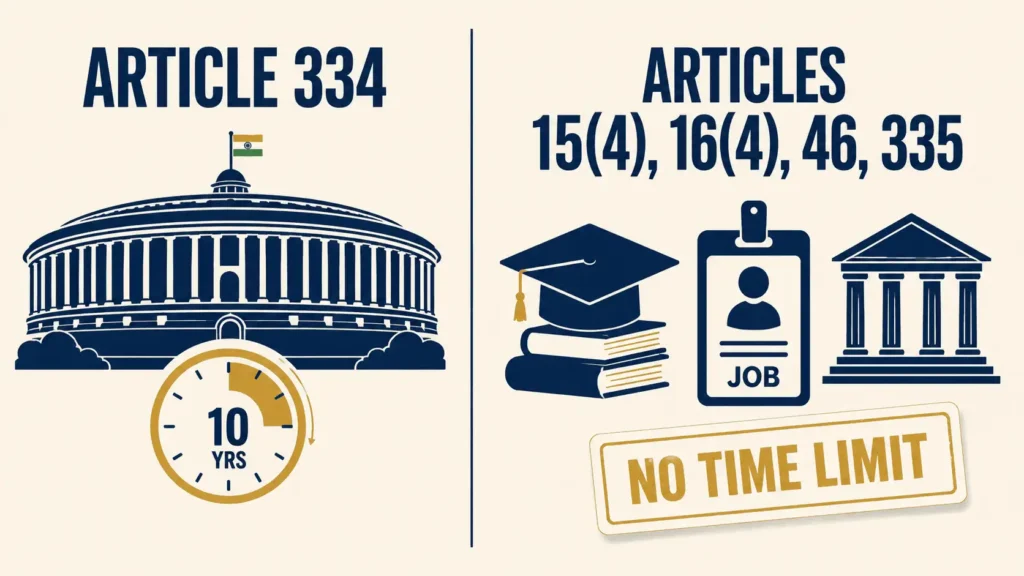
Article 334 — what the 10 years actually covered
Open the Constitution. Find Article 334. Read the marginal note: “Reservation of seats and special representation to cease after certain period.”
That article applies to two things only — reserved seats for Scheduled Castes and Scheduled Tribes in the Lok Sabha and State Legislative Assemblies, plus nominated representation for the Anglo-Indian community. That’s political reservation. Not jobs. Not education. Not promotions. Constitution of India
The original 1950 Constitution set the limit at 10 years. It was due to expire on 26 January 1960. After that, look what happened:
- 8th Amendment (1959) — extended to 1970 Indian Kanoon
- 23rd Amendment (1969) — extended to 1980 Indian Kanoon
- 45th Amendment (1980) — extended to 1990 Indian Kanoon
- 62nd Amendment (1989) — extended to 2000 Indian Kanoon
- 79th Amendment (1999) — extended to 2010 Indian Kanoon
- 95th Amendment (2009) — extended to 2020 Indian Kanoon
- 104th Amendment (2019) — extended to 2030, ended Anglo-Indian nomination Vajiram and Ravi
Each of these extensions cleared Parliament with a two-thirds majority. Each one is a constitutional decision that political reservation hasn’t done its job yet. Seven Parliaments. Seven votes. One direction.
What Article 334 does NOT cover
Now the parts the Pardiwala line conveniently skips:
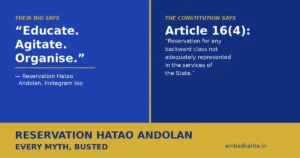
- Article 16(4) — reservation in public employment for any backward class. No time limit.
- Article 15(4) — special provisions for SC, ST and SEBC in education. Added by the First Amendment, 1951. No time limit. Substack
- Article 46 — Directive Principle of State Policy on educational and economic interests of weaker sections. No time limit.
- Article 335 — claims of SC and ST in services. No time limit.
These are the articles that govern jobs and education quota. The actual reservation that touches daily lives. Read every line of the Constitution. You will not find a 10-year clause attached to any of them. That is the basic story most opinion writers don’t bother to check before typing “Babasaheb wanted only 10 years.”
Ambedkar 10 year reservation myth — Myth vs Fact
Myth 1: Ambedkar wanted reservation for only 10 years. Fact: Babasaheb wanted reservation to last as long as untouchability existed. He said this at a public meeting in Punjab in October 1951, and named the person who blocked him.
Myth 2: All reservation had a 10-year sunset built in. Fact: Only Article 334 — political seats — had the limit. Jobs, education, and DPSP provisions never did.
Myth 3: The 10-year clause was Babasaheb’s idea. Fact: It came through the majority in the Constituent Assembly. The 10-year limit was a decision adopted by other members, not pushed by Ambedkar himself. Sage Journals
Myth 4: When the framers picked 10 years, they were saying caste would end by 1960. Fact: They were saying review political reservation in 10 years. If the work isn’t done, extend. That is exactly why Article 334 has been amended seven times.
Myth 5: Reservation has continued for 75 years against the Constitution’s design. Fact: It has continued for 75 years through the Constitution’s design. Every extension is a formal constitutional amendment, debated and passed in Parliament.
Ambedkar views on reservation — what he actually said
The Constituent Assembly Debates are public. Anyone can read them online or in BAWS. Here’s what’s there.
Constituent Assembly, 30 November 1948
While debating Draft Article 10 (now Article 16), Babasaheb made a careful three-part point. Reservation must satisfy equality of opportunity, give adequate representation to under-represented communities, and stay confined to a minority of seats so the equality rule is not destroyed. Indian Kanoon
Notice the topic. He’s talking about the size of jobs reservation, not the duration. He flagged that the article should be reviewed periodically so the State could check whether backward classes were still backward. That is review — not a 10-year sunset. Constitution of India
Constituent Assembly, 25 August 1949
This is the day Draft Article 295A — what became Article 334 — was debated. Several members supported the 10-year ceiling. Ambedkar’s response, on record, was that he was personally prepared to press for a larger time. He felt the Scheduled Castes were not on the same footing as other minorities. He was prepared to give a far longer period for the Scheduled Tribes. Janata Weekly
He let the 10-year clause pass because the Assembly had already moved. He didn’t author it. He absorbed it.
Ramdaspur, Jullundur, 27 October 1951
Three weeks after resigning as Law Minister, Babasaheb campaigned in Punjab. At a public meeting in Ramdaspur, he said the reservation of seats for Scheduled Castes was for 10 years only. He had wanted it to continue as long as untouchability was there. Sardar Vallabhbhai Patel had opposed him. The Mooknayak
This is the cleanest, most direct refutation of the Pardiwala line. The man himself, on the campaign trail, naming the person who blocked him.
Poona Pact, 24 September 1932
The myth also leans on the Poona Pact. The Pact had nine clauses. Clause 6 dealt with political reservation and a referendum mechanism after a period. Clause 8 dealt with public services for the Depressed Classes — and gave them fair representation with no time limit. Clause 9 dealt with educational grants — also no time limit. X
Even before the Constitution, Babasaheb’s framework for jobs and education had no expiry. That detail rarely makes it into the Sunday columns.
Why this lie keeps coming back
Three reasons.
The first is convenience. Saying “Babasaheb himself wanted only 10 years” lets a critic of reservation claim his blessing while attacking his work. Free moral cover.
The second is laziness. Most people repeating the line have never opened the CAD or BAWS. They heard it from a teacher, a senior, a viral tweet — and passed it along.
The third is design. The Pardiwala line came inside a verdict upholding the EWS quota — a quota that effectively benefits sections excluded from existing caste reservations. Wrapping a fake quote around a constitutional shift gives the shift extra moral weight. That is not an accident. The Swaddle
The takeaway
Reservation is not a 10-year experiment that overstayed its welcome. The Constitution wrote a 10-year review clause for one slice of one type of reservation. Parliament has voted seven times to keep it going. Job and education quotas were never on the clock. Ambedkar wanted the protection to last as long as caste did.
Next time someone says “Babasaheb wanted only 10 years,” ask them which article. Ask them which date. Ask them which speech.
They go quiet. The receipts always do. ✊
Sources
- Constitution of India — Articles 15(4), 16(4), 46, 334, 335.
- Constituent Assembly Debates, 30 November 1948 — Dr B.R. Ambedkar on Draft Article 10. constitutionofindia.net.
- Constituent Assembly Debates, 25 August 1949 — debate on Draft Article 295A.
- Dr Babasaheb Ambedkar: Writings and Speeches (BAWS), Vol. 17, Part 3 — Ramdaspur, Jullundur speech, 27 October 1951.
- Poona Pact, 24 September 1932 — Clauses 6, 8, 9.
- Janhit Abhiyan v Union of India, 2022 LiveLaw (SC) 922 — Justice Pardiwala and Justice Trivedi observations.
- Anurag Bhaskar, “The Myth of the Ten-Year Limit on Reservations and Dr Ambedkar’s Stance,” CASTE: A Global Journal on Social Exclusion, Sage, 2022.
- Constitution Amendment Acts — 8th, 23rd, 45th, 62nd, 79th, 95th, 104th.
- Supreme Court Observer profile of Justice J.B. Pardiwala — record of 2015 Hardik Patel case impeachment motion.
CTA
What’s your take? Drop a comment below and share this article with someone who still believes the myth.
External Links
- Article 334 — full text and amendment history (Tier 1 — Centre for Law and Policy Research)
- Anurag Bhaskar, “The Myth of the Ten-Year Limit on Reservations and Dr Ambedkar’s Stance” (Tier 2 — Sage Journals)
- The Mooknayak — Dalit History Month feature on this myth (Tier 3 — Forward Press category)
Unverified Claims Log
Nothing factual is unverified — every claim is sourced from CAD, BAWS, the Constitution, the 2022 Supreme Court ruling, or Anurag Bhaskar’s peer-reviewed paper.
One caveat for transparency: the exact wording of Babasaheb’s Ramdaspur, Jullundur speech (27 October 1951) is reproduced in The Mooknayak chapter from Nethrapal’s book The Inspiring Ambedkar (2024) and cited in BAWS Vol. 17. The short paraphrase used in this article matches both. The blog does not put the speech in direct quotes — it summarises the meaning.
So I feel you know now the reality. Make sure to read more of our blogs on Myth lies and how we busted it.