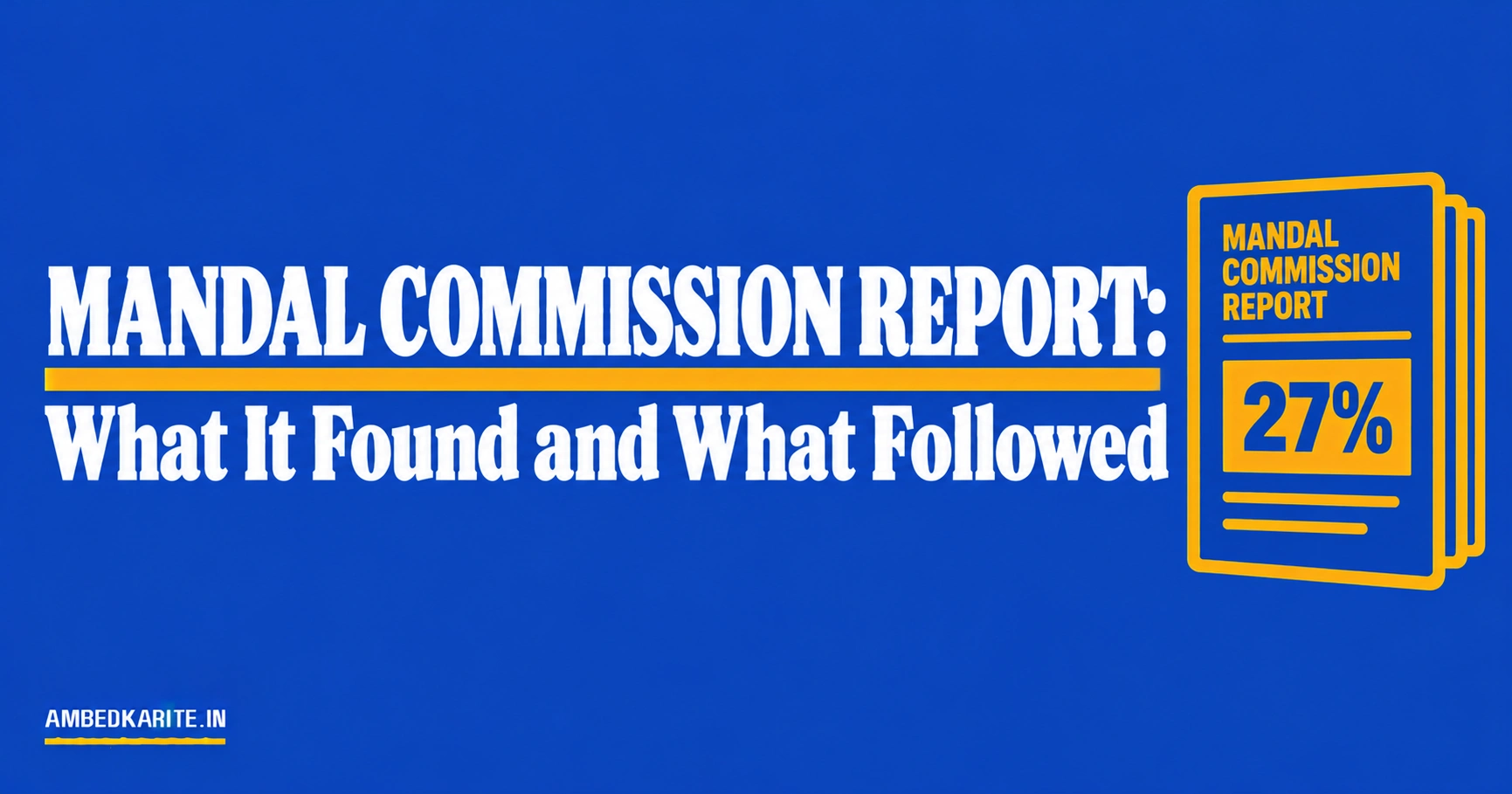
Mandal Commission Report, released on December 31, 1980, recommended 27% reservation for jobs and education for Other Backward Classes (OBCs), and with implementation in 1990s, changed the face of Indian politics (Business Standard, “The Mandal Commission decoded”; Wikipedia, “Mandal Commission”). This article elaborates on the setup of the commission, working, findings and recommendations of the commission, and the role of V.P. Singh and the Supreme Court thereafter. It offers a brief overview from 1979 to 1993. It helps the readers with our existing articles on reservations. Our article on Other Backward Classes offers details on the classification. Our article on caste-based reservations in India explains the quota system.
What is the Mandal Commission?
The second backward classes commission (The Mandal Commission) was set up by the then Prime Minister of India, Morarji Desai on January 1, 1979. It was set up under Article 340 of the Constitution of India to examine the conditions of socially and educationally backward classes of the population and suggest ways and means for their advancement (StudyIQ, “Mandal Commission Report, Timeline, Recommendations”). It was named after its Chairman, B.P. Mandal, a member of Parliament from Bihar (Wikipedia, “B.P. Mandal”). The First Backward Classes Commission was set up earlier and this commission was the second of its kind.
What the Mandal Commission report found
The report stated that social, educational and economic factors played an important role in determining which sections, communities and classes of the population were educationally and economically backward (The Quint, “How VP Singh Stirred a Hornet’s Nest with the Mandal Commission”; Anantam IAS). With a combination of surveys, knowledge and the 1961 census, it prepared a national list of 3,743 OBC cases, 2,108 ‘depressed classes’ and other backward classes (Business Standard). It placed the share of OBCs in the total population at around 52% and stated that this was excluding the Scheduled Castes and Scheduled Tribes (StudyIQ). The Commission submitted its report to the President of India, N. Sanjiva Reddy, on 31st December, 1980 (Business Standard). Our article on the caste census of India gives more details on the estimate of 52%, including the reasons for excluding OBCs from the census.
Mandal Commission recommendations
The Commission suggested that 27% reservation in all jobs in the Central Government and its Public Sector Undertakings and in all higher education, be extended to the OBCs, thereby increasing the total reservation to Scheduled Castes, Scheduled Tribes and Other Backward Classes to 49.5% (Wikipedia, “Mandal Commission”). It was also suggested that this reservation be extended to promotions in all services (The Quint; GeeksforGeeks, “Mandal Commission”). I have not seen the other recommendations of the Commission; therefore, this post does not contain recommendations other than the above. For recommendations, please check the log.
Mandal Commission 27 reservation: why only 27 percent?
The Commission put the OBC population at around 52 percent. However, it gave recommendations for 27 percent reservations. This was to keep the total reservations below 50 percent. (Model Diplomat, “Mandal Commission and Caste Based Reservations”). The court later confirmed this (Model Diplomat). Our article on Scheduled Castes gives an overview of other government classifications.
V.P. Singh and the Mandal Commission, 1990
The Commission was formed in 1978, but the report was published in 1980. It was again commissioned in 1983 and 1986. The report was published in 1986 and again in 1988 (Business Standard). Almost a decade later, on August 7, 1990, Prime Minister V.P. Singh of the National Front government announced in Parliament that the report’s recommendations on appointments and employment would be implemented (The Quint, Business Standard). This decision was controversial and led to the 1990 Anti-Mandal Protests and student unrest in northern and western India (Wikipedia, “Mandal Commission”). Our post on the Anti-Mandal Commission Protests covers the student unrest. Our post on whether Dr. Ambedkar endorsed reservations for 10 years covers another related claim.
Indra Sawhney and Mandal (1992)
The case came to be known as the Mandal case (Wikipedia, “Mandal Commission”) after it was challenged in the Supreme Court of India, heard by a nine-judge bench, with Indra Sawhney as the main petitioner (The Quint). On 16 November 1992, the Supreme Court ruled in favor of the 27% reservation for Other Backward Classes (OBCs) and directed the Central government to frame rules for identifying the OBCs who are socially and educationally advanced (Our reported case), and thus, should be included in the creamy layer (The Quint). The Supreme Court also ruled that the Central government should not provide reservation in promotion to the OBCs (Model Diplomat). It is worth mentioning that later rulings have amended some provisions of this judgment. You may read the judgment on Indian Kanoon.
What happened later?
In 1993, the Parliament of India created the National Commission for Backward Classes (UPSC With Nikhil, “Mandal Commission and Aftermath”). As our guide on Other Backward Classes of India explains, the creamy layer is reserved for households having an annual income of ₹8 lakh (Wikipedia, “Mandal Commission”). In the 2022 judgment of Janhit Abhiyan, the Supreme Court allowed the Central government to provide a separate quota to the Economically Weaker Sections beyond the 50% limit (Model Diplomat). I haven’t reviewed this judgment, and therefore, this guide will not discuss this judgment in detail.
Timeline
| Date (approximate) | Event |
|---|---|
| Dec. 20, 1978 | Commission announced, Business Standard |
| Jan. 1, 1979 | Commission established, Business Standard |
| Dec. 31, 1980 | Commission submitted report, Business Standard |
| Aug. 7, 1990 | V.P. Singh announced report’s implementation, The Quint |
| Aug. 13, 1990 | Implementation directives issued, StudyIQ |
| Nov. 16, 1992 | Judgment in Indra Sawhney vs. Union of India, The Quint |
| (Year unknown) | National Commission for Backward Classes was established, UPSC with Nikhil |
Mandal Commission’s estimation of 52% of the population being Other Backward Classes (OBCs) is still debated, as data for such classifications is not included in India’s census. The Ambedkarite Educational Program helps members learn ways to legitimize and classify their writings, and publish their works online for 297 Indian Rupees (about $4 USD). You can learn these skills for free, and help the cause.
Takeaway
The Mandal Commission, 1980, used 11 criteria to identify 3,743 castes as Other Backward Classes (OBCs), and estimated 52% of the population as OBCs. The Commission recommended 27% reservation in central government jobs and in higher education. The Mandal Commission report also increased the total reservation to 49.5% (from the existing 27%). V.P. Singh’s government, in 1990, implemented the report, and the 27% OBC reservation was upheld by the Supreme Court in the case of Indra Sawhney (1992) with the explanation that the creamy layer be excluded and the total reservation not be exceeded to 50% (from the total OBC reservation). In 1993, the Parliament also established the National Commission for Backward Classes.
Frequently Asked Questions
What was the Mandal Commission?
The Second Backward Classes Commission, set up on January 1, 1979, under Article 340, chaired by B.P. Mandal, to identify socially and educationally backward classes.
What did the Mandal Commission report recommend?
A 27 per cent quota for OBCs in central government jobs and higher-education seats, which took total reservation to 49.5 per cent with the SC and ST quotas.
Why did V.P. Singh implement the Mandal report?
On August 7, 1990, his government announced it would implement the report’s recommendation on jobs, after about a decade. The decision led to widespread student protests.
What did Indra Sawhney decide?
On November 16, 1992, a nine-judge bench upheld the 27 per cent OBC quota, subject to creamy-layer exclusion, and affirmed the 50 per cent ceiling.
How many castes did the Mandal Commission list as OBCs?
3,743 castes and communities, estimated at 52 per cent of the population.
SOURCES
- Business Standard, “The Mandal Commission decoded: How OBC reservation came into effect”
- Wikipedia, “Mandal Commission”
- Wikipedia, “B. P. Mandal”
- The Quint, “How VP Singh Stirred a Hornet’s Nest With the Mandal Commission”
- StudyIQ, “Mandal Commission Report, Timeline, Recommendations”
- GeeksforGeeks, “Mandal Commission: History, Report, Recommendations and Impact”
- Model Diplomat, “Mandal Commission and Caste-Based Reservation”
- Anantam IAS, “Mandal Commission: OBC Reservation Report and 1990 Implementation”
- UPSC With Nikhil, “Mandal Commission And Aftermath”
- Indra Sawhney v. Union of India, Supreme Court of India, November 16, 1992 (please add the Indian Kanoon link)
- Report of the Backward Classes Commission (Mandal Commission), First Part, 1980 (please add the official source)