Every January 1, thousands gather at a pillar near Pune. Every January 1, someone online calls dalits and mahar caste traitors.
That’s the fight this article settles. Not with outrage — with the actual record of Mahar caste history, start to finish.
Here’s the claim you’ll hear, usually dressed up as “just asking questions”: Mahars — the caste Dr. B.R. Ambedkar was born into — fought for the British against Indian rulers in 1818. Therefore they’re “anti-national.” Therefore their pride in it is shameful.
It’s a half-true claim wearing a whole lie’s clothes. Let’s go section by section, so nothing’s left vague.
What Mahar Caste Actually Means
Mahar is a Scheduled Caste, concentrated in Maharashtra, officially recognized across 16 Indian states. Under British-era village administration, known as the baluta system, Mahars held fixed village duties: watchman, boundary adjudicator, messenger, wall-mender. They held small hereditary land rights called watan in exchange.
That’s mahar caste meaning in one line: not a job description for filth, as some later myths claim, but a formal — if deeply unequal — village office.
They were also, under Brahmanical social codes of the time, treated as untouchable. Both things were true at once. That contradiction is the whole story.
Mahar Caste History Before the British
Mahars show up in Maharashtra’s recorded history early. The 14th-century poet-saint Chokhamela, a Mahar by birth, is one of the most revered voices in the Varkari bhakti tradition — proof that caste exclusion and cultural contribution ran side by side for centuries.
Military service goes back just as far. Mahars served in Maratha king Shivaji’s armies in the 1600s, and continued under his successors through the 1700s. This matters later — the British didn’t “discover” Mahar soldiers. They recruited into an existing tradition.
Peshwa Rule: The Broom and the Pot
This is where the steel-man gets steel-manned properly. Some online accounts soften or deny Peshwa-era caste rules entirely, framing pre-colonial India as casteless harmony disrupted only by the British. The record says otherwise.
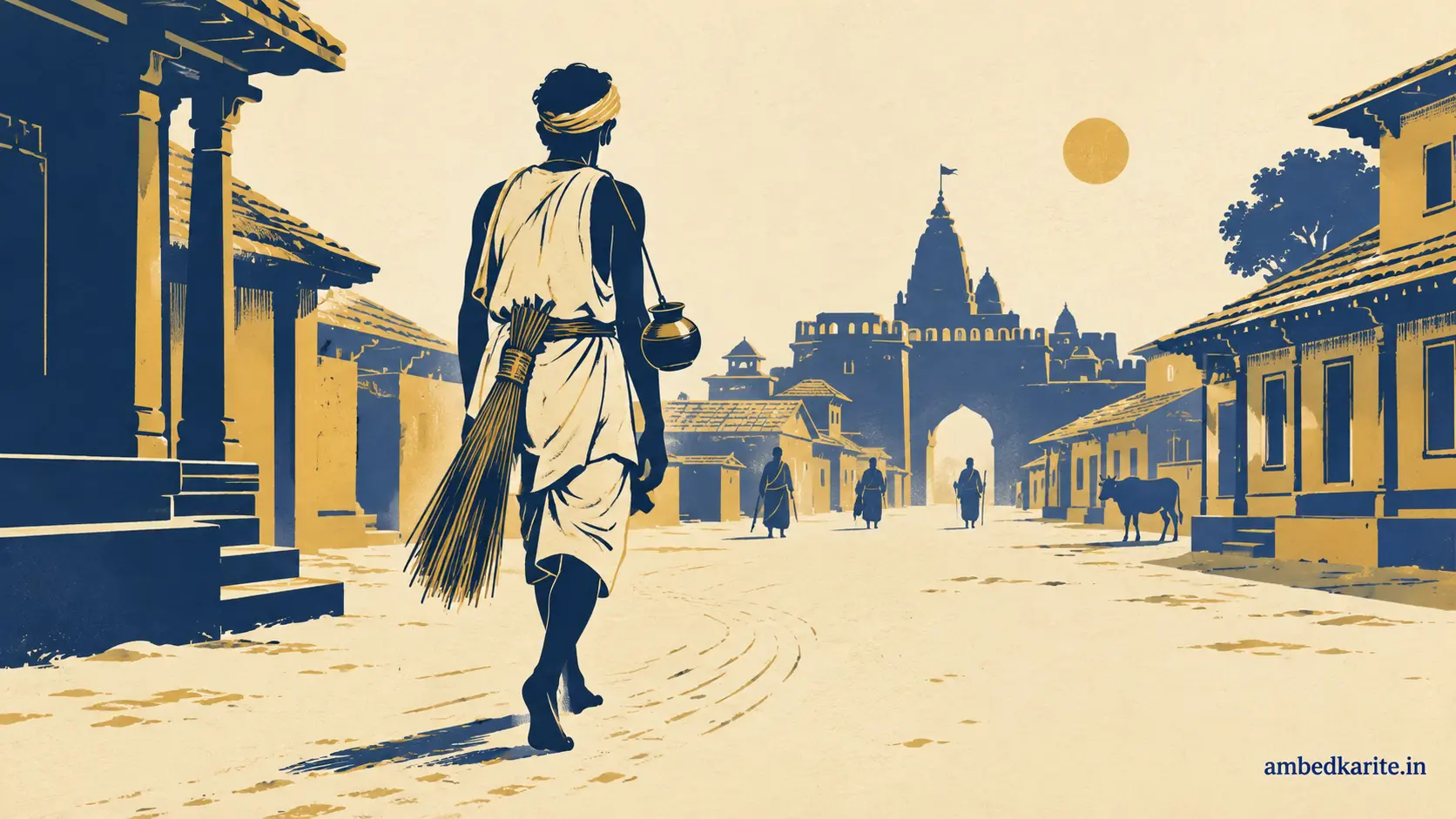
In Ambedkar’s own account in Annihilation of Caste, untouchables in Peshwa-ruled Poona were barred from public streets if a Hindu was approaching, so their shadow wouldn’t “pollute” anyone. They had to wear a black thread at the wrist or neck, marking them for avoidance. And in the capital itself, an untouchable had to tie a broom to his waist to sweep away his own footprints — and carry a pot around his neck, to catch his own spit, so it never touched ground a Hindu might later walk on.
This isn’t folklore. It’s Ambedkar’s own documented account, published and re-published for decades. The broom and the pot are the single most repeated detail in Mahar oral and written history — because they happened.
So no, caste wasn’t a British invention. It predates colonial rule by centuries, administered by an Indian state.
Battle of Bhima Koregaon, 1818
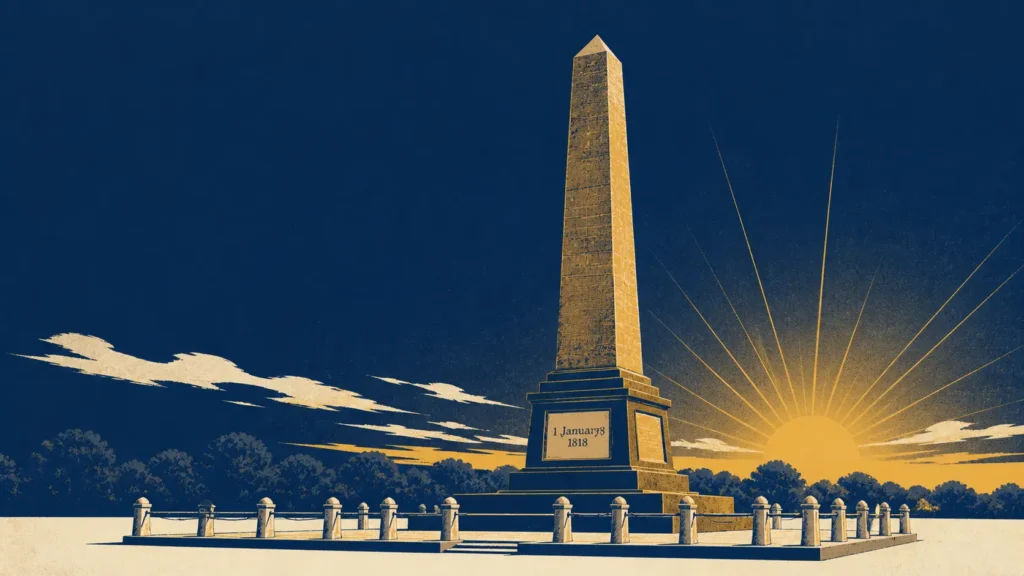
On New Year’s Day 1818, roughly 500 soldiers of the East India Company’s Bombay Native Infantry — a large share of them Mahar — held their ground at Koregaon, on the banks of the Bhima river, against a Peshwa force many times their size. The Peshwa army withdrew that evening. Six months later, Peshwa rule in western India was over for good.
The British built a memorial obelisk at the site in 1851. Most of the names on it are Mahar soldiers.
For Mahars and other Dalits, the day isn’t just a military anniversary. It’s remembered as the end of the regime that invented the broom and the pot — fought, in part, by the very community that wore them.
“Did Dalits Help the British Conquer India?” — The Real Answer
Here’s the part critics think is their gotcha. And here’s the twist: Ambedkar said it first, louder, and on the record.
In a 1941 letter to the Times of India, Ambedkar wrote plainly that the British would never have been able to conquer India without the help of the untouchables. He wasn’t hiding this. He was using it — to argue for the right to serve in the army again.
So if you’re waiting for the “well, actually, that never happened” rebuttal — it’s not coming, because it did happen. What’s wrong isn’t the fact. It’s the framing. Four problems with calling it “anti-national”:
“India” wasn’t a nation in 1818. It was a patchwork of kingdoms, several of them actively oppressing the people now being called traitors. The Peshwa state wasn’t “the motherland” to a Mahar forced to wear a spit-pot. It was the regime enforcing that rule.
Everyone allied with the British at some point. Maratha rulers did. Rajput states did. Sikh regiments did, later, against other Indians. Nobody brands them “anti-national” for it — the label only gets reached for when it’s Dalits.
Joining the army was one of very few paths to dignity. Pay, rank, a uniform that commanded a salute instead of a slur. That’s not ideology. That’s survival with better options than the village offered.
The British repaid none of it. Which brings us to the next section.
1892: Banned From the Army They Bled For
British officers, especially after the Afghan wars, started pushing something called the “martial races” theory — the idea that only certain Indian communities were naturally suited to soldiering. In 1892, the government banned further Mahar recruitment entirely, reclassifying them as “non-martial.”
So the group that helped hand the British their final victory in western India got locked out of the army within a lifetime of doing it. No loyalty bonus. No gratitude. Just a new excuse for exclusion.
Mahar ex-soldiers didn’t stay quiet. Early leaders like Gopal Baba Walangkar — a former army man himself — began petitioning the British government for reinstatement as far back as the 1890s, decades before Ambedkar entered public life.
Ambedkar Was Born Mahar — Here’s Why That Matters
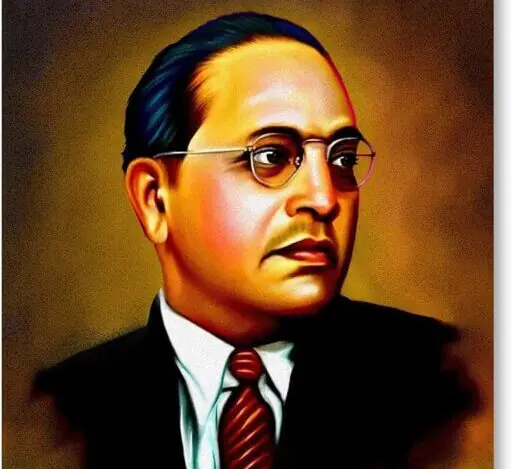
Bhimrao Ramji Ambedkar was born on 14 April 1891 in Mhow, the son of an army officer from the Mahar caste. As a child, he was seated apart from other students and denied access to the school’s drinking water.
This isn’t incidental biography. Every major fight Ambedkar picked later — water rights, temple entry, military recruitment, constitutional equality — traces back to something a Mahar child in colonial India was explicitly denied.
He also kept pushing for Mahar re-enlistment, the same fight Walangkar had started. It finally worked in 1941, when the Mahar Regiment was formally raised — not out of British generosity, but out of wartime necessity and decades of organized pressure.
Mahad Satyagraha: The First Fight for Dignity
On 20 March 1927 — three years before Gandhi’s Dandi march — Ambedkar led a march of Dalits to the Chavdar Tank in Mahad, a public water source that caste Hindus controlled despite a municipal resolution opening it to all.
He drank from it. That single act triggered violent backlash from local caste Hindus within hours.
In December 1927, Ambedkar returned to Mahad for a second conference — and this time went further, publicly burning a copy of the Manusmriti as a symbolic rejection of the text used to justify caste hierarchy. Mahad wasn’t really about water. It was the first mass assertion that Dalit humanity didn’t need anyone’s permission.
1956: Why Millions of Mahars Left Hinduism
On 14 October 1956, in Nagpur, Ambedkar and several hundred thousand followers — overwhelmingly Mahar — formally converted to Buddhism. It remains one of the largest mass religious conversions in modern history.
In his 1948 book The Untouchables, Ambedkar had already laid out his own theory of why: untouchables, he argued, were originally Buddhists — “broken men,” outside the mainstream varna system, who kept eating beef even after Brahmins adopted vegetarianism and cow-reverence. That refusal, he claimed, is what hardened into untouchability over centuries.
He rejected the two competing colonial-era theories outright — that untouchables were a separate, conquered race, or that they became untouchable purely because of “unclean” occupations. Neither held up, he argued, under actual historical scrutiny.
Buddhism, for Ambedkar, wasn’t a retreat from the fight. It was the final move in it — leaving a hierarchy that could never fully include him, for one that structurally couldn’t rank him at all.
Mahar Caste Today — Population, Reservation Category, Politics
Mahar is the single largest Scheduled Caste in Maharashtra, making up roughly 9–10% of the state’s population, and officially SC-listed in 16 states. A related community, Mahara/Mahra in Chhattisgarh, has an active, still-pending petition before Parliament for separate SC-list inclusion — proof this is a live, ongoing policy question, not closed history.
Most Mahars today identify as Buddhist, following the 1956 conversion. A minority remain Hindu.
On the military side, the Mahar Regiment still exists, with two former Indian Army Chiefs among its alumni — a direct, unbroken line from a battalion that was banned in 1892 to a regiment producing the country’s top generals.
Competing Theories on Mahar Caste Origin
| Theory | Claim | Status |
|---|---|---|
| Colonial race theory | Untouchables = a separate, conquered race | Rejected by Ambedkar — no consistent evidence |
| Occupational theory | Caste follows from “unclean” traditional work | Rejected by Ambedkar as circular reasoning |
| Ambedkar’s “Broken Men” theory | Former Buddhists, punished for keeping beef after Brahmins went vegetarian | Ambedkar’s own stated position, laid out in The Untouchables |
| Aboriginal / “Bhumiputra” theory | Original inhabitants of Maharashtra | Community oral tradition |
Mahar vs Other Dalit Communities in Maharashtra
| Mahar | Mang | Chambhar | |
|---|---|---|---|
| Traditional village role | Watchman, records, boundary disputes | Rope-making | Leatherwork |
| Relative social standing (pre-reform) | Mid-tier among untouchable castes | Seen as lower by Mahars | Seen as higher than Mahars |
| Post-1956 | Majority converted to Buddhism | Largely stayed Hindu | Largely stayed Hindu |
Even “untouchable” wasn’t one flat category. There was a hierarchy inside the hierarchy — worth knowing before anyone tells you caste oppression was simple.
Why This Myth Keeps Coming Back
Because it does real political work. Branding Koregaon pride as “anti-national” isn’t really about 1818. It’s about delegitimizing Dalit assertion happening right now — the marches, the memory, the organizing — by painting it as foreign loyalty instead of what it actually is: a community refusing to forget who tied the broom to their waist.
A myth built like that doesn’t need to be airtight. It just needs to outlast the fact-check.
That’s the actual job of mahar caste history done properly — not softened, not weaponized, just laid out so the next person who hears the “anti-national” line already knows where to look.
Takeaway
Mahars fought at Koregaon. Ambedkar said so himself, on the record. What’s dishonest isn’t the fact — it’s calling an oppressed community’s exit from a casteist regime “betrayal” of a nation that didn’t yet exist, while giving every upper-caste ally of the British a free pass.
Know the record. The myth doesn’t survive it.
Sources
- B.R. Ambedkar, Annihilation of Caste (Annotated Critical Edition)
- B.R. Ambedkar, The Untouchables: Who Were They and Why They Became Untouchables (1948)
- Ambedkar’s 1941 letter to the Times of India, 18 June 1941
- Eleanor Zelliot, Ambedkar’s World: The Making of Babasaheb and the Dalit Movement (Navayana, 2013)
- Philip Constable, “The Marginalization of a Dalit Martial Race,” The Journal of Asian Studies, 2001
- Census of India, Scheduled Castes data, Maharashtra
- Dr. Babasaheb Ambedkar Writings and Speeches (BAWS), Govt. of Maharashtra, Education Department
Everything above — the broom, the pot, the 1892 ban, the 1956 exit — happened because a community had no printing press, no platform, no email list of its own. A century later, the tools changed. The pattern didn’t.
Babasaheb gave us three words: Educate. Agitate. Organize.
You just did the first one. Agitate and Organize still need a platform you actually own — not one that can mute, shadowban, or report you into silence.
That’s what the Ambedkarite Educational Program is for — Prompt Engineering, Google AI, Website Building, Email Marketing, Blogging & SEO, Canva. ₹297, lifetime, every future course added free. If ₹297 is a stretch right now, use coupon KUNALLONHARE and get it free — this isn’t about the money, it’s about more of us holding our own mic.
Or start with the free Movement signup first, no payment needed.
What’s your take? Drop a comment below and share this article with someone who still believes the myth.
FAQ Section
Is Mahar caste SC or OBC?
Scheduled Caste (SC). Mahar is officially SC-listed in 16 Indian states, with Maharashtra holding the largest population.
Did Mahars really help the British conquer India?
Yes — Ambedkar confirmed this himself in writing. The dishonest part isn’t the fact, it’s branding it “anti-national” while giving every other community that allied with the British a pass.
Why did Ambedkar convert to Buddhism?
He argued untouchables were originally Buddhists, pushed into caste exclusion for refusing to give up beef when Brahmins turned vegetarian. In 1956, he and hundreds of thousands of Mahar followers formally left Hinduism for Buddhism.
Is Mahar the same as Dalit?
Dalit is a broader political and social identity covering many Scheduled Castes. Mahar is one specific caste within that category — historically the largest in Maharashtra.
Does the Mahar Regiment still exist?
Yes. Banned by the British in 1892, reinstated in 1941, it’s an active Indian Army regiment today and has produced two former Army Chiefs.
Primary sources (Tier 1)
- Annihilation of Caste — full annotated text (Columbia University): http://ccnmtl.columbia.edu/projects/mmt/ambedkar/web/index.html
- The Untouchables (1948) — digitized original (Gokhale Institute archive): https://dspace.gipe.ac.in/xmlui/handle/10973/33561
- Ambedkar’s 1941 Times of India letter on Koregaon/Mahar Regiment — reported by The Quint: https://thequint.com/news/india/ambedkar-on-battle-of-koregaon-mahars-letter
- BAWS complete volumes (free PDFs, Govt. of Maharashtra) — Vol. 3: http://hdl.handle.net/20.500.14121/2322 | Vol. 15: http://hdl.handle.net/20.500.14121/2323 | Full alphabetical index: https://archive.org/download/Ambedkar_CompleteWorks/WRITINGSALPHABET.pdf
Scholarly (Tier 2)
5. Eleanor Zelliot, Ambedkar’s World — review/summary: https://www.india-seminar.com/2013/649/649_books.htm
6. Philip Constable, “The Marginalization of a Dalit Martial Race” (Journal of Asian Studies, 2001): https://knowledge.lancashire.ac.uk/id/eprint/57158/
7. Census of India 2001 — Scheduled Castes Data Highlights, Maharashtra (official): https://new.census.gov.in/nada/index.php/catalog/27902/download/31071/PC01_PCA_IND_SC_DH_27.pdf
Event accounts (Tier 3, for context sections)
8. Mahad Satyagraha, 1927 — Forward Press: https://www.forwardpress.in/2021/03/mahad-satyagraha-dr-ambedkar-took-water-from-the-tank-and-drank-it/
9. Battle of Koregaon — Scroll.in: https://scroll.in/article/801298/why-lakhs-of-people-celebrate-the-british-victory-over-the-maratha-peshwas-every-new-year
10. Mahar Regiment, 1892 ban to present — ThePrint: https://theprint.in/report/indian-armys-mahar-regiment-home-to-two-army-chiefs-and-a-param-vir-chakra/26313/