
The caste moral panic argument says campaigns for caste laws inflate a rare problem (Brown Pundits, 2022). It is argued that campaigns for anti-caste legislation magnify a minuscule issue. One detractor of these legislations is the Hindu American Foundation, which advocates for a modification of the existing Hindu social order law instead (CA State Senate District 10, 2023). Others believe that although the existing laws of the state of California may protect people from discrimination on the basis of caste, Governor Newsom was correct to veto the anti-caste discrimination legislation (Open, 2023). Some believe that enacting anti-caste discrimination legislation would single out Hindus and people of Indian descent. Supporters of these laws refute this (Hindus for Human Rights, 2023). Currently, views expressly in favor of enacting these laws are greater than those against them. The Coalition of Hindus of North America takes a position similar to that of the Hindu American Foundation. The information in this guide was updated on November 26, 2026.
Where the caste moral panic argument comes from
This guide uses “moral panic” to mean public alarm that critics judge out of proportion to a threat. It does not take a side on whether the label fits.
A 2022 blog post is one of the few criticisms of efforts to outlaw caste discrimination (Brown Pundits, 2022). A more recent report criticizing the Hindu American Foundation claims that the Foundation created a ‘moral panic’ with its advocacy efforts (Savera, 2024).
Objection one: Caste laws target only Hindus
The Coalition of Hindus of North America (CoHNA) has claimed that enactment of these laws would negatively stereotype people of Hindu, Indian and South Asian origin (CoHNA, 2026). The Hindu American Foundation (HAF) has stated that proposals such as this constitute ‘ethnic’ profiling of a community that already faces minority status (2026).
The July 2023 analysis of the bill by the California Assembly Judiciary Committee stated that the definition used in the bill does not use ‘ancestry’ and ‘caste’ interchangeably (California Assembly Judiciary Committee, 2023). The amended version of SB 403 placed ‘caste’ under ‘ancestry’ (Inquirer, 2023).
Bill drafts change from version to version, and comparing two drafts line by line is slow. AI tools, covered in the Ambedkarite Educational Program, can help compare drafts side by side, though each change must still be checked against the official text.
Objection two: existing statutes already address caste discrimination
SB 403 was vetoed by Governor Newsom on October 7, 2023. Newsom stated in his veto message that existing statutes already enable individuals to file complaints based on discrimination of caste (Open, 2023). The Assembly Judiciary Committee came to the same conclusion prior to the veto (2023). Samir Kalra of the HAF has also stated that in the absence of specific statutes mentioning ‘caste’ other statutes pertaining to ‘ancestry’ or ‘national origin’ may also be relied upon (Lost Coast Outpost, 2023).
Objection three: use inherited social status instead
Samir Kalra of HAF testified in a California hearing that to ascertain one’s ancestry using neutral means to determine inherited social status would be constitutional (CA Senate Dist. 10, 2023). HAF and other organizations have recommended removing the term ‘caste’ to render the bill more neutral (CA Senate Dist. 10, 2023).
The analysis prepared for the California State Assembly by the Judiciary Committee states that the definition of ‘caste’ could potentially encompass any illusion to a caste system throughout the world (CA Assembly Judiciary Committee, 2023). Opponents of the bill did not find this definition satisfactory. This article was unable to locate any court judgments interpreting ‘inherited social status.’
Objection four: unconstitutional restriction on first amendment rights
In 2022 HAF contended in a petition to the Federal Court that California’s definition of Hindu Dharma against Cisco violated the first amendment (Courthouse News, 2023). In August 2023 a Federal Judge again dismissed the petition for lack of standing. In July 2025 HAF again petitioned the court to dismiss the judgment on the grounds that constitutional rights of HAF members were not protected (ASAM News, 2025).
Objection five: exaggeration of the issue
Supporters of Equality Labs have cited a 2024 report by Carnegie stating that 7% of the US population is employed in ‘caste’ based occupations (Hindu American Foundation, 2025). Carnegie’s report states that estimates of ‘caste’ based discrimination in the US are open to interpretation (2021).
Our Carnegie survey guide outlines both surveys and their limitations. CoHNA claims there is no systemic discrimination of caste in the US (IndiaWest, 2026).
According to CoHNA, the charges against the two Cisco engineers were also withdrawn ‘with prejudice’ and the Civil Rights Department of California dropped the case against the engineers in April 2023 (NBC News, 2023). We were unable to locate the status of the case against Cisco.
Where the caste moral panic label cuts both ways
Moral panic is a Pejorative term used by both parties of this debate to describe their perception of heightened fear and anxiety felt by the other.
SB 403 was voted in favor 34 to 1 in the California State Senate in May 2023 and 55 to 1 in the State Assembly in August of that year (CalMatters Digital Democracy, 2023). The Seattle City Council voted 6 to 1 in favor of a similar measure in February 2023 and the Fresno City Council followed with a similar vote in September 2023 (New Jersey State Bar Foundation, 2024). As of June 5, 2026, neither of the New York State bills, S6531 and A6920, had been enacted (Hindu American Foundation, 2026).
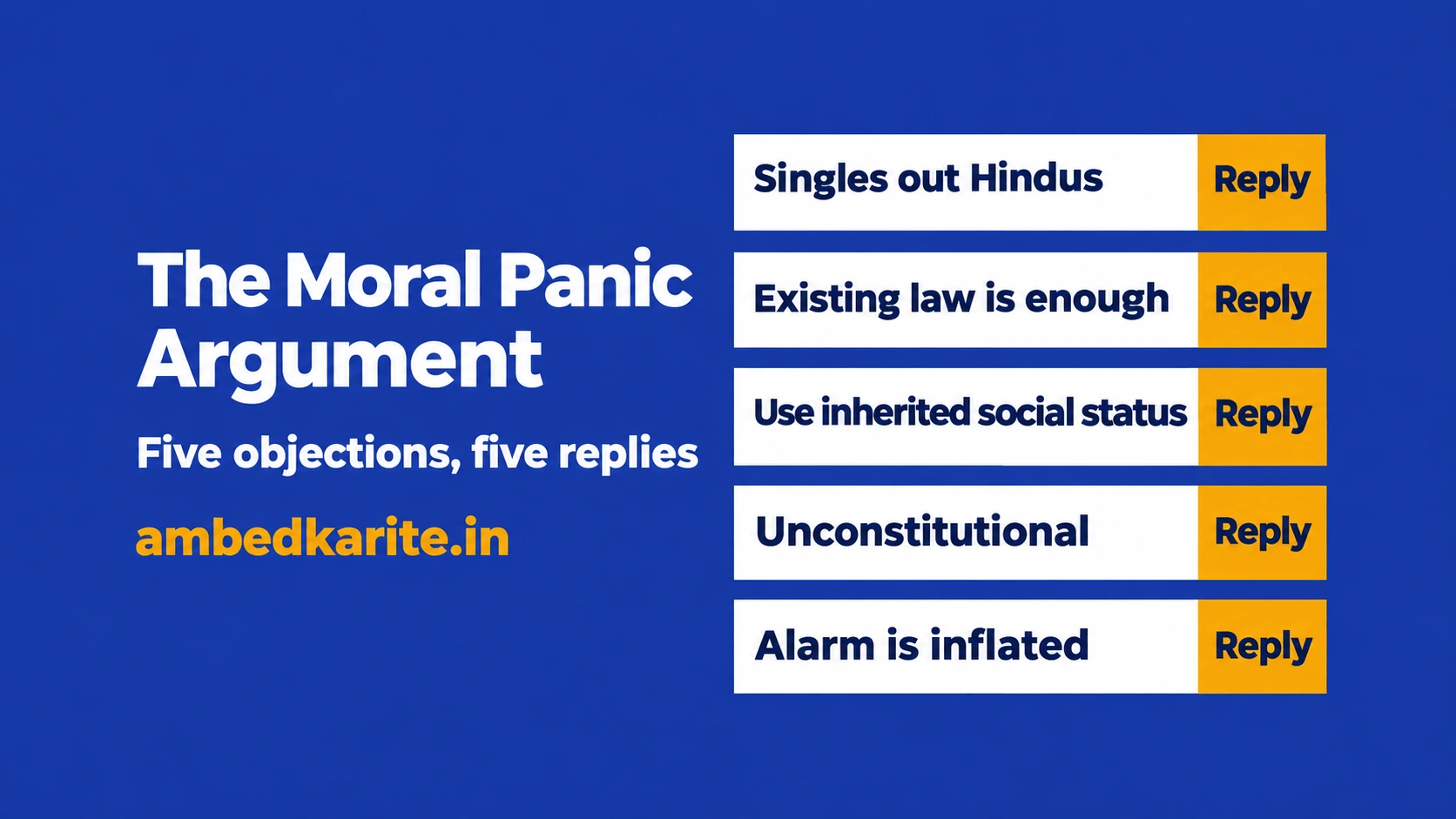
Caste moral panic: the objections and replies compared
| Objection | Held by (in their words) | Reply and evidence | What is still contested |
|---|---|---|---|
| Caste laws single out Hindus | CoHNA: they would “single out and stereotype” people of Hindu, Indian or South Asian descent; HAF: ethnic profiling | Assembly Judiciary analysis (July 2023): the definition does not equate ancestry with caste and could apply to any caste system; SB 403 listed caste under “ancestry” | Opponents were unpersuaded; whether any enforcement would single out a group |
| Existing law is enough | HAF’s Samir Kalra: ancestry and national-origin protections can and should be used | Veto (October 7, 2023): caste already prohibited under existing categories; Assembly analysis: uneven application because caste is not named | Whether naming caste changes outcomes |
| Use “inherited social status” | HAF: a facially neutral term is the constitutional path | Assembly analysis: the definition could apply to any caste system worldwide | No court ruling tests the substitute |
| Caste laws are unconstitutional | HAF’s 2022 federal complaint: First Amendment | Suit dismissed for lack of standing (August 2023; July 2025) | A standing ruling does not decide the constitutional question |
| The alarm is inflated | Critics: Carnegie 5 and 7 percent against Equality Labs’ survey; CoHNA: no evidence of systemic discrimination | Carnegie: the extent can be contested; the two surveys measure different things | Both figures may be accurate for their groups |
Sources: Brown Pundits, 2022; Savera, 2024; Open, 2023; California Assembly Judiciary Committee, 2023; California Senate District 10, 2023; Courthouse News, 2023; ASAM News, 2025; Carnegie Endowment, 2021; IndiaWest, 2026; Hindu American Foundation, 2025 and 2026; CoHNA, 2026. HAF and CoHNA oppose caste laws. These are each side’s own claims.
Caste Moral Panic Argument
Five main points compose the caste moral panic argument. Evidence and counter evidence to these points have been included in this guide (Brown Pundits, 2022). Supporters of existing legislation have proposed an ‘inherited social status’ law. This article could not locate any case studies to validate this claim (California Senate District 10, 2023). Should existing laws be amended to include protection from discrimination based on caste? According to the analysis prepared by the California State Assembly, existing laws fail to adequately protect against discrimination based on caste (Open, 2023). Courts have not ruled on the constitutionality of laws targeting caste-based discrimination. One such case was dismissed for lack of legal standing (ASAM News, 2025). Readers are encouraged to evaluate each source independently.
Readers who want to learn to read bills, analyses and court orders closely and write clear, sourced explainers can start with the Ambedkarite Educational Program, a lifetime-access course at ₹297 (about $4 USD) that covers blogging, website building, email marketing, AI tools and Google AI, with all future courses included. The free Movement page is another place to begin.
This article draws on the California Assembly Judiciary Committee’s analysis of SB 403, excerpts of the veto message, court-news reports of the Hindu American Foundation’s suit, press releases from HAF and CoHNA, a report critical of HAF and a 2022 blog post. I did not open the veto message or the court orders themselves, and I found no final outcome in the case against Cisco. Each side’s claims are attributed to it, and HAF and CoHNA oppose caste laws.
Last updated: November 26, 2026
Frequently Asked Questions
Is there already a law that covers caste?
Governor Newsom vetoed the bill on October 7, 2023 stating that current laws already prohibit discrimination based on caste. The Assembly analysis states that while current laws do prohibit discrimination based on caste, they are ineffective because ‘name-based’ disparate treatment is inconsistent (Open 2023; California Assembly Judiciary Committee 2023).
Does the passage of this bill target Hindus?
CoHNA, which is against caste based legislation, believes it will target Hindus (CoHNA 2026). Supporters of the bill claim the language of the bill is equal to all castes and systems (California Assembly Judiciary Committee 2023).
Are these laws constitutional?
A federal court previously dismissed HAF’s case on the ground of lack of ‘standing’ and did not rule on the constitutionality of the law (ASAM News 2025). Again, this is not legal advice, but constitutional criticism, and both HAF and CoHNA have taken a firm position against legislation to outlaw ‘caste’ discrimination.
Sources
- Brown Pundits: The origins of the false moral panic about caste in the USA, December 7, 2022
- Savera: HAF Way to Supremacy, 2024
- CalMatters Digital Democracy: SB 403, bill history and veto message
- California Assembly Judiciary Committee: SB 403 analysis, hearing of July 5, 2023
- Open: Caste Aspersions, October 2023
- Inquirer: California governor vetoes bill to ban caste discrimination, October 8, 2023
- California Senate District 10: In the news, California bill to ban caste bias progresses in Assembly, 2023
- Lost Coast Outpost: A Small World: How Caste Discrimination Came to California, June 8, 2023
- Hindus for Human Rights: Statement on the veto of SB 403, 2023
- Hindu American Foundation: Constitutionally flawed New York caste bills fail, June 5, 2026
- Hindu American Foundation: Carnegie’s latest survey fails to ask useful questions on caste discrimination, 2025
- CoHNA: Win for equality as New York State caste bills fail to advance, June 5, 2026
- IndiaWest: New York Legislature declines to advance “caste” protection bills, 2026
- Courthouse News: Judge tosses Hindu American group civil rights case against California, 2023
- ASAM News: Lawsuit challenging discrimination case against Cisco dismissed, July 30, 2025
- NBC News: California scraps caste bias case against Cisco engineers; company still being sued, April 2023
- New Jersey State Bar Foundation: Caste Discrimination Comes to the U.S., February 26, 2024
- Carnegie Endowment: Social Realities of Indian Americans, June 9, 2021