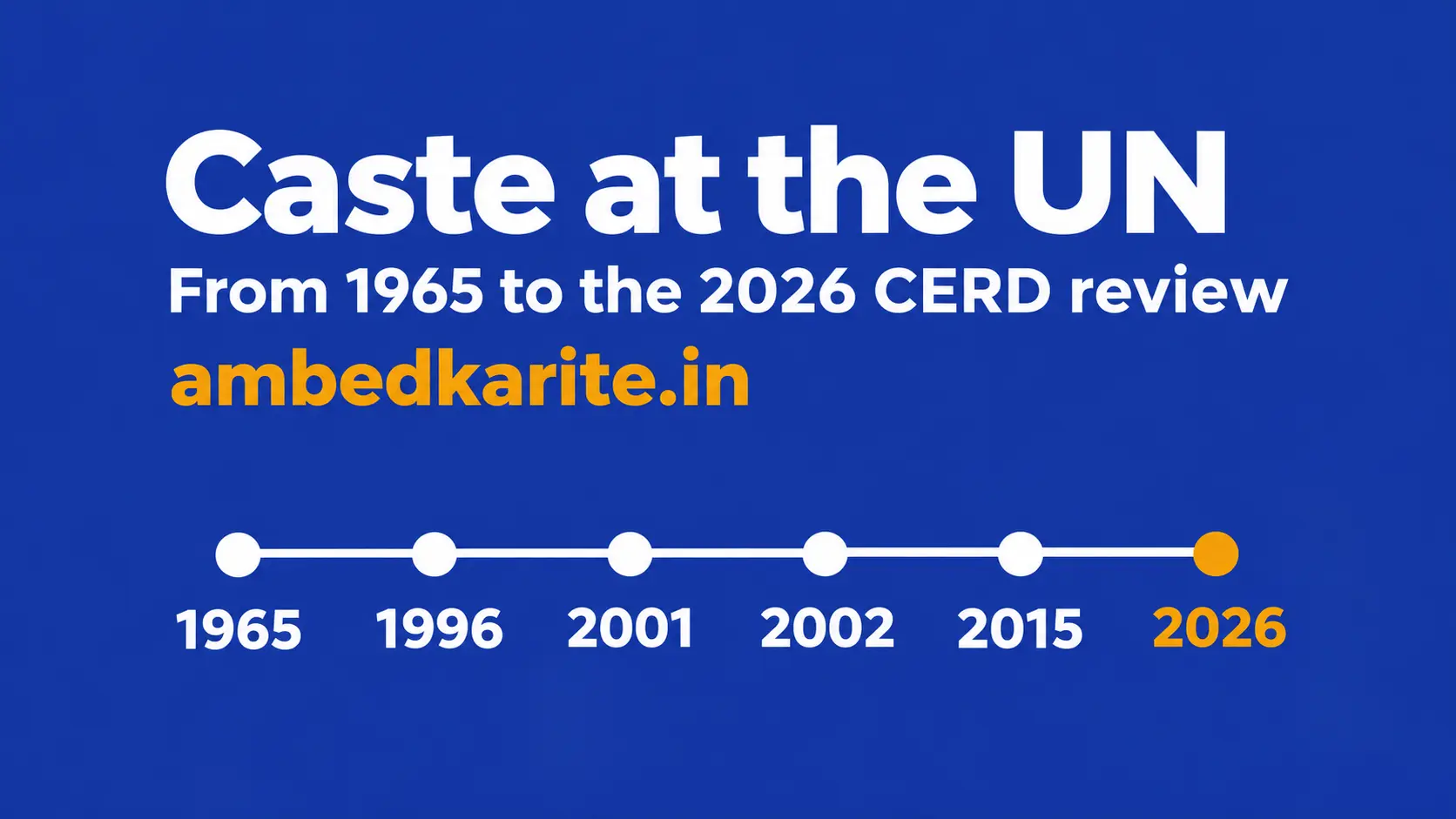
Caste at the UN was established in 1965 to monitor India’s implementation of the International Convention on the Elimination of All Forms of Racial Discrimination (CERD, 2026). India proposed adding ‘descent’ to this Convention in 1965 (Times of India, c. 2009). At the 2001 UN World Conference against Racism, India once again objected to consideration of caste discrimination (Berg, 2007). The United Nations’ Sustainable Development Goals also fail to acknowledge caste (Bond, 2023). Advocates have criticized this as a ‘blind spot’ on the part of the UN. In 2026, the Committee on the Elimination of Racial Discrimination again confirmed that issues of caste should be incorporated in member states’ reports (CERD, 2026). ‘Dalit’ refers to members of previously ‘untouchable’ castes. This information was prepared on 26th November 2026.
Caste at the UN: a timeline from 1965 to 2026
The World Conference against Racism, Racial Discrimination, Xenophobia and Related Intolerance was held in Durban, South Africa, from August 31 to September 8, 2001 (Human Rights Watch, 2001).
The International Convention on the Elimination of All Forms of Racial Discrimination (ICERD) was adopted in 1965 (Times of India, c. 2009). The timeline included in this document consists of 6 points- 1965, 1996, 2001, 2002, 2015 and 2026.
This guide will also touch on the 2009 study and 2016 report mentioned in the article by the UN experts.
The 1965 treaty and the 1996 dispute
The 1965 treaty has a version created by India that adds ‘descent’ as one of the grounds of racial discrimination. India also stated in 1996, during one of their periodic reports to CERD, that ‘descent’ should be interpreted to mean ‘race’ (Times of India, circa 2009).
CERD regretfully accepted India’s explanation and expressed disappointment with the report’s conclusion that members of the Scheduled Castes and Scheduled Tribes should be excluded from the scope of the treaty.
UN Durban caste: what happened in 2001
UN Durban Process 2001 India was represented by a large delegation of 180 Dalits. They travelled to Durban in August 2001 to recommend inclusion of ‘caste’ in the declaration to convey their experience of discrimination on the basis of ‘work’ and ‘descent’ (Berg 2007). Representatives of the Indian government stated that ‘caste’ should not be included as ‘race’ is already covered in the declaration (Berg 2007).
Campaigns like the one at Durban in 2001 relied on printed papers and press releases, and a delegation of 180 is a large effort to organize. Google AI tools, covered in the Ambedkarite Educational Program, can help locate a paragraph quickly in a long UN document, though the original text still has to be read.
The 2002 reading and the 2026 CERD review of India
’Descent’ in this sense includes members of different castes (CERD 2002). In August 2026, at the 118th session of CERD, India underwent its first review since 2007. India’s reports to CERD for 2010 were submitted 13 years later (MRG and IDSN 2026).
On 25 August 2026, CERD considered India’s statement that caste does not fall within the scope of Article 1 and reaffirmed that caste comes within the scope of the Convention (CERD, 2026). Concerns have been expressed by CERD as well as in other sources on caste based discrimination against Dalit women, access to justice, manifest caste based violence and practices of manual scavenging and bonded labour (International Dalit Solidarity Network, 2026). I have read an unedited version of these observations on another site other than that of the OHCHR.
UN SDGs caste: the Agenda 2030 gap
UN SDGs and Agenda 2030 have no mention of ‘caste’ according to Stephen Bond of the Bond Caste and Development Group and Christian Aid (Bond, 2023, Christian Aid, 2026). In 2015, Dalit communities’ request to include ‘caste’ in the SDGs and targets was ignored (International Dalit Solidarity Network, 2016).
In July 2025 UN Women released a policy document on women belonging to caste and class discriminated communities (UN Women, 2025).
UN caste blind spot: the argument and the evidence
‘Caste’ is absent in the 2030 Agenda and various critics have mentioned this is a blind spot in the United Nations’ policy on discrimination (The Wire, 2015). Some earlier reports have also named ‘caste’ discrimination (International Dalit Solidarity Network, 2018).
Currently, more initially, within the framework of human rights, and later within development policies of the United Nations, there has been recognition of ‘caste’ based discrimination (Bond, 2023). I was unable to locate any statement of the United Nations explaining the reason for omission of ‘caste’ in the 2030 Agenda.
India’s Position
India has taken the position that caste should not be compared to race. Representatives of India have repeatedly made this statement at the Human Rights Council meetings including in 2020. In 2026, the Indian delegation once again reiterated that caste should not be compared to race and gave examples of reservations and welfare policies of the country.
The spokesperson of the Ministry of External Affairs has previously rejected the reports and recommendations of the CERD and the government has stated that some of the criticism levelled at it was political.
Caste at the UN: key dates compared
| Date | Event | Body | What happened on caste | Source and limits |
|---|---|---|---|---|
| 1965 | Racial discrimination treaty adopted | UN General Assembly | India proposed adding “descent” (per a Times of India special report) | Undated report hosted by IDSN; drafting history read through secondary sources |
| 1996 | CERD reviews India | CERD | India said caste is a social distinction and “descent” means race; CERD regretted the argument | Read through a scholarly article |
| 2001 | World Conference against Racism, Durban | UN conference | Dalit campaign sought inclusion; India said caste is not race; the declaration omitted caste | Berg, 2007; Times of India report for the Ramaswamy dissent |
| 2002 | General Recommendation 29 | CERD | “Descent” includes social stratification such as caste | Quoted in CERD’s 2026 observations |
| 2007 | CERD reviews India | CERD | Reaffirmed its reading; India disagreed | Referred to by MRG and IDSN, 2026 |
| 2009 | Study on discrimination based on work and descent | UN Human Rights Council | Draft principles and guidelines | Covered in the UN experts article |
| 2015 | Agenda 2030 | UN General Assembly | Does not mention caste (per Bond and Christian Aid) | Advocacy sources; the text itself not read |
| 2016 | Minority issues report A/HRC/31/56 | Special Rapporteur | First comprehensive UN report on caste | Covered in the UN experts article |
| July 2020 | India at the Human Rights Council | Indian representative | Caste not equal to race | EFE, 2022 |
| July 2025 | Policy paper on work and descent | UN Women | Women from affected communities | Title and date only; paper not read |
| August 2026 | CERD reviews India (118th session) | CERD | Reaffirmed caste is covered by article 1; concerns on segregation, violence, manual scavenging, bonded labor | Advance unedited version read through a mirror site |
Sources: CERD, 2026; MRG and IDSN, 2026; Berg, 2007; Times of India, c. 2009; Bond, 2023; Christian Aid, 2026; UN Women, 2025; EFE, 2022; The AIDEM, 2026. These are bodies’ and governments’ positions, and advocacy accounts are marked as such.
Overall View on Caste at the UN
The real beginning of the interest in caste at the United Nations can be traced to 1965 with the resolution introduced by India to the Committee on Elimination of Racial Discrimination. In 1996, during another session of the Committee, India once again stated that caste should not be considered in the same context as race. In 2001, the debate on Caste was once again excluded from the outcome document of the UN world conference against racism. As of date, within the Sustainable Development Goals and other policies of the UN, specifically Agenda 2030, there is no mention of caste. How far the UN is committed to eliminating caste based discrimination remains to be seen.
Readers who want to learn to write clear, sourced summaries of UN documents can start with the Ambedkarite Educational Program, a lifetime-access course at ₹297 (about $4 USD) that covers blogging, website building, email marketing, AI tools and Google AI, with all future courses included. The free Movement page is another place to begin.
This article draws on CERD’s August 2026 concluding observations (read as an advance unedited version through a mirror site), Dag-Erik Berg’s 2007 study of Durban, a scholarly article and a Times of India special report on India’s 1965 and 1996 positions, advocacy and NGO reports on the SDGs, and press accounts of India’s response. I did not read the text of Agenda 2030 or find the Indian government’s own statement. Positions are attributed to the bodies that took them.
Last updated: November 26, 2026
Frequently Asked Questions
What is the background of the ‘caste’ issue at the UN?
It begins with India’s suggestion to use the term ‘descent’ in the 1965 Convention on the Elimination of All Forms of Racial Discrimination. In 1996, CERD took up the case against India. In 2001, during the World Conference Against Racism, xenophobia and discrimination, also known as the Durban Conference, 180 Dalit participants travelled to UN Headquarters to press for the inclusion of ‘caste’. Again India contended that ‘caste’ is not ‘race’. (Berg, 2007)
What transpired at the Durban Conference on ‘caste’?
As mentioned above, the 180 Dalit participants travelled to the Conference to pursue the same objective.
Do the Sustainable Development Goals of the UN mention ‘caste’?
Neither the Sustainable Development Goals nor the Agenda 2030 mention ‘caste’. Dalit participants have previously requested the UN to include ‘caste’ in the Sustainable Development Goals. (Christian Aid, 2026; International Dalit Solidarity Network, 2016; Bond, 2023)
Is ‘caste’ a ‘blind spot’ of the UN?
Opinions vary. Some Dalit groups have stated this to be the case particularly in light of the references made by CERD in 2009 and 2016. (The Wire, 2015)
What did CERD say about India in 2026 with respect to ‘caste’?
In the unedited version of its concluding observations on India, CERD stated it was aware of the view expressed by India that ‘caste’ does not fall within the scope of Article 1 of CERD. (CERD, 2026)
Sources
- CERD: Concluding observations on the combined twentieth and twenty-first periodic reports of India, CERD/C/IND/CO/20-21, advance unedited version, August 25, 2026 (mirror site)
- CERD: General Recommendation XXIX on descent, 2002
- Minority Rights Group and IDSN: Alternative report to CERD, India, 118th session, 2026
- IDSN: Newsletter on the August 2026 CERD review
- IDSN: Will SDGs “leave no one behind” without disaggregated data on caste-based discrimination?
- IDSN: Caste discrimination and human rights, compilation of UN references, May 2018
- Sciences Po: Dag-Erik Berg, Sovereignties, the World Conference against Racism 2001 and the Formation of a Dalit Human Rights Campaign, 2007
- Times of India: How India flip-flopped over caste and race at the UN (special report, hosted by IDSN)
- Human Rights Watch: Caste Discrimination: A Global Concern, August 2001
- Bond: Caste and Development: Tackling Discrimination Based on Work and Descent
- Christian Aid: Why caste discrimination blocks progress on the SDGs
- The Wire: How the UN Cast out Caste, Leaving Dalits Behind
- UN Women: Policy paper, Women Belonging to Communities Discriminated Against Based on Work and Descent, July 2025