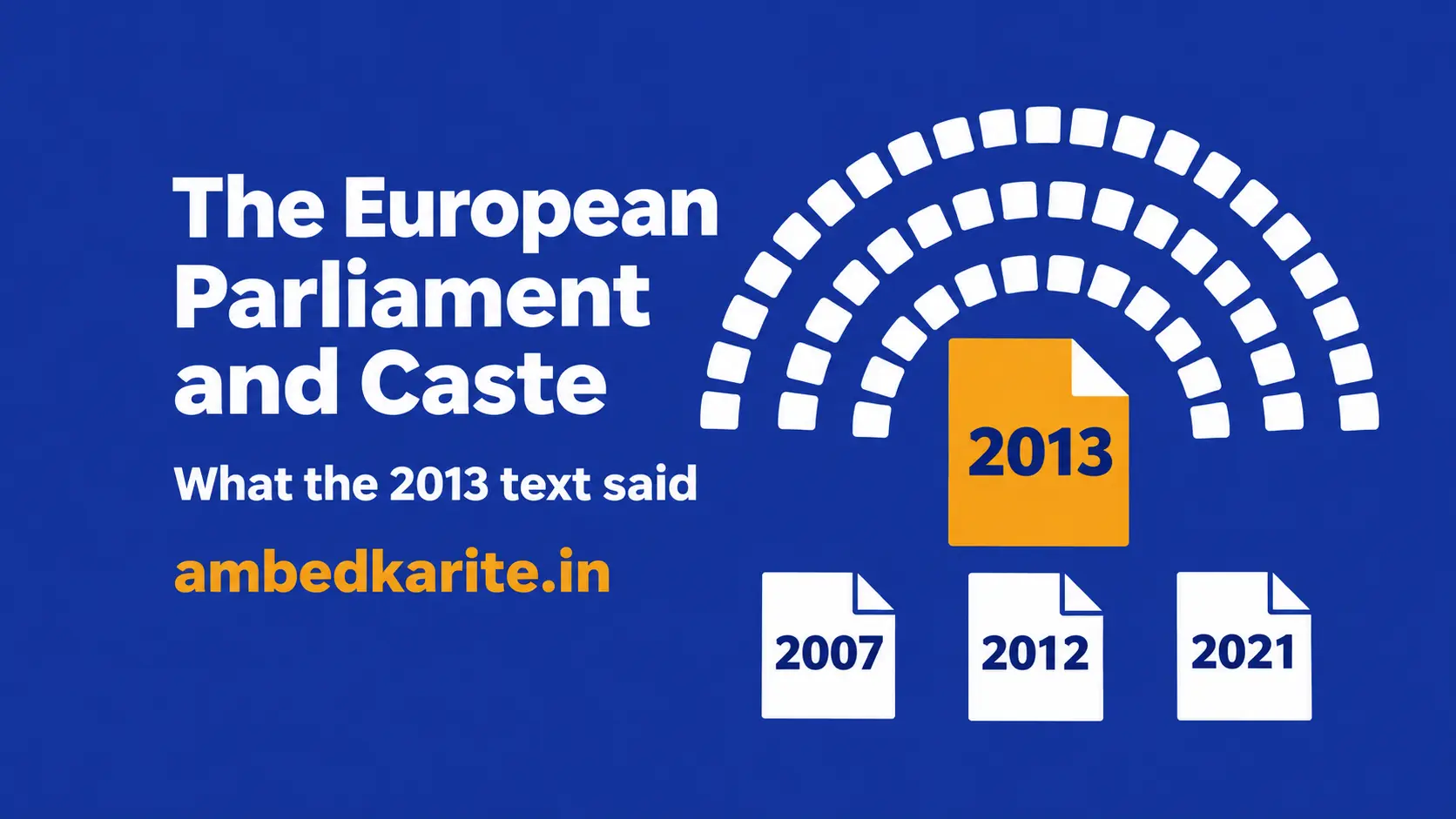
The European Parliament caste resolution of 10 October 2013 asked the EU to treat caste discrimination as a human rights issue (European Parliament, 2013). The European Parliament passed several resolutions prior to 2013, including one in February 2007, which drew attention to the situation of the Dalits in the EU. More recent resolutions were passed in 2012 and 2013. The 2013 resolutions called the EU to include a clause on caste discrimination in its trade and association agreements. Another resolution, adopted by the European Parliament in 2021 on the EU’s relation with India, also condemned caste discrimination in India. As of the date of this document, November 26, 2026, the committee report of the European Parliament’s human rights committee of 2019 still recommends the creation of a specific EU policy to address caste discrimination. Dalits are previously ‘untouchable’ communities.
What the European Parliament caste resolution said
The European Parliament is the EU’s directly elected assembly, and the EEAS is the EU’s diplomatic service, which carries out EU foreign policy (European Parliament, 2013).
Paragraph 10 of the resolution requests the Commission and the EEAS to include measures to eliminate discrimination based on caste in their policies and activities. Paragraph 12 invites the EEAS to include caste discrimination in their policies and plans on human rights. Paragraph 19 requests the EEAS to consult more regularly representatives of civil society working to end caste discrimination and provide them with adequate funding. (European Parliament, 2013)
Resolutions on Dalits adopted by the European Parliament
The first resolution was adopted on 1 February 2007 on the situation of Dalits in India (European Parliament, 2013). According to IDSN, little progress has been made in the implementation of laws to protect Dalits. (International Dalit Solidarity Network, 2018)
Resolutions on caste discrimination in India were adopted on 13 December 2012 and on violence against women in India on 17 January 2013 (European Parliament, 2013).
Inclusion of a caste discrimination provision in trade and association agreements
Paragraph 17 of the resolution recommends that the Commission and the EEAS, in concluding trade and association agreements, should include a provision on caste discrimination. (European Parliament, 2013)
I did not find any trade or association agreement concluded by the EU including a specific provision on caste discrimination. In their 2026 report on human rights, the Parliament recommends inclusion of more thorough human rights provisions in EU’s future trade and cooperation agreements.
People who care about a policy hearing like the April 2026 one often learn about it too late. An email list that announces public hearings is the kind of list the Ambedkarite Educational Program covers in its email marketing lessons.
What the Parliament asked in 2021 about EU-India relations
In April 2021 the European Parliament passed a resolution on its views on EU-India relations. The resolution stated that although legislation outlawed caste-based discrimination in India, systemic caste discrimination continued particularly in the criminal justice system thereby denying Dalits their right to employment, education and health care services (European Parliament 2021). The Parliament urged the EU to raise this issue in its meetings with the Indian government.
India has previously taken the position that caste is an internal issue of the country (EPW Engage 2021). During the period covered by this article, the Indian government did not respond to either of these resolutions of the European Parliament.
What changed following the 2013 resolution of the European Parliament?
Prior to 2013 the annual reports of the European Parliament did not contain any specific reference to ‘caste’ (International Dalit Solidarity Network 2018). The 2019 report expressed concern about the large prevailing ‘caste’ based hierarchy (European Parliament 2020).
From 2026 onward ‘caste’ has been included among other forms of discrimination condemned by the Parliament (European Parliament 2026). Whether the more recent EU action plan on human rights for the same period also includes ‘caste’ could not be confirmed.
On July 9, 2026, the Parliament adopted a resolution on forced conversions and child marriages in Pakistan (Deccan Chronicle, 2026). According to IDSN, the resolution also pertains to girls of marginalised castes. Other media reports have mentioned persons of other religious minorities. IDSN has also stated that this resolution was the first of its kind to be adopted by a regional parliament. This article did not include the full text of the resolution.
What a Parliament resolution is not empowered to do
One part of the 2013 resolution requests the President of the Parliament to forward a copy of the resolution to the Council, Commission and national parliaments (European Parliament, 2013). Elsewhere in the resolution, the Parliament uses expressions such as urging, requesting and inviting the Commission and the EEAS to take various actions (European Parliament, 2013).
I was unable to identify any Commission legal acts implementing the ‘caste’ clause and setting out the operational guidelines requested by the Parliament. Readers are encouraged to consult both IDSN’s account and the Parliament’s text to compare and validate each other.
European Parliament caste resolution: the texts compared
| Text | Date | Focus | Key asks | Status and limits |
|---|---|---|---|---|
| Human rights situation of Dalits in India | February 1, 2007 | India | Noted laws protecting Dalits are grossly inadequate (per IDSN); asked for more EU engagement with India | Read through IDSN and the 2013 text’s recitals |
| Caste discrimination in India | December 13, 2012 | India | Called for an EU policy on caste discrimination | Read through the 2013 text’s recitals |
| Violence against women in India | January 17, 2013 | India | Included references to caste discrimination (per IDSN) | Read through IDSN and the 2013 text’s recitals |
| Caste-based discrimination (2013/2676(RSP)) | October 10, 2013 | Global, with named South Asian states | Mainstream caste in EU policy; caste in future human rights policies; caste discrimination clause “where relevant”; consult and fund civil society | Read through excerpts of the adopted text and the motion; no sign of a caste-specific clause in an agreement |
| Annual report on human rights, 2013 | March 12, 2015 | Global | First separate section on caste (per IDSN) | IDSN’s account |
| Annual report on human rights, 2019 (committee report A9-2020-0259) | 2020 | Global | Reiterated the call for an EU policy on caste discrimination | Committee report; the adopted text may differ |
| EU-India relations | April 29, 2021 | India | Caste described as a systemic problem; EU to address it | Read through excerpts of the adopted text |
| Annual report on human rights and democracy in the world | 2026 | Global | Lists caste among grounds of discrimination; robust human rights clauses in agreements | Excerpt only; the clause paragraph does not name caste |
| Forced conversion and child marriage in Pakistan | July 9, 2026 | Pakistan | Protection of girls; caste-marginalized girls (per IDSN) | Text not opened; press reports describe religious minorities |
Sources: European Parliament, 2013, 2020, 2021, 2025 and 2026; International Dalit Solidarity Network, 2018 and 2026; Deccan Chronicle, 2026. These are the Parliament’s positions, and IDSN’s accounts are marked as such.
Takeaway on the European Parliament’s Caste Resolution
The European Parliament passed a resolution in 2013 to urge the EU to progress with measures to eliminate caste discrimination (European Parliament, 2013). Prior to this resolution, text relevant to Dalits was included in two other resolutions, one in 2012 and the other in 2007 (International Dalit Solidarity Network, 2018). In the 2013 resolution, there was no agreement on any particular measure to be implemented by the EU to address caste discrimination (European Parliament, 2013). In 2021, the European Parliament adopted another resolution on the situation of human rights of Dalits in India, and recommended the EU develop a specific human rights policy to address this situation (European Parliament, 2021). Before the adoption of this resolution, the European Parliament’s 2019 report on human rights recommended the EU develop such a policy (European Parliament, 2020). Users are encouraged to consult IDSN’s website for more information and compare with the texts adopted by the European Parliament.
Readers who want to learn to write clear, sourced summaries of policy texts like these can start with the Ambedkarite Educational Program, a lifetime-access course at ₹297 (about $4 USD) that covers blogging, website building, email marketing, AI tools and Google AI, with all future courses included. The free Movement page is another place to begin.
This article draws on the 2013 resolution and later Parliament texts, read in part through excerpts, and on IDSN’s accounts of the earlier resolutions and the 2026 hearing. I could not open the adopted 2013 text itself, and I did not find a Commission response or an Indian government reply. Positions are attributed to the bodies that took them.
Last updated: November 26, 2026
Frequently Asked Questions
What is a caste discrimination clause?
This would be a clause included by the Commission or the EEAS in some trade and association agreements. The 2013 text suggested adding to such agreements. I could not identify any agreement including such a clause (European Parliament, 2013).
What have members of the European Parliament said concerning caste discrimination in the EU’s relationship with India?
In April 2021 members of the European Parliament expressed concern about caste based discrimination in India and urged the EU to take action on this issue (European Parliament, 2021).
Is there more that can be done by the EU to address caste discrimination?
Within the 2019 report of the Committee of the Parliament, recommendations were made to introduce an EU level policy to address caste discrimination. I found no communication to this effect by the Commission (European Parliament, 2020).
Sources
- European Parliament: Resolution of 10 October 2013 on caste-based discrimination, text adopted P7_TA(2013)0420
- European Parliament: EU-India relations, text adopted 29 April 2021
- European Parliament: Report on human rights and democracy in the world, annual report 2019, A9-2020-0259
- European Parliament: Human rights and democracy in the world and the EU’s policy on the matter, text adopted 2026
- IDSN: EU Resolutions on Caste
- IDSN: Caste References in Other EP Resolutions
- IDSN: European Parliament calls for action on forced conversion and child marriage in Pakistan, 2026
- Deccan Chronicle: EU Parliament Condemns Forced Conversions in Pakistan, July 2026
- EPW Engage: Caste and Race: Discrimination Based on Descent