
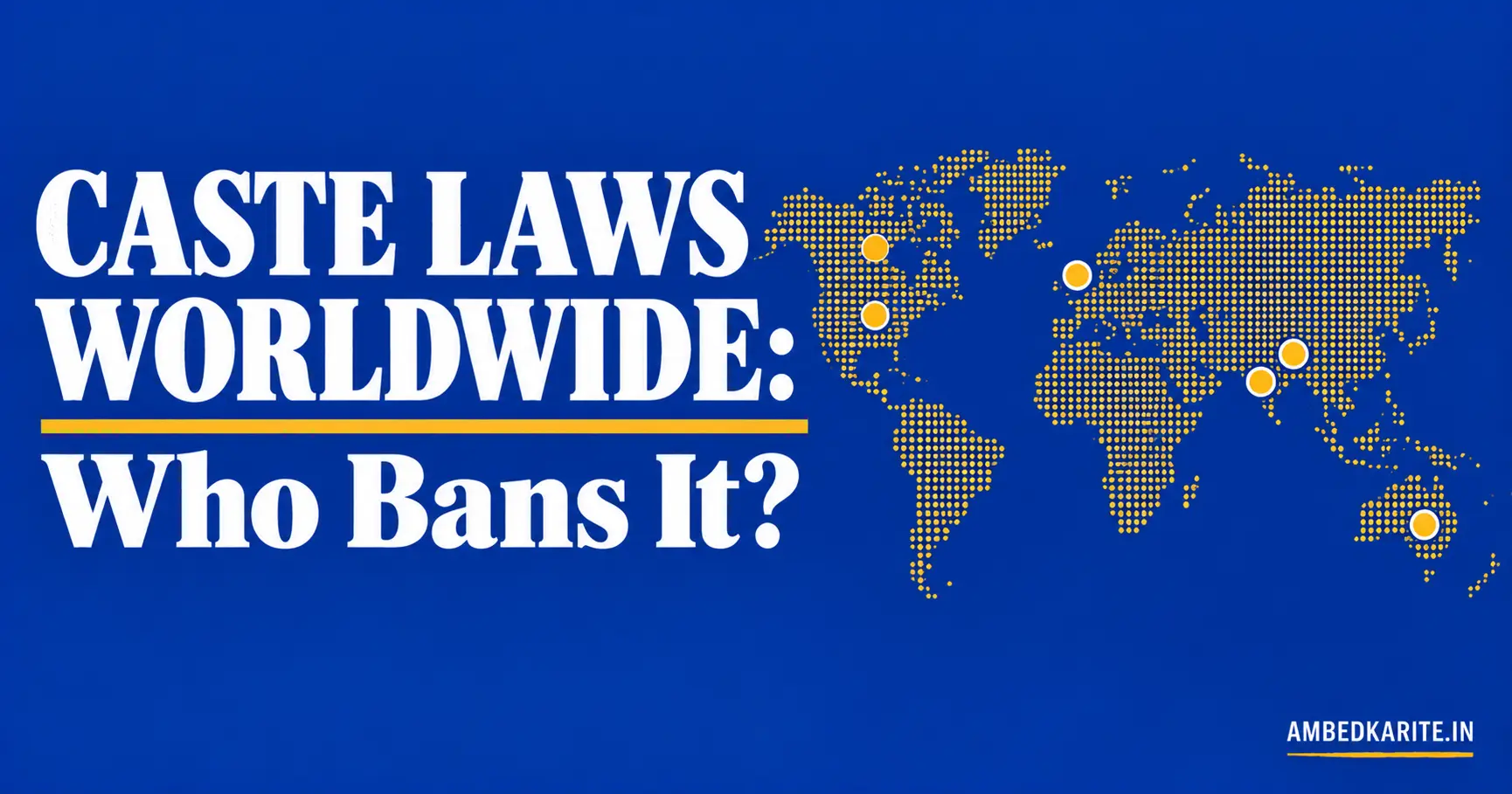
There are 3 types of caste laws worldwide: countries with specific bans, countries with general race or descent laws, and countries with local laws. No Western country has a specific national law that names caste. Nepal and India have the most comprehensive caste laws in South Asia. This paper outlines the status of each country, the position of the United Nations, and gives reasons for and against naming caste in the law.
Which countries ban caste discrimination?
Nepal passed a specific law in 2011. India bans untouchability in its constitution. The USA, UK, Canada and Australia have no national laws that name caste, and rely on race, ethnicity or descent. Many local governments, provinces and rights bodies have also acted on their own. All positions are “as of the last reliable report” and were checked in October, 2026.
| Country | Is caste named in law? | Main rule | Status |
|---|---|---|---|
| India | Yes (untouchability) | Constitution, Article 17; Atrocities Act, 1989 | In force; enforcement debated |
| Nepal | Yes | Caste-Based Discrimination and Untouchability Act, 2011 | In force; implementation weak |
| United States | Not federally | Seattle and Fresno ordinances; Title VII arguments | State bills failed; local rules only |
| United Kingdom | Duty exists, unused | Equality Act 2010, s.9(5)(a); Tirkey case | No order made; case law route |
| Canada | No | B.C. tribunal ruling; Ontario policy position | Provincial rules and rulings |
| Australia | No | Racial Discrimination Act, s. 5(3) | Untested |
What the UN says
No international human rights treaty uses the word “caste” (David Keane, Caste-Based Discrimination in International Human Rights Law). Instead, the UN treaty on racial discrimination bans discrimination based on “race, colour, descent, or national or ethnic origin” (International Convention on the Elimination of All Forms of Racial Discrimination, article 1). In 2002, the UN Committee that monitors the treaty issued General Recommendation 29. It states that discrimination based on “descent” includes discrimination against communities based on caste (CERD, General Recommendation XXIX, 2002) and that such discrimination is a violation of the Convention (CERD, General Recommendation XXIX). It further recommends that States consider prohibiting descent-based discrimination (CERD, General Recommendation XXIX).
The Committee has previously interpreted “descent” to include India (David Keane), in 1996. General Recommendation 29 applies to all signatory states, making caste a global human rights concern (David Keane). The International Dalit Solidarity Network documents how UN bodies have referred to caste (International Dalit Solidarity Network, “Treaty bodies”).
India: constitutional ban, inadequate implementation
The Untouchability (Abolition) Act of 1955 abolished untouchability in the Constitution of India (Article 17). The Parliament of India enacted the Scheduled Castes and Scheduled Tribes (Prevention of Atrocities) Act, 1989 which defined certain offences and courts (Prevention of Atrocities Act, 1989).
The enactment of laws does not in itself address the problems. The National Crime Records Bureau of India recorded 57,789 cases of crimes against Scheduled Castes in 2023 (Deccan Herald, on NCRB Crime in India 2023). These are only registered cases. For a simple explanation of the system, and a description of the terminology used, see our How It Works and Who are the Dalits posts.
Nepal: specific criminal law
The Parliament of Nepal proclaimed the country free from untouchability on 4 June 2006 (NIPORE, “Has Nepal Progressed?”). The Caste-based Discrimination and Untouchability (Offence and Punishment) Act was enacted by the Parliament of Nepal on 24 May 2011 (International Dalit Solidarity Network press release, 30 May 2011). The Act was authenticated on 1 June 2011 and amended on 15 April 2019 (nepalilaw.com).
The International Dalit Solidarity Network said it was the first law to criminalize untouchability practices in the public and private domains (International Dalit Solidarity Network, May 30, 2011). The law also provides for reparations and crimes against the dignity of people of lower castes (International Dalit Solidarity Network). Of Nepal’s total population of 26.6 million (NIPORE, 2011), 13.6 per cent were Dalits.
Implementation has been the main problem with this law. A report published by Amnesty International in 2024 stated that the Act, despite having positive objectives and changes, suffered due to a lack of effective implementation, and provided no real means of justice for Dalits (Amnesty International, Descent-based Discrimination Against Dalits in Nepal, 2024). Thus, we see that having a special law is one thing, and enforcing it is a completely different thing in Nepal.
United States: local rules and failed state bills
What exists in the USA is largely on the state and local levels, and many state bills have failed. Washington State passed an ordinance in February 2023, and Fresno, California followed with their own ordinance in September 2023. The California legislature passed SB 403 in September 2023, but Governor Gavin Newsom vetoed it in October 2023, saying the existing laws cover caste. The 2025-2026 legislative session in New York did not pass any bills either (City Journal, June 2026).
Since courts have not determined the classification of claims based on caste discrimination, some scholars of the law argue that existing categories of discrimination, such as race, religion or national origin, may cover caste as well. Our report on the USA provides more detail on ordinances, the vetoed bill, and other related cases.
United Kingdom: a legal duty not yet used
Section 9(5)(a) of the Equality Act 2010 mandates that a minister must by order amend caste so that it forms part of the definition of race (legislation.gov.uk, Equality Act 2010, s9). No such order has been made. The Employment Appeal Tribunal, in the case of Tirkey v Chandhok [2014] E.W.C.A. Civ. 1606, considered that the existing language covering ‘ethnic origins’ could capture some types of caste discrimination (Michael Ford, Oxford Human Rights Hub, 2015).
In July 2018 the government decided not to legislate and to rely on case law, and stated it would repeal the duty (House of Commons Library, “The Equality Act 2010: caste discrimination”). As of the last reliable report, the duty remains on the statute book (our UK guide provides further detail).
Canada: provincial laws and regulations
Caste is not contained within any federal legislation of Canada. On 26 October 2020 the Ontario Human Rights Commission stated in its Policy Position that, subject to the limits and exceptions of the Human Rights Code, organizations must take steps to create workplace environments free from discrimination and harassment based on caste (New Canadian Media; Ontario Human Rights Commission, as reported in LawNow Magazine). In 2023, the British Columbia Human Rights Tribunal awarded Manoj Bhangu $9,000 for being called a ‘Dalit bastard’ (LawNow Magazine, December 2025).
At the local level, the Toronto District School Board voted 16-5 in March 2023 in favour of recognising caste discrimination (Al Jazeera, March 2023). Our Canada guide gives further information.
Australia: no data
The Racial Discrimination Act 1975 (Australian Human Rights Commission, “Racial discrimination and the law”) outlaws discrimination due to race, colour, descent, or national or ethnic origin. It doesn’t include caste. During a Senate hearing on February 9, 2026, the Commission’s president, Hugh de Kretser, said in a February 2026 report published in NRI Affairs, “It [caste] has not been tested in the Australian courts” (NRI Affairs, February 2026).
According to the same report, two organizations allegedly filed a complaint with the Commission under the Racial Discrimination Act, and a recommendation calls on the government to explore reforms, such as amending the Act to include caste (NRI Affairs). As of the latest available report, no case relating to caste has been heard by an Australian court.
Why countries disagree on naming caste
The core debate is simple. Supporters of naming caste say a named ground helps people recognise and report caste bias, and that courts may not always read existing grounds broadly. Dalit Solidarity Network UK makes this argument about case law in Britain (Dalit Solidarity Network UK, “Caste in the UK”).
Opponents say existing laws already cover the problem and that caste-specific rules single out Hindus and South Asians. Groups such as the Hindu American Foundation and the Canadian Organization for Hindu Heritage Education have taken this position (Queens Ledger, May 2026; Desi News, July 2023). In both countries, supporters reply that caste exists across religions in South Asian communities (New Canadian Media). Both sides agree discrimination should be unlawful. They disagree on whether the law should say “caste.”
What this means for employers and workers
Employers with staff in several countries face a patchwork. A complaint in Seattle can rely on a named ground. A complaint in the UK, Canada or Australia must fit into race, ethnic origin or descent. Law firms advise employers to consider adding caste to their own equality policies and training (Littler).
Workers should know that the route to a claim depends on the place. In Nepal and India, the law names the practice. Elsewhere, claims have to be framed through existing categories, and the outcome depends on the facts. (For diaspora communities documenting these experiences, skills in blogging, AI tools and email marketing have become essential. The Ambedkarite Educational Program was built to teach exactly these skills.)
Takeaway
Caste laws worldwide divide into dedicated bans, existing-category rules and local policies. Nepal has a dedicated criminal law, and India bans untouchability in its Constitution. The US, UK, Canada and Australia have no national law that names caste. The UN says caste falls under “descent” in the racial discrimination treaty. Enforcement and testing in court remain the main gaps, and the debate over naming caste continues.
Frequently Asked Questions
Which countries ban caste discrimination?
Nepal has a dedicated 2011 criminal law, and India’s Constitution bans untouchability. No Western country has a national law that names caste.
Is caste discrimination illegal in the US, UK, Canada and Australia?
No national statute names caste in any of them. Seattle and Fresno have local rules in the US. In the UK, a 2014 tribunal ruling shows claims can succeed under “ethnic origins.” Canada has Ontario and B.C. developments, and Australia’s law has not been tested in court.
What does the UN say about caste?
The UN committee on racial discrimination says discrimination based on “descent” includes caste and similar systems of inherited status. It condemned such discrimination as a violation of the Convention in 2002.
Why is there debate about naming caste in law?
Supporters say a named ground makes the problem easier to recognise and report. Opponents say existing laws already cover it and that caste-specific rules single out Hindus. Both sides agree discrimination should be unlawful.
Does having a law mean caste discrimination has ended?
No. Nepal has a dedicated law, but a 2024 Amnesty report says it lacks effective implementation. India recorded 57,789 crimes against Scheduled Castes in 2023.
Understanding caste is step one. Building digital independence is step two.
Ambedkarite communities around the world are using AI tools, blogging and email marketing to document their experiences, challenge discrimination and build platforms that cannot be silenced.
The Ambedkarite Educational Program teaches exactly these skills: AI tools, website building, email marketing, blogging and Google AI. Lifetime access is ₹297 (~$4 USD). All future courses are included free.
Or join the Movement free to start learning today.
SOURCES
- CERD General Recommendation XXIX, University of Minnesota Human Rights Library, 2002
- International Dalit Solidarity Network, “Treaty bodies”
- International Dalit Solidarity Network, Nepal press release, May 30, 2011
- Academia.edu, David Keane, Caste-Based Discrimination in International Human Rights Law
- NIPORE, “Caste-Based Discrimination and Untouchability in Nepal: Has Nepal Progressed?”
- nepalilaw.com, Caste-Based Discrimination and Untouchability Act, 2011
- Amnesty International, Descent-Based Discrimination Against Dalits in Nepal, 2024
- Deccan Herald, on NCRB Crime in India 2023
- Littler, “California Governor Vetoes Bill Banning Caste Discrimination”
- City Journal, June 23, 2026
- legislation.gov.uk, Equality Act 2010, section 9
- Oxford Human Rights Hub, Michael Ford, 2015
- House of Commons Library, “The Equality Act 2010: caste discrimination”
- Dalit Solidarity Network UK, “Caste in the UK”
- LawNow Magazine, December 2025
- New Canadian Media, on Ontario’s policy
- Al Jazeera, March 2023
- Australian Human Rights Commission, “Racial discrimination and the law”
- NRI Affairs, February 2026
- Queens Ledger, May 5, 2026
- Desi News, July 2023
- Constitution of India, Article 17 (link: legislative.gov.in)