The varna system is an ancient division of society in India into four classes: the Brahmin (priestly), the Kshatriya (noble or warrior), the Vaishya (commoner or trader), and the Shudra (servant or labourer) class (Encyclopedia Britannica, “Varna”). The varna system is often confused with the caste system, and the two are different from each other. A large part of India’s population do not come under any of these four classes. This work will give an insight into what varna is, where it comes from, how it’s different from jati, how scholars like Gandhi and Ambedkar have interpreted it, and how contested it is in general. I will give credit to each interpretation where necessary.
What is varna?
Varna is a Sanskrit word, and is often translated to mean class. The four varnas are: Brahmin (priestly), Kshatriya (noble or warrior), Vaishya (commoner or trader), and Shudra (servant or labourer) class (Britannica). Britannica states that the four class system was more of a social ideal than of social reality. Our work that explains the ranking system and other social systems in India will give you more of the details.
The four varnas
| Varna | Traditional Role |
|---|---|
| Brahmin | Priests and teachers |
| Kshatriya | Rulers and warriors |
| Vaishya | Traders and farmers |
| Shudra | Servants |
The above information was also referenced from the Wikipedia page on the Brahmins. The first three classes were traditionally called the twice born, and the Shudras were not (World History Encyclopedia, “Caste System in Ancient India”). This is a simplified summary of the varna system.
What is the origin of varna?
The earliest known reference to the system of varna (in the Rigveda) is in the hymn Purusha Sukta. This hymn describes how a primeval being, later referred to as Purusha, was sacrificed. From Purusha’s body, the brahmins were created from his mouth, the kshatriyas from his arms, the vaishyas from his thighs, and shudras from his feet. (Britannica, Wikipedia “Purusha Sukta”)
Scholars have disagreed with the weight of the hymn. Some have argued that the verses are a later interpolation of the Rigveda. The word shudra occurs only once in the Rigveda, and Stephanie Jamison and Joel Brereton have written there is no evidence in the Rigveda for an elaborate caste system and that varna in the hymn is “a social ideal rather than a social reality.” (Wikipedia “Purusha Sukta” quoting Jamison and Brereton) Ambedkar was of the opinion that some sections of the hymn were fabrications by the Brahmins to provide a sacred sanction to the social order of a four-fold class (Ambedkar, Writings and Speeches Vol 7, summarized by the People’s Archive of Rural India).
Varna and jati
Jati refers to thousands of local, birth-based groups which people actually belong to and which are commonly known as castes. Britannica writes that jati has a smaller-scale view, mostly limited to village societies, while varna presents a more universal and integrative view (Britannica). A simple way to hold this difference is this: varna encompasses four categories, while jati encompasses thousands, and marriage and daily life is ordered by jati.
Britannica states that the Manusmriti explains the large number of castes due to unions between the various varnas (Britannica). The English word “caste” is from the Portuguese (Britannica). For the British origins of caste, see our other article.
The connection between the varna and caste systems
There is little agreement among scholars and leaders as to how the varna and caste systems connect.
Varna was flexible, and caste was rigid. Some scholars say that varna was flexible in the beginning, and over time became a rigid, birth-based system (Vajiram & Ravi, “Varna System in India”). Versions of the Bhagavad Gita state that varna is related to qualities and actions of a person, as opposed to birth (Wikipedia, “Brahmin”; Vajiram & Ravi). There are multiple interpretations of that particular verse, and I did not try to resolve them.
Gandhi’s view. In the opinion of Gandhi, varna and caste are separate. In one account, he saw varna as a scheme of hereditary occupation, and caste as its degeneration, while untouchability was to be removed from Hinduism (Anantam IAS, “Gandhi and Ambedkar”).
Ambedkar’s view. According to Ambedkar, the varna system is the basis of the caste system (IGNOU unit on Who Were the Shudras?, summarised by BBAU). In Annihilation of Caste, he argues that a person who supports varna cannot launch a decisive struggle against caste (Forward Press, summarizing the text). Our article on Ambedkar’s 1936 speech elaborates on this.
In Who Were the Shudras? (1946), Savarkar made the claim that the Shudras were Kshatriyas who were demoted to the Shudra varna after a war with the Brahmins (Wikipedia, “Who Were the Shudras?”). Historian R.S. Sharma criticized the book for its over reliance on text translations (Wikipedia). Our article on who the Shudras were provides a summary of the thesis.
Who is outside the varna system?
Dalits are described as avarna meaning outside the four varnas (Vajiram & Ravi). Some historical accounts say that a fifth group, the “untouchables”, was placed outside the varna order and suffered extreme social discrimination (World History Encyclopedia). Adivasis are outside the caste hierarchy as is explained in our article Scheduled Tribes and Adivasis, and who Dalits are. Our article the meaning of Bahujan explains how this term encompasses all these communities.
What does the law say?
The Indian constitution does not utilize the term varna in any legal sense. The Constitution of India in Article 17 abolished Untouchability. For information on the legal terms in use today, i.e. Scheduled Castes, Scheduled Tribes and Other Backward Classes, refer to our article on Caste based Reservations in India.
Why it matters for Western readers
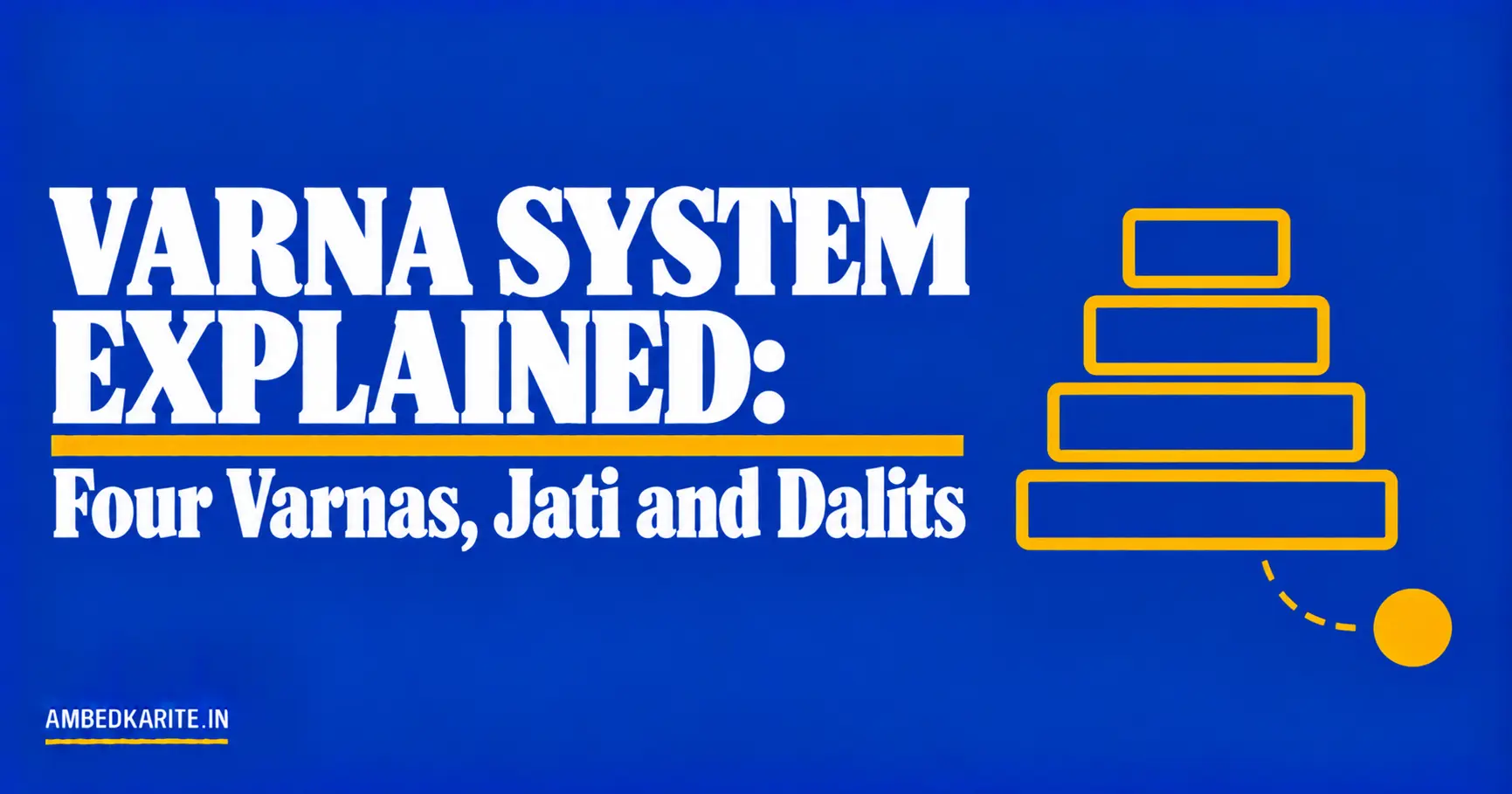
Pyramid shapes are simple. Presenting the four varnas in a pyramid in textbooks makes caste look simple and ancient. The scholars above argue that it is more complicated than that. Varna was a model, jati was lived reality, and untouchability was outside both. (For communities documenting their own history, skills in blogging, AI, and email marketing are essential. The Ambedkar Educational Program is tailored to teach just that.)
Takeaway
The varna system is described in the Purusha Sukta of the Rigveda which differentiates society into four classes (Brahmin, Kshatriya, Vaishya and Shudra). Varna is a philosophical model, and jati is thousands of birth-based groups which constitute the lived reality of caste. Some reading, including the Bhagavad Gita, interpret varna in terms of personality and work. Ambedkar, on the other hand, argued that the varna system leads to the development of caste. Generally, Dalits and Adivasis are outside the four classes. There is a lot of debate on how the model evolved.
Frequently Asked Questions
What is the varna system?
It is an ancient Indian model that divides society into four classes: Brahmin (priests), Kshatriya (rulers and warriors), Vaishya (traders) and Shudra (servants and labourers).
What are the four varnas?
Brahmin, Kshatriya, Vaishya and Shudra. The Rigveda’s Purusha Sukta describes them as coming from the mouth, arms, thighs and feet of a primeval person.
What is the difference between varna and jati?
Varna is the four-part theoretical model. Jati refers to the thousands of local, birth-based groups, commonly called castes, that organise marriage and daily life.
Are Dalits part of the varna system?
No. Dalits are described as avarna, meaning outside the four varnas. Adivasis are also generally outside the caste hierarchy.
Did Ambedkar and Gandhi agree on varna?
No. Gandhi distinguished varna from caste and supported a form of varna without hierarchy, while Ambedkar held that the varna system was responsible for caste.
Understanding caste is step one. Building digital independence is step two.
Ambedkarite communities around the world are using AI tools, blogging and email marketing to document their experiences, challenge discrimination and build platforms that cannot be silenced.
The Ambedkarite Educational Program teaches exactly these skills: AI tools, website building, email marketing, blogging and Google AI. Lifetime access is ₹297 (~$4 USD). All future courses are included free.
Or join the Movement free to start learning today.
SOURCES
- Encyclopaedia Britannica, “Varna”
- Wikipedia, “Purusha Sukta”
- Wikipedia, “Shudra”
- Wikipedia, “Brahmin”
- World History Encyclopedia, “Caste System in Ancient India”
- Vajiram & Ravi, “Varna System in India”
- People’s Archive of Rural India, Dr. Babasaheb Ambedkar: Writings and Speeches, Vol. 7
- Wikipedia, “Who Were the Shudras?”
- BBAU, “Unit 5: Who Were Shudras?”
- Forward Press, “Santram BA, Ambedkar and Gandhi on ‘Annihilation of Caste’”
- Anantam IAS, “Gandhi and Ambedkar”