Shudras denied education before the British? A viral Substack post says that’s pure propaganda. Here’s the fun part: her own sources say the opposite. 👇
Dr. Neha Das published “Were Shudras and Dalits Denied Education in the Pre-British Era?” in January 2025. Her proof is British survey data from the 1820s and 1830s. So let’s read that data. All of it, including the footnotes she skipped.
The Claim: “Shudras Denied Education” Is a Myth, She Says
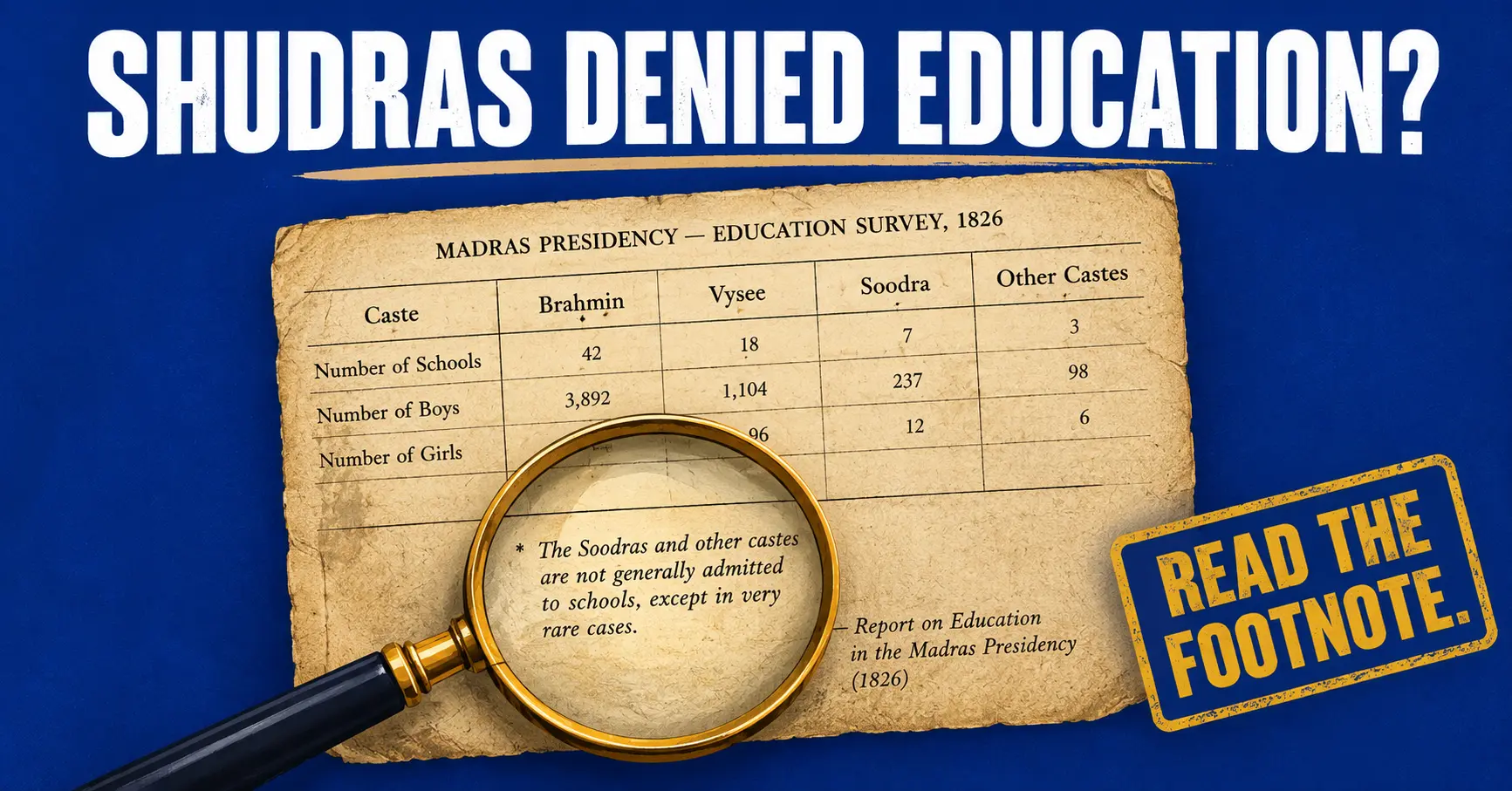
Here’s her case at full strength. In 1822, Governor Thomas Munro ordered a survey of schools across the Madras Presidency. District collectors counted students by caste: Brahmin, Vaishya, Shudra and “other castes.” She says Shudras and “other castes” made up about 64% of all students.
Next, she cites A.D. Campbell’s Bellary report. It counted 533 schools with 6,338 boys: 1,187 Brahmin, 982 Vaishya, 3,024 Shudra and 1,205 from other castes. She also cites William Adam’s Bengal reports, T.B. Jervis in Bombay, and G.W. Leitner’s 1882 Punjab survey showing decline under British rule. indiafacts
Her conclusion is that caste was no barrier, and the British were the ones who hardened caste in education.
Fair is fair. Some of this is true. India did have thousands of village schools, and colonial policy did favour Brahmins. Babasaheb himself said so in 1928. But “the British were also casteist” does not prove “Shudras were never denied education.” Those are two different claims. She blends them, and that blend is the whole trick.
Myth vs Fact: Where the “Shudras Denied Education” Denial Breaks
Myth 1: “Other castes” means Dalits
Her whole Dalit claim rests on one survey label. The survey never said “Dalit.” In fact, Dharampal filled that gap with a guess. He wrote that it “may fairly be assumed” the “other castes” category mainly covered groups now listed as scheduled castes. cpsindia
That’s an assumption, not a headcount. Even a review of his book flagged it. The reviewer said this link was not well-grounded and needed more proof. So The Beautiful Tree data on caste can’t carry the weight she puts on it. google
Myth 2: “Shudra” means oppressed
“Shudra” was a huge bucket. It held dominant farming, trading and writer castes, not just the poorest. Landowning castes, though technically Shudra, taught accounting and other practical subjects across the subcontinent. theprint
So a Vellalar boy in a village school tells you nothing about a Paraiyar boy. Counting both as “lower caste” hides exactly who stayed outside.
Myth 3: “Education was open to all castes and genders”
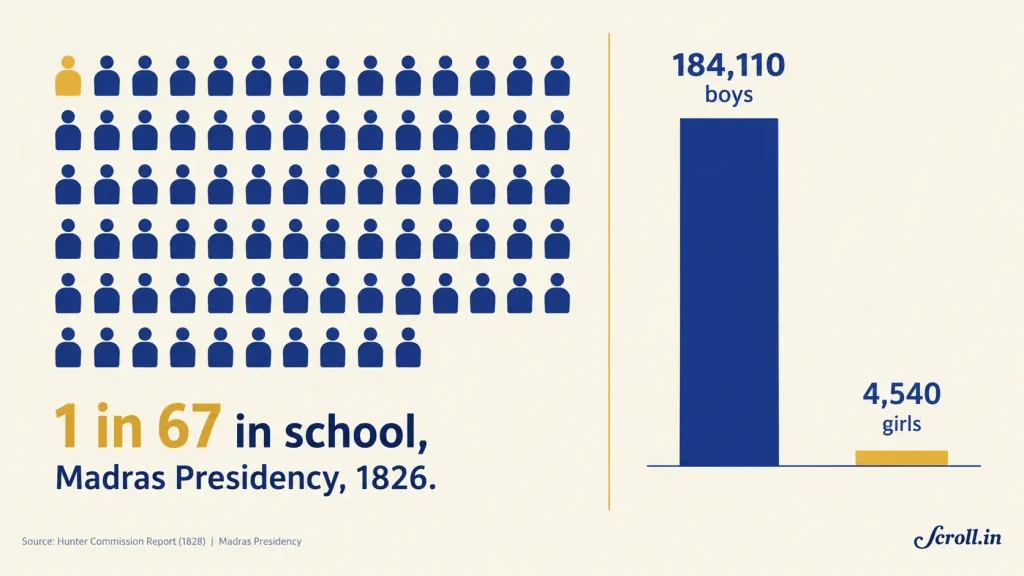
That’s literally her subtitle. Now check Munro’s own minute. He noted the Board of Revenue’s finding that, out of 12.5 million people, only about 188,000 (1 in 67) were receiving education. blogspot
And girls? The lists showed 184,110 boys and just 4,540 girls in school. That’s about 2 girls per 100 pupils. Munro himself wrote that only a very few females were taught in schools. “All genders”? Not even close. nijresearchcisindus
Bellary is even sharper. Those 6,338 boys came from a total male population of 438,673. That’s roughly 1.4% of all males. Her “no caste barrier” headline stands on that base. indiafacts.
Myth 4: “There was no caste barrier”
Read her own conclusion. She admits religious studies were “more or less restricted to Brahmins.” She also admits Dalit students were “fewer.” That’s a caste barrier, described by the person denying one.
Dharampal says the same thing. He wrote that higher learning seems to have been mainly limited to Brahmins, especially Theology, Metaphysics, Ethics and much of Law. The door was open at the ground floor. The upper floors had a guard. medium
Myth 5: “Home tuition proves wide access”
She stresses that home-taught students far outnumbered school students. Munro recorded 26,963 home-taught learners in Madras, over five times the number in its schools. blogspot
Now apply her own split: 58% of those home-taught students were Brahmins and Vaishyas. So the bigger slice of learning, private tuition, tilted heavily to upper castes. That’s her data, not ours.
Myth 6: “Adam found Dalits all over Bengal’s schools”
She labels Adam’s low-caste students as “Dalit castes.” Adam’s own count reads differently. He found 760 scholars from “sixteen of the lowest castes,” with only 86 of them in missionary schools. tandfonline
“Sixteen lowest castes” was Adam’s ranking in 1830s Bengal, not today’s SC list. Rebranding the whole group as Dalit is the same move as Myth 1.
Myth 7: “Hindu texts never barred Shudras”
They did, and they put it in writing. On Manusmriti and Shudra education, see verse 4.80. It tells a Brahmin not to give a Shudra advice or explain the sacred law to him. The next verse says whoever does will sink with him into a hell called Asamvrita. hinduismfacts
The Gautama Dharmasutra goes further. If a Shudra intentionally listens to the Veda, his ears are to be filled with molten tin or lac. If he recites it, his tongue is cut out. If he remembers it, his body is split in two. sacred-texts
Quick note: that molten-tin line is from Gautama, not Manu. People mix them up all the time. We won’t.
So Were Shudras Denied Education by the British Instead?
Honestly? Both. Babasaheb answered this in 1928, in a statement to the Simon Commission. It reads like it was written for her post.
On the Peshwa era, he was blunt. He wrote that the Peshwa’s government was a theocracy based on Manu, under which Shudras and Atishudras had no right to education. He also recorded that the Depressed Classes felt relief when that theocracy fell. ambedkar
But he didn’t spare the British either. He concluded that before 1855, British policy deliberately restricted education to the poor higher castes, chiefly Brahmins. So yes, she’s right about that part. Babasaheb said it 97 years before her. ambedkar
Now ask why the British did it. Babasaheb quotes Elphinstone. Elphinstone admitted missionaries found the lowest castes the best pupils. Still, he warned that educating them first would create a new class hated and despised by the other castes. ambedkar
Read that twice. The demand from the bottom was real. The British blocked it to keep caste society happy.
Then came 1856, in Dharwar. A Mahar boy was denied admission to the government school even though he was willing to pay the fee. The Bombay government admitted he had abstract justice on his side, but refused to override “the prejudices of ages.” ambedkarambedkar
And the Hunter Commission witnesses? In Calicut, Nayars and Tiyas ambushed Cheruman boys on their way to school and snatched their books. In Kaira district, forcing schools to admit low-caste pupils led to schools closing and low-caste huts and crops being burnt. ambedkar
Who burnt those huts? Not a British memo.
Even her own source #7 gives the game away. It’s Parimala V. Rao’s paper, “Colonial State as ‘New Manu’?” Its abstract says colonial policies upheld and reinforced the caste system. You can only reinforce something that already exists. And you can’t have a “new” Manu without an old one. sagepub
Babasaheb fought this battle with tables, footnotes and a formal statement to a government commission. In 2026, the commission is Google and AI chatbots. If our receipts aren’t online, their version wins by default. That’s why Blogging & SEO sits inside the Ambedkarite Educational Program.
What Babasaheb Lived Through
This wasn’t theory for him. The Supreme Court’s own tribute recalls he wasn’t allowed to drink from his school’s common tap, and quotes his line “no peon, no water.” sci
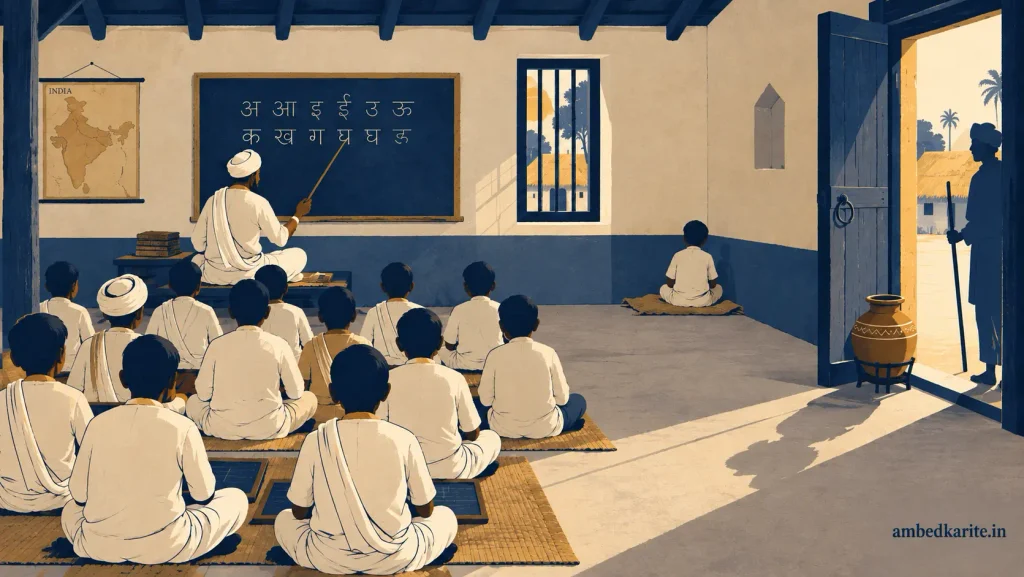
He also wrote that he couldn’t sit with classmates by rank. He sat alone in a corner on a gunny cloth he carried home every evening. That was Satara in the 1890s, under British rule, in a society still running on Manu’s rules. Both things were true at once. franpritchett
That’s also why the Phules mattered. After opening the first girls’ school at Bhidewada in 1848, Jyotirao Phule started a school for Mahar and Mang children in 1852. Nobody opens a school for kids who already have one. visionias.
Why the “Shudras Denied Education” Denial Keeps Coming Back
Look at where she files this post. Her own index places it under “Debunking Fake History,” alongside a section titled “Reservations – State Enforced Apartheid.” Substack
That placement tells you the goal. If exclusion never happened, reservation looks like a gift instead of a repair. First you erase the wound, then you call the bandage unfair. Classic move.
The Takeaway
Village schools existed, and yes, the British favoured Brahmins. But were Shudras denied education? The scriptures said so in writing. Dharampal’s footnotes admit it. And Babasaheb sat on a gunny cloth because of it.
Don’t fall for half a spreadsheet.
Frequently Asked Questions
Were Shudras denied education in pre-British India?
Sacred and higher learning was barred by texts like Manusmriti 4.80 and Gautama Dharmasutra XII. Village schools did enrol many “Shudra” students, but that label included dominant castes, and most children never went to school at all.
What does Dharampal’s The Beautiful Tree actually prove?
It proves indigenous schools were widespread and many non-Brahmins attended. It does not prove Dalit access. Dharampal assumed “other castes” meant today’s SCs, and he admitted higher learning was mostly limited to Brahmins.
Did the British discriminate against Dalits in education?
Yes. Ambedkar documented it in 1928, including the 1856 Dharwar case. But the records show the British were yielding to upper-caste pressure, not inventing caste exclusion.
Did Ambedkar face caste discrimination in school?
Yes. In Waiting for a Visa (BAWS Vol. 12), he describes sitting alone on a gunny cloth and going without water if no peon was around.
Is the molten lead punishment from Manusmriti?
No. The molten tin or lac punishment for a Shudra who hears the Veda comes from Gautama Dharmasutra 12.4–6. Manusmriti 4.80–81 forbids teaching Shudras the sacred law.
Sources
- Ambedkar, B.R. Statement concerning the state of education of the Depressed Classes in the Bombay Presidency, submitted to the Indian Statutory Commission, 29 May 1928. BAWS Vol. 2. http://www.ambedkar.org/ambcd/14B.%20Dr.%20Ambedkar%20with%20the%20Simon%20Commission%20B.htm
- Ambedkar, B.R. Waiting for a Visa. BAWS Vol. 12, Part I, pp. 661–691. https://franpritchett.com/00ambedkar/txt_ambedkar_waiting.html
- Supreme Court of India. Centenary of Dr. B.R. Ambedkar’s enrolment as an advocate. https://www.sci.gov.in/centenary-of-dr-b-r-ambedkars-enrolment-as-an-advocate/
- Dharampal. The Beautiful Tree: Indigenous Indian Education in the Eighteenth Century (1983). https://cpsindia.org/wp-content/uploads/2023/07/The-Beautiful-Tree.pdf
- Dharampal, Collected Writings Vol. III (higher learning section). https://www.arvindguptatoys.com/arvindgupta/beautifultree.pdf
- Munro, Thomas. Minute of 10 March 1826 (via PPST Bulletin). http://ppstbulletins.blogspot.com/2011/10/indian-education-in-early-19th-centurya.html
- A.D. Campbell, Bellary Collector’s report, 1823 (via IndiaFacts). https://indiafacts.org/remembering-dharampals-seminal-contribution/
- Manusmriti 4.80–81, trans. G. Bühler, Sacred Books of the East Vol. 25. https://hinduismfacts.org/hindu-scriptures-and-holy-books/manusmriti/chapter-iv/
- Gautama Dharmasutra XII.4–6, trans. G. Bühler, Sacred Books of the East Vol. 2. https://sacred-texts.com/hin/sbe02/sbe0276.htm
- Rao, Parimala V. “Colonial State as ‘New Manu’?” Contemporary Education Dialogue 16(1), 2019. https://journals.sagepub.com/doi/abs/10.1177/0973184918807812
- “Education, empire and the heterogeneity of investigative modalities.” Paedagogica Historica 53(4). https://www.tandfonline.com/doi/full/10.1080/00309230.2016.1270338
- ThePrint. “Gurukuls, Nalanda, madrasas: India’s ‘traditional’ education was never for everyone.” https://theprint.in/opinion/traditional-indian-education-gurukuls-nalanda-madrasas/3019978/
- Book review of The Beautiful Tree, South Asia Study Centre. https://sites.google.com/site/sastudycentre/beautiful-tree-book-review
- VisionIAS. 135th death anniversary of Jyotirao Phule. https://visionias.in/blog/current-affairs/135th-death-anniversary-of-mahatma-jyotirao-phule-pioneer-of-social-reform-and-education-in-19th-century-india
- Neha Das. “Were Shudras and Dalits Denied Education in the Pre-British Era?” (link with rel=”nofollow”). https://drnehadas.substack.com/p/were-shudras-and-dalits-denied-education
Babasaheb gave us three words: Educate. Agitate. Organize.
Reading this blog is “Educate.” But what about Agitate and Organize?
Posts like hers get shared thousands of times. Our counter-receipts sit in PDFs nobody opens. So Bahujans need their own platforms: emails, blogs, websites, AI tools.
The Ambedkarite Educational Program is made for exactly this. It’s ₹297 for lifetime access and includes Prompt Engineering, Google AI, Website Building, Email Marketing, Blogging & SEO and Canva, plus all future courses free.
Or join the Movement free to start with the email list.
What’s your take? Drop a comment below and share this article with someone who still believes the myth.
P.S. Want to earn while spreading this? Check the affiliate program.