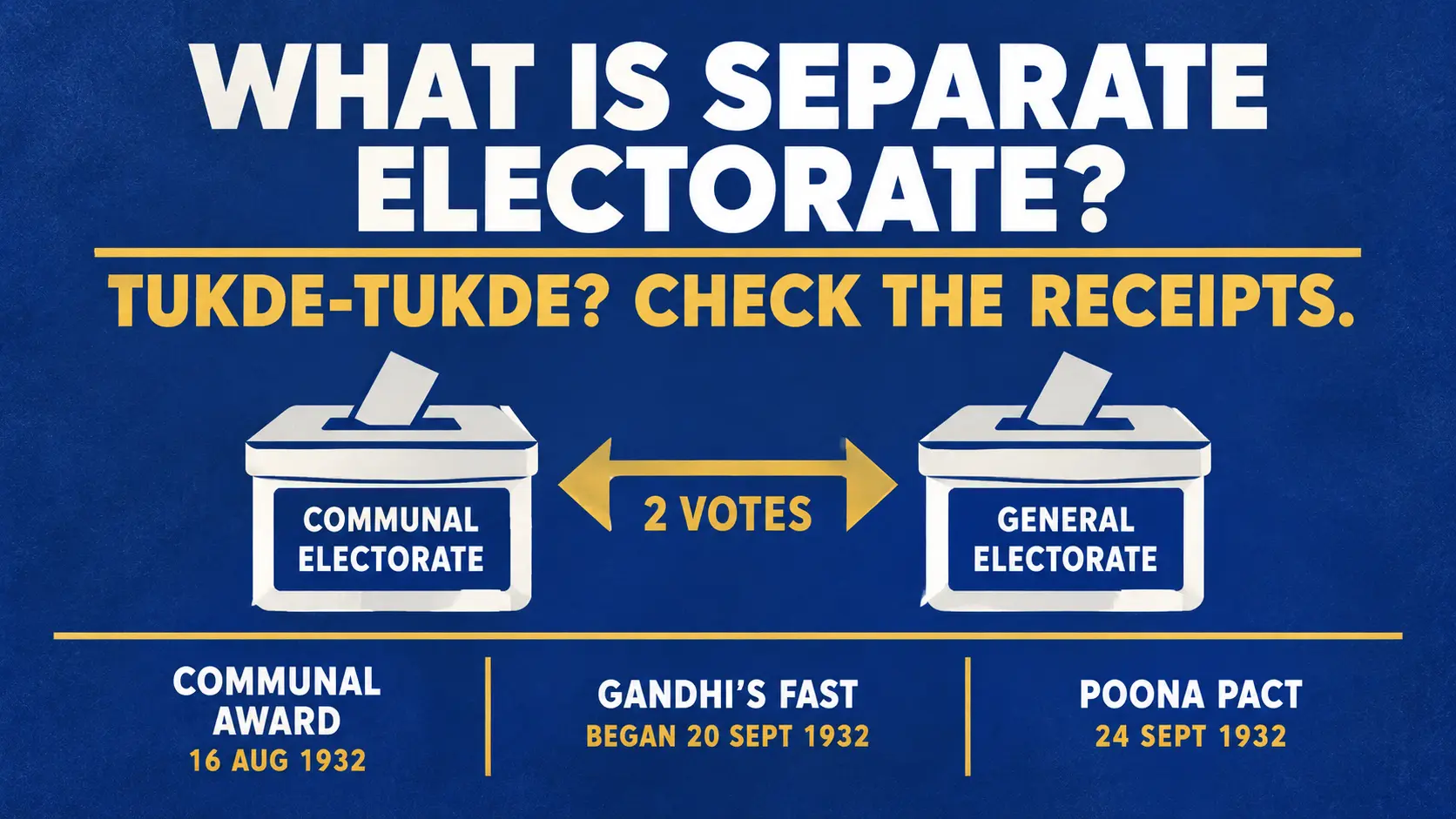
What is separate electorate, and why is it back on your feed? 👇 In April, Chandrashekhar Azad, MP from Nagina, asked the Lok Sabha for separate electorates for Dalits. Then a viral X post asked if it was a “tukde tukde” demand.
Here’s a fun fact that ruins that argument. The receipts sit in the Constituent Assembly Debates, free for anyone to read. Also, Ambedkar’s 1932 ask was about how Dalits elect their representatives, not about territory.
So let’s break it down: what is separate electorate, and what did Ambedkar actually ask for?
What Is Separate Electorate? A 30-Second Answer
In a separate electorate, only voters of one community vote for the seats kept for that community. In a joint electorate, everyone votes together. That’s the whole difference.
Here’s the catch: the British ran this system long before Dalits asked for it. The Indian Councils Act of 1909 gave it to Muslims only. Then the 1919 Act extended it to Sikhs, Christians and Anglo-Indians. Finally, the Communal Award of 1932 added the Depressed Classes, the term used for Dalits back then.
So the rulebook was colonial. Ambedkar wanted Dalits to get what other groups already had.
The Claim: Separate Electorates Mean “Tukde-Tukde”
Now that you know what is separate electorate, here is the strongest case against it. Fair hearing first, then the facts.
First, the British used separate electorates to split Indians. Critics say the 1932 Award repeated that trick on Dalits.
Second, Gandhi feared it would cut Hindu society into two blocs. He announced a fast unto death on 20 September 1932 to stop it.
Third, Partition happened. After that, the Constituent Assembly ended separate electorates for every community. On 28 August 1947, H.J. Khandekar, himself a Dalit member, called a related proposal a step toward “Pakistan within India”.
Finally, there is the 2026 version. Critics ask why a demand for separate electorates in Parliament draws so little outrage.
That is the best form of the argument. Now the receipts.
The Communal Award 1932: A Double Vote, Not a Wall
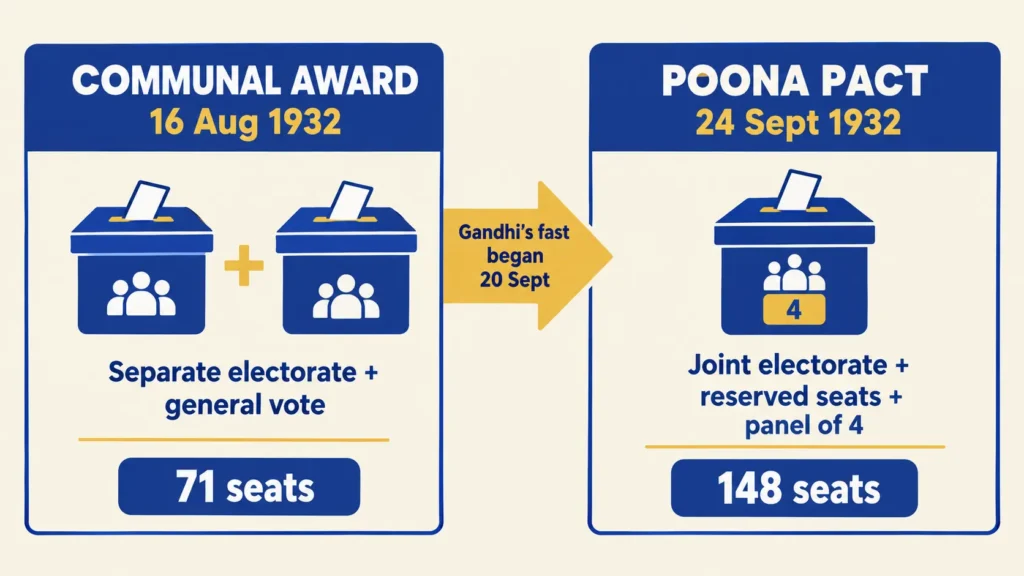
On 16 August 1932, Prime Minister Ramsay MacDonald announced the Communal Award. The Round Table Conferences had failed to settle representation, so he decided it himself. The Award gave the Depressed Classes 71 special seats in provincial legislatures. Separate electorates would run for 20 years.
Here’s the part the tukde-tukde posts skip. The Award gave Dalits a double vote. One vote went to the separate electorate. The other went to the general electorate, alongside everyone else.
Ambedkar called that second vote a political weapon beyond reckoning. So what is separate electorate in practice? Dalit voters pick their own candidates, and still have a say in every other seat.
Why Ambedkar wanted it
Ambedkar feared a plain joint electorate. In that setup, a Dalit candidate would depend on caste-Hindu majorities to win. That’s why he wanted seats that Dalit voters controlled.
The Muslim and Sikh comparison
In 1932, Ambedkar asked a sharp question. If separate electorates had not splintered the nation for Muslims and Sikhs, why fear them for Dalits?
Partition came later, and critics say that settled it. The Assembly’s fix was to end the system for every group in 1947. Fair enough. But look at what Ambedkar asked for in 1932: a voting method, not a border.
What the Poona Pact 1932 Actually Changed
Gandhi began his fast against the Award on 20 September 1932. Then Ambedkar negotiated with him and other Hindu leaders at Yerwada jail. On 24 September 1932, Ambedkar and Gandhi signed the Poona Pact. He later complained the deal was forced.
The Pact dropped the separate electorate. Reserved seats inside a joint electorate replaced it. In return, provincial seats for the Depressed Classes rose to 148, against 71 in the Award. They also got 18% of general seats in the central legislature.
The voting changed too. Dalit voters first picked a panel of four candidates among themselves. Then the general electorate chose one. This primary system ran for ten years unless both sides ended it earlier.
The referendum nobody mentions
Ambedkar had asked for more. He wanted Dalit voters to hold a referendum later and choose between separate and joint electorates. Gandhi agreed to a referendum but wanted it after five years. Ambedkar pushed for ten.
C. Rajagopalachari broke the deadlock. Reserved seats would continue until both communities agreed otherwise. So what is separate electorate, if Dalit voters can choose it or drop it themselves? A choice Ambedkar wanted in their hands. The man now called tukde-tukde wanted Dalit voters to have the final say.
Ambedkar Separate Electorate: What the Record Shows After 1932
Ambedkar did not go quiet after the Pact. In 1945, his book What Congress and Gandhi Have Done to the Untouchables argued that Congress had hollowed out the deal. Then, in 1947, a memorandum to the Constituent Assembly argued for ending the joint system for Dalits.
So no, he did not quietly agree. He made his case in the open, inside the Assembly.
The Assembly heard him. In July 1947, the Minorities sub-committee voted 26 to 3 against separate electorates. It kept reserved seats in joint electorates, first for ten years. Ambedkar sat on that sub-committee.
The 28 August 1947 debate
That day, S. Nagappa moved a middle path. A Scheduled Caste candidate would need a minimum share of Scheduled Caste votes, such as 35 per cent, to win a reserved seat. In the same speech, Nagappa said he wanted joint electorates and knew the evils of separate ones.
Khandekar still called it separate electorates in disguise. He also said Ambedkar’s name topped the amendment. So the tukde label got tried in 1947, inside the Assembly. The reply came through debate, and the Assembly kept the committee’s joint-electorate scheme.
The 1949 fight to keep reserved seats
Later, some members floated ending reserved seats for Scheduled Castes too. In Raja Sekhar Vundru’s account, as cited by Anurag Bhaskar, Ambedkar decided to walk out, and Sardar Patel’s committee reconsidered. On 25 May 1949, the Assembly dropped reserved seats for other minorities but kept them for Scheduled Castes. Then, on 23 August 1949, Ambedkar moved the motion that became Article 330.
Today’s Constitution runs on joint electorates with reserved seats under Articles 330 and 332. Ambedkar chaired the Drafting Committee of that Constitution. So the man labelled tukde-tukde led the drafting of a joint-electorate Constitution.
Why the “Tukde” Label Keeps Coming Back
Here’s the thing: a real debate sits under this one. Reserved-seat MPs depend on party tickets. Kanshi Ram made that case in Chamcha Yug, and Azad cited it in his April speech. Scholars such as Christophe Jaffrelot and Raja Sekhar Vundru argue that parties can co-opt Dalits through reserved tickets.
You can agree or disagree. Either way, it is an argument about representation, and shouting tukde-tukde skips it. Ask the people using the label what is separate electorate, and most can’t answer. Classic move: name the fear, skip the facts.
Babasaheb started his own newspaper, Mooknayak, on 31 January 1920. Today, feeds decide who gets heard. The fix isn’t crying. It’s owning a blog, a website and an email list. (That’s exactly what AEP trains Ambedkarites for.)
The Takeaway
📌 So, what is separate electorate? A colonial voting rule that Ambedkar wanted for Dalits, with a double vote attached. His 1932 ask was a voting method, and the Assembly ended the system for every group in 1947. Ambedkar’s Constitution runs on joint electorates with reserved seats. Whether the 2026 demand is wise is a fair debate. The “tukde” label is not a fact.
Babasaheb gave us three words: Educate. Agitate. Organize.
Reading this article is “Educate.” But what about Agitate and Organize?
Today, X bans accounts. Reels get shadow-banned. WhatsApp groups get reported. So Bahujans need their own platforms: emails, blogs, websites, AI tools.
The Ambedkarite Educational Program is made for exactly this. ₹297 lifetime, includes Prompt Engineering, Google AI, Website Building, Email Marketing, Blogging & SEO, Canva, plus all future courses free.
Or join the Movement free and start with the email list.
P.S. Want to earn by sharing facts? Try the affiliate program.
Frequently Asked Questions
What is separate electorate?
It is a system where only voters of one community elect the representatives for seats kept for that community. In a joint electorate, all voters choose together. The British introduced it for Muslims in 1909.
Did Ambedkar want separate electorates?
Yes. He demanded them for Dalits, and the 1932 Communal Award granted them with a double vote. He argued for changing the joint system as late as 1947, but the Assembly chose joint electorates.
Why did Ambedkar sign the Poona Pact?
Gandhi began a fast against the separate electorate on 20 September 1932. Ambedkar negotiated and signed on 24 September 1932. The Pact raised reserved seats but dropped the separate electorate.
How many seats did the Poona Pact give?
It gave 148 reserved seats in provincial legislatures, against 71 in the Communal Award. It also set 18% of general seats in the central legislature.
Are separate electorates allowed in India today?
No. The Constituent Assembly ended them for all communities in 1947–49. Scheduled Castes and Scheduled Tribes now have reserved seats in joint electorates under Articles 330 and 332.
Sources
- Constituent Assembly Debates, 28 Aug 1947: https://indiankanoon.org/doc/297715/
- Advisory Committee report on minority rights: https://www.constitutionofindia.net/committee-report/report-of-the-advisory-committee-on-the-subject-of-minority-rights/
- Poona Pact 1932 (CLPR archive): https://www.constitutionofindia.net/historical-constitution/poona-pact-1932-b-r-ambedkar-and-m-k-gandhi/
- “Why did B.R. Ambedkar Accept the Poona Pact?” (CLPR): https://www.constitutionofindia.net/blog/why-did-b-r-ambedkar-accept-the-poona-pact/
- Anurag Bhaskar, “Whether Ambedkar Wanted Reservation for Only Ten Years?” (SSRN): https://papers.ssrn.com/sol3/papers.cfm?abstract_id=3970168
- Poona Pact and Dalit representation, International Journal of Asian Studies (Cambridge): https://www.cambridge.org/core/journals/international-journal-of-asian-studies/article/poona-pact-indian-national-congress-and-the-descriptive-and-substantive-representation-of-dalits-in-colonial-india/C0A2334CEAF6C10CEDE652CA240663E3
- BAWS Vol. 9 (book description, PARI): https://ruralindiaonline.org/en/library/resource/dr-babasaheb-ambedkar-vol-9-gandhi-congress-and-the-untouchables/
- The Tribune, “The Poona Pact”: https://www.tribuneindia.com/news/exam-mentor/the-poona-pact
- Model Diplomat, Poona Pact 1932: https://modeldiplomat.com/learn/glossary/poona-pact-1932
- Encyclopaedia Britannica, Poona Pact: https://britannica.com/EBchecked/topic/469892/Poona-Pact
- The Wire, journalistic legacy of Ambedkar: https://m.thewire.in/article/caste/the-journalistic-legacy-of-b-r-ambedkar-the-editor
- OpIndia, 22 Sept 2026 (cited for the claim being made, not for facts): https://www.opindia.com/2026/09/why-chandrashekhar-azad-chose-sep-24-for-reservation-protest-the-poona-pact-ambedkars-separate-electorate-demand-delhi-police-permission-row/
- Constitution of India, Arts. 330, 332: https://www.constitutionofindia.net/read/
What’s your take? Drop a comment below and share this article with someone who still believes the myth.