Does untouchability still Exist?
While surveys and reports show untouchability is still present in some form in India, the evidence is scant and the major national survey is over 10 years old. This guide will explore what the data and documented examples show and what they don’t show, and it will discuss the legal framework. This guide will benefit those with little to no knowledge of untouchability and will not include graphic detail.
What does untouchability mean?
Untouchability in this context refers to the social discrimination of Dalits (previously “untouchables”) and other members of the lower castes based on the rigid, hierarchical caste structure in India. It can also refer to the practice of separating different castes in daily life, including the use of separate public utilities and the assignment of unclean tasks. Untouchability is legally banned in India. This guide explains what Article 17 says. Our other guides describing the caste system, Dalits and casteism cover the terminology in more detail.
Is untouchability still present?
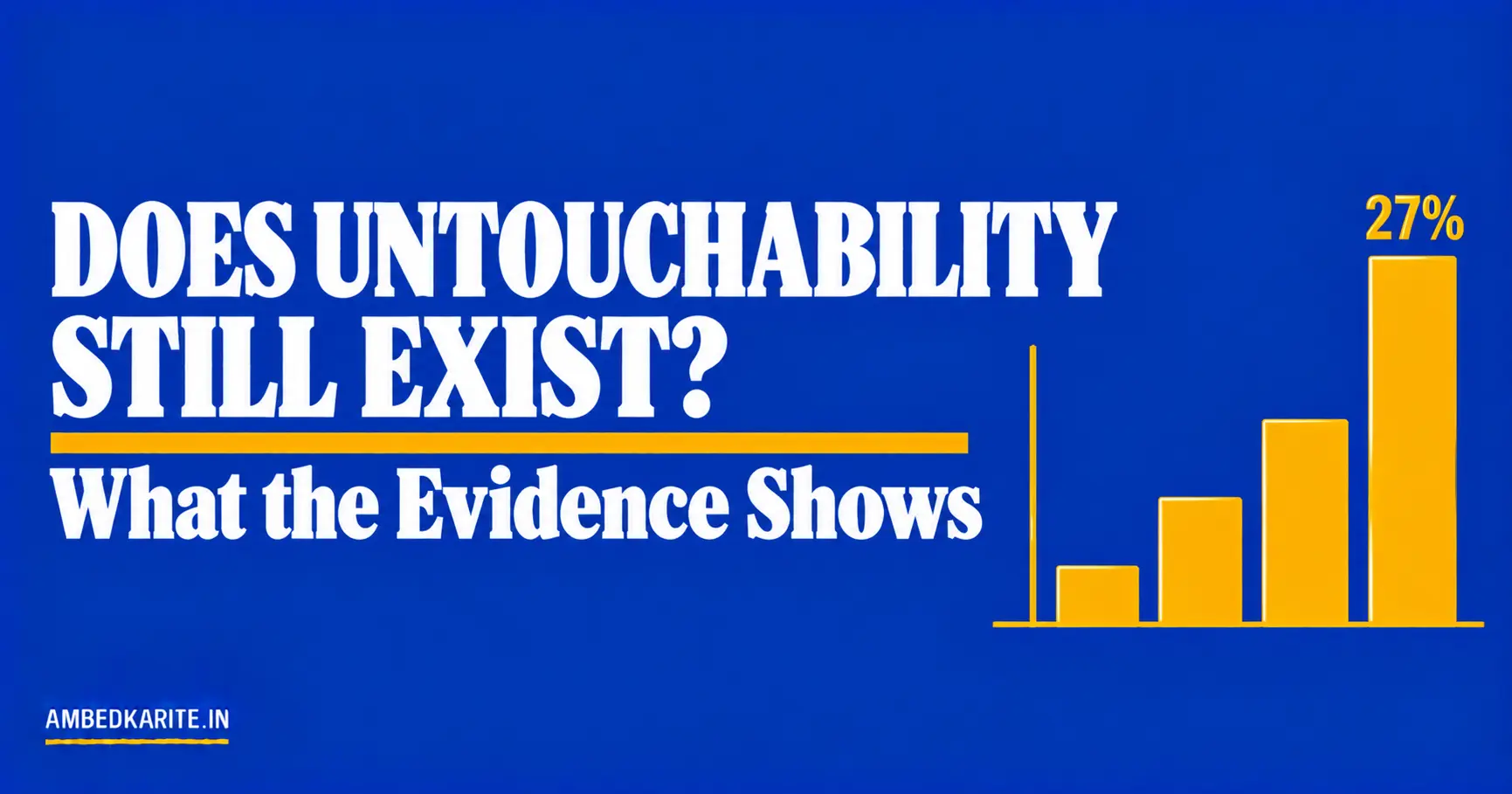
The best national-level data comes from the India Human Development Survey (IHDS), second round (2011-2012). It is the first and only large-scale survey in India that includes questions on untouchability (Untouchability in India: Subaltern Questions, citing Thorat and Joshi). Based on IHDS, Amit Thorat and Omkar Joshi found that 27% of the sampled households confirmed the presence of untouchability (Thorat and Joshi, Economic and Political Weekly, 2020).
The paper provides the following patterns:
- Place: about 30 per cent of rural households and about 20 per cent of urban households reported it (Thorat and Joshi, PAA paper, 2015).
- Group: 52 per cent of Brahmin households, 33 per cent of OBC households and 24 per cent of non-Brahmin forward-caste households reported it (Thorat and Joshi, PAA paper). The authors reported Brahmin households were 6.5 times more likely than Scheduled Castes households to report it (PAA paper).
- What reduces it: Households with wider social networks outside their own community were less likely to report it (Thorat and Joshi, EPW).
According to the survey, a small percentage of people marry across castes. Only 5 per cent of people in India reported an inter-caste marriage (International Dalit Solidarity Network, on IHDS).
Untouchability in India today: what crime data shows
Indian police data shows a different case. In 2023, the National Crime Records Bureau of India documented 57,789 cases of atrocities against Scheduled Castes, and 12,960 cases against Scheduled Tribes (Deccan Herald, on NCRB Crime in India 2023). These data are on crimes reported, and not all crimes involving untouchability. They show that people continue to report cases of atrocities against members of Scheduled Castes and Scheduled Tribes, as described in our atrocity prevention act. These cases, however, cannot tell us about the level of untouchability occurring in the absence of a reported crime.
Examples of modern untouchability from research
There are practices documented by researchers and the media. These practices aren’t representative or show how prevalent they are.
Separate cups at tea stalls. Human Rights Watch documented the use of separate tea tumblers for Dalits at neighborhood tea stalls and a ban on Dalits drawing water from some public sources (Human Rights Watch, Broken People, 1999). Magazine reporting on a survey of 565 villages describes the two tumbler system as a practice that is still prevalent (The Law Institute, summarizing a survey of 565 villages in 11 states).
School meals. Human Rights Watch reports that in the government mid-day meal program, Dalits were repeatedly denied by dominant-caste parents and children to be cooked by Dalit cooks (Human Rights Watch, Hidden Apartheid, 2007). In Yadgir, Karnataka, a school meal program was affected when a cook and his assistant, who were not willing to wash the plates used by Dalit children, stopped the meal program (The Week, April 2025).
Temples. The Week (2025) reports Dalit families were denied entry to a temple during the Maha Shivratri festival.
Water. As reported by The Week (2025), residents of the Anandapura slum in Bengaluru were denied piped water by the water board, and residents installed a pump to get water from a temple’s water supply.
These practices are mostly journalistic and old. See the log for more details. One form of exploitation, which research links to caste, is covered in our guide to bonded labour.
Changes and unknowns
Article 17 and the laws that amended it outlawed untouchability and made it a punishable offense. Beyond this, we cannot tell if untouchability is increasing or decreasing in the country, as the IHDS-II is the only major survey that included this question (ResearchGate, citing Thorat and Joshi). There is no earlier round to compare it to.
There are limitations to the data. It relies on self-reported information from households, and therefore the actual situation could be even worse (ResearchGate, citing Thorat and Joshi). The authors also point out that the scale of untouchability is largely unreported, particularly in rural areas, and that crimes of untouchability are highly underreported (ResearchGate, citing Thorat and Joshi; International Dalit Solidarity Network). Furthermore, data is from 2011-2012.
The law and legal framework
Article 17 of the Constitution of India outlaws untouchability and prohibits its practice in any form. The Protection of Civil Rights Act, 1955 and The Scheduled Castes and The Scheduled Tribes (Prevention of Atrocities) Act, 1989 implement it. According to the 2011 Census of India, the scheduled castes constituted about 16.6% of the total population of India. Our article on the case system of India explains how the castes are ranked, and our article on scheduled tribes and Adivasis explains the other components of the legal framework.
Why it matters in the West
This question allows us to address why conversations around caste occur within diaspora communities. Our articles on caste in America and caste in Silicon Valley detail studies and cases from around the world. (For individuals and organizations documenting their first-hand experiences, knowledge of blogging, artificial intelligence (AI) and email marketing have become essential. The Ambedkarite Educational Program was created to teach exactly these skills.)
Takeaway
Does untouchability exist? Evidence suggests it does. In the 2011-12 national survey, 27 percent of households said they practice it, more in rural compared to urban areas. Police reported thousands of crimes against Scheduled Castes and Scheduled Tribes in 2023. Separate school meals, cups and school water dispensers, and access to temples and water are some of the reported cases of untouchability. While Article 17 of the Constitution of India declares untouchability unlawful, the data is old, self-reported, and no other survey has been done to gauge untouchability, so we cannot say if it is on the rise or fall.
Frequently Asked Questions
Does untouchability still exist in India?
Yes. In the 2011–12 India Human Development Survey, 27 per cent of households said they practise it in some form. Reports document specific practices, though it is illegal under Article 17.
What is untouchability?
It is the practice of treating some communities as “polluting” because of caste and keeping them apart, for example in water access, seating and temples. India’s Constitution abolished it in 1950.
How common is untouchability today?
The only national survey is from 2011–12, and it found 27 per cent of households, about 30 per cent in rural areas and 20 per cent in urban areas. There is no newer national figure.
Is untouchability illegal in India?
Yes. Article 17 of the Constitution abolishes it, and the Protection of Civil Rights Act 1955 and the Atrocities Act 1989 provide penalties.
Can untouchability be measured?
Only partly. Surveys rely on what households admit, and crime data counts registered cases, so both are likely to understate the problem. No earlier national survey asked the same questions.
Understanding caste is step one. Building digital independence is step two.
Ambedkarite communities around the world are using AI tools, blogging and email marketing to document their experiences, challenge discrimination and build platforms that cannot be silenced.
The Ambedkarite Educational Program teaches exactly these skills: AI tools, website building, email marketing, blogging and Google AI. Lifetime access is ₹297 (~$4 USD). All future courses are included free.
Or join the Movement free to start learning today.
SOURCES
- Economic and Political Weekly, Amit Thorat and Omkar Joshi, “The Continuing Practice of Untouchability in India: Patterns and Mitigating Influences,” January 11, 2020
- Population Association of America, Thorat and Joshi, 2015 paper
- ResearchGate, “Untouchability in India: Subaltern Questions”
- The Week, “Lives, buried: Untouchability persists in India,” April 2025
- Human Rights Watch, Broken People: Caste Violence Against India’s “Untouchables,” 1999
- Human Rights Watch, Hidden Apartheid, 2007
- The Law Institute, “The Enduring Struggle Against Untouchability and Social Exclusion in India,” November 2025
- Deccan Herald, on NCRB Crime in India 2023
- International Dalit Solidarity Network, on IHDS findings
- Constitution of India, Article 17 (link: legislative.gov.in)
- Census of India, 2011 (link: censusindia.gov.in)