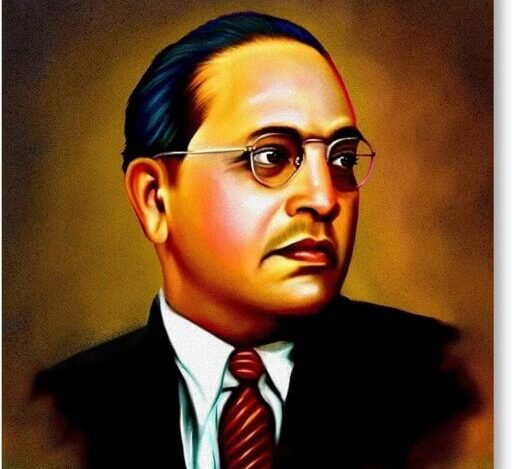
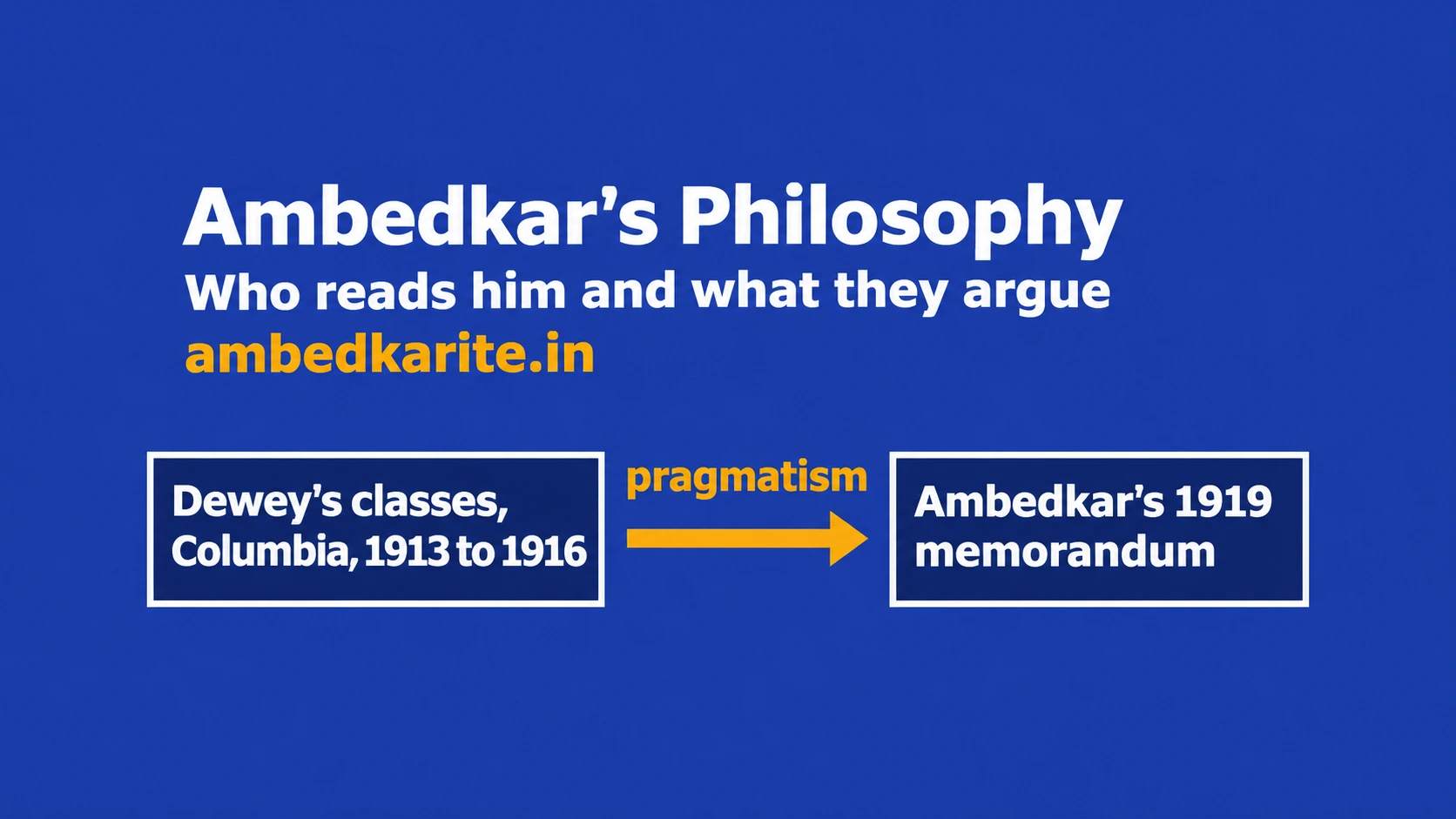
Ambedkar philosophy is now read by scholars of pragmatism and political theory, though no source counts how many Western philosophers do so (Prakash, 2024). Scholars in political philosophy and pragmatism have taken interest in some aspects of Ambedkar’s thought. The exact number of Western philosophers who have done this is unknown (Prakash, 2024). As Prakash (2024) notes, the editors of the 2014 English edition of the Annihilation of Caste saw renewed interest in Ambedkar as a political philosopher. Prior to this, some had recognized him as a major thinker, especially during the 1990s’ anti-caste movement (Prakash, 2024). Stroud (2023) has also argued that elements of Dewey’s philosophy influenced Ambedkar’s thinking to an extent that he should be considered a Navayana pragmatist. B.R. Ambedkar (1891-1956), a Dalit philosopher from India, participated in drafting India’s constitution and was the first Chairman of the Drafting Committee (Prakash, 2024). To the best of our knowledge this is the only work available that provides an English language synthesis of some of Ambedkar’s ideas within the framework of the Western philosophy tradition. It was written on November 28, 2026.
Ambedkar philosophy: who is reading it
Pragmatism is a philosophy that tests ideas by their practical results, and John Dewey was one of its main American thinkers (University of Chicago Press, 2023).
Prakash (2024) mentions some reasons that explain the new found interest in Ambedkar in political philosophy. Prior to 2014, as he rightly points out, most philosophers saw Ambedkar as a social and political thinker but not as a major figure of political thought.
Outside of pragmatism, Western philosophers may gain interest in other facets of Ambedkar’s theory in the future.
Ambedkar pragmatism: what Dewey taught him
A key influence on Ambedkar during his time at Columbia was John Dewey. Prakash (2024) notes that ideas and constructs in Ambedkar’s 1919 memorandum to the Southborough Committee can be related to Dewey’s Democracy and Education.
According to Prakash (2024), Dewey believed that individuals were drawn together by common ideas and beliefs through open communications. Ambedkar, however, believed that individuals associated with each other on the basis of class in Indian society. Ambedkar was hoping to meet Dewey to discuss these ideas during his trip to the U.S. in 1952 to receive an honorary degree from Columbia. Sadly, Dewey died two days before Ambedkar’s arrival.
Stroud’s book: the main study
Scott R. Stroud’s The Evolution of Pragmatism in India: Ambedkar and Dewey was published on January 30, 2023 by the University of Chicago Press. In this work Stroud explores Ambedkar’s ideas during his studies with Dewey from 1913 to 1916 and his later writings on the teachings of Buddha.
Prakash (2024) calls Stroud a philosopher and praised this book. Other endorsements for this book come from the Philosophy in Review and the Journal of Buddhist Philosophy. Apart from this book Stroud has also written articles on Dewey and his ideas on India in The Pluralist and on Navayana pragmatism in the Journal of Speculative Philosophy.
Stroud is presently a professor of communication at the University of Texas at Austin.
A book review, a publisher’s blurb and the book itself each say something slightly different, and a reader can mix them up. Keeping a short table of who said what, and where, is the kind of source discipline covered in the blogging lessons of the Ambedkarite Educational Program.
Navayana pragmatism
Stroud refers to Ambedkar’s version of Dewey’s philosophy as ‘Navayana pragmatism’ after the name Ambedkar gave to his branch of Buddhism, ‘Navayana’ (Prakash, 2024). Stroud also notes some aspects of Ambedkar’s thought which differ from Dewey’s (University of Chicago Press, 2023).
In this article I focus on the years leading to Ambedkar’s conversion to Buddhism in 1956 (Prakash, 2024). ‘Navayana pragmatism’ has been used to define an idea to frame Ambedkar’s association with Dewey. I did not come across any literary work which takes this to the level of a philosophical framework.
Ambedkar’s commitment to democracy
Rathore in ‘Ambedkar’s Preamble’ (2020) claims Ambedkar was the first to incorporate the ideals of liberty, equality and fraternity in the preamble to the Indian constitution (Prakash, 2024). I did not read this book.
Democracy as conceptualised by Ambedkar is less about elections and other institutional mechanisms of representation, and more about the unfettered ability of individuals to come together and form groups of their choice (Prakash, 2024). Guru and Sarukkai’s The Cracked Mirror (Oxford University Press, 2012) is one of the few philosophical works cited by Prakash (2024).
Measure of success
Statistics showing the number of university level courses, books and articles written on Ambedkar’s philosophy in various years do not exist (Prakash, 2024). Therefore it would be premature to state with certainty that interest in Ambedkar’s thoughts in the Western world is on the rise (Prakash, 2024).
This article was also unable to find any comparisons between Ambedkar and John Rawls.
Ambedkar philosophy: what each source shows
| Source | What it claims | What it cannot show |
|---|---|---|
| Prakash, NYRB (2024) | Ambedkar’s rediscovery as a political philosopher led to the 2014 edition; few recognized him as a major thinker before the 1990s; Dewey’s influence shows in the 1919 memorandum | A count of philosophy scholarship: it is a historian’s account |
| Stroud, The Evolution of Pragmatism in India (2023) | Traces Ambedkar’s Columbia years to the 1950s; names “Navayana pragmatism”; notes where Ambedkar pushed back against Dewey | That philosophers broadly accept the term |
| Rathore, Ambedkar’s Preamble (2020) | Suggests Ambedkar inserted justice, liberty, equality and fraternity in the preamble | Proof: Prakash reports it as a suggestion; this article did not read the book |
| Stroud’s journal articles (2023, 2024) | Navayana pragmatism in the Journal of Speculative Philosophy; Dewey and India in The Pluralist | Reach or citation counts |
| Counts of philosophy papers or courses | None found | Not applicable |
| A comparison of Ambedkar and Rawls | None found | Not applicable |
Sources: Prakash, 2024; University of Chicago Press, 2023; OUCI, 2024; Academia.edu, 2023. These are the scholars’ own claims as summarized by the sources.
Takeaway on Ambedkar philosophy
Philosophy of Ambedkar is being increasingly read and acknowledged by pragmatists and political theorists, states Prakash, with no supporting evidence (2024). Navayana Pragmatism, as argued by Stroud, is another variation from Dewey, which he published in 2023 (University of Chicago Press, 2023). Among other things, Stroud’s work extensively analyzes Ambedkar’s criticism of Gandhi. The constituent elements of Ambedkar’s political philosophy along with some ambiguous remarks concerning the Preamble to the Indian Constitution have been analyzed by Rathore (2024). Users are advised to assess these views independently.
Certain figures in political theory and pragmatism have been identified by Gyan Prakash but none of them has published on the subject (Prakash, 2024).
Readers who want to learn to read scholarship closely and write clear, sourced explainers can start with the Ambedkarite Educational Program, a lifetime-access course at ₹297 (about $4 USD) that covers blogging, website building, email marketing, AI tools and Google AI, with all future courses included. The free Movement page is another place to begin.
This article draws on Gyan Prakash’s 2024 review in The New York Review of Books (read in full), the University of Chicago Press’s listing for Stroud’s 2023 book, and listings of Stroud’s journal articles. I did not read Stroud’s or Rathore’s books, and I found no count of philosophy scholarship on Ambedkar and no source for a Rawls comparison. Each scholar’s claim is attributed to the scholar.
Last updated: November 28, 2026
Frequently Asked Questions
What is Pragmatism in the case of Ambedkar?
Ambedkar was exposed to the ideas of John Dewey during his studies at Columbia between 1913 and 1916. He later adapted these ideas for the Indian context (University of Chicago Press, 2023; Prakash, 2024).
Who is Scott Stroud?
Stroud is an associate professor of communication at the University of Texas at Austin and the author of The Evolution of Pragmatism in India (University of Chicago Press, 2023).
What are the main elements of Ambedkar’s political thoughts?
Prakash, writes that for Ambedkar, democracy should enable free and equal people to join together to achieve their goals and shape their future (Prakash, 2024).
What do you understand by Navayana pragmatism?
This is Stroud’s term to define Ambedkar’s adaptation of Dewey’s ideas to initiate and propagate a new school of Buddhism that he called ‘Navayana’ (Prakash, 2024).
Sources
- Prakash: A “Life of Contradictions,” The New York Review of Books, June 20, 2024
- University of Chicago Press: The Evolution of Pragmatism in India: Ambedkar, Dewey, and the Rhetoric of Reconstruction, 2023 (publisher text on a retailer listing)
- OUCI: John Dewey and India: Expanding the John Dewey-Bhimrao Ambedkar Story, The Pluralist, 2024
- Academia.edu: Justice, Democracy, and Liberation: Ambedkar’s Navayana Pragmatism and the Tortuous Path of Social Democracy, Journal of Speculative Philosophy, 2023