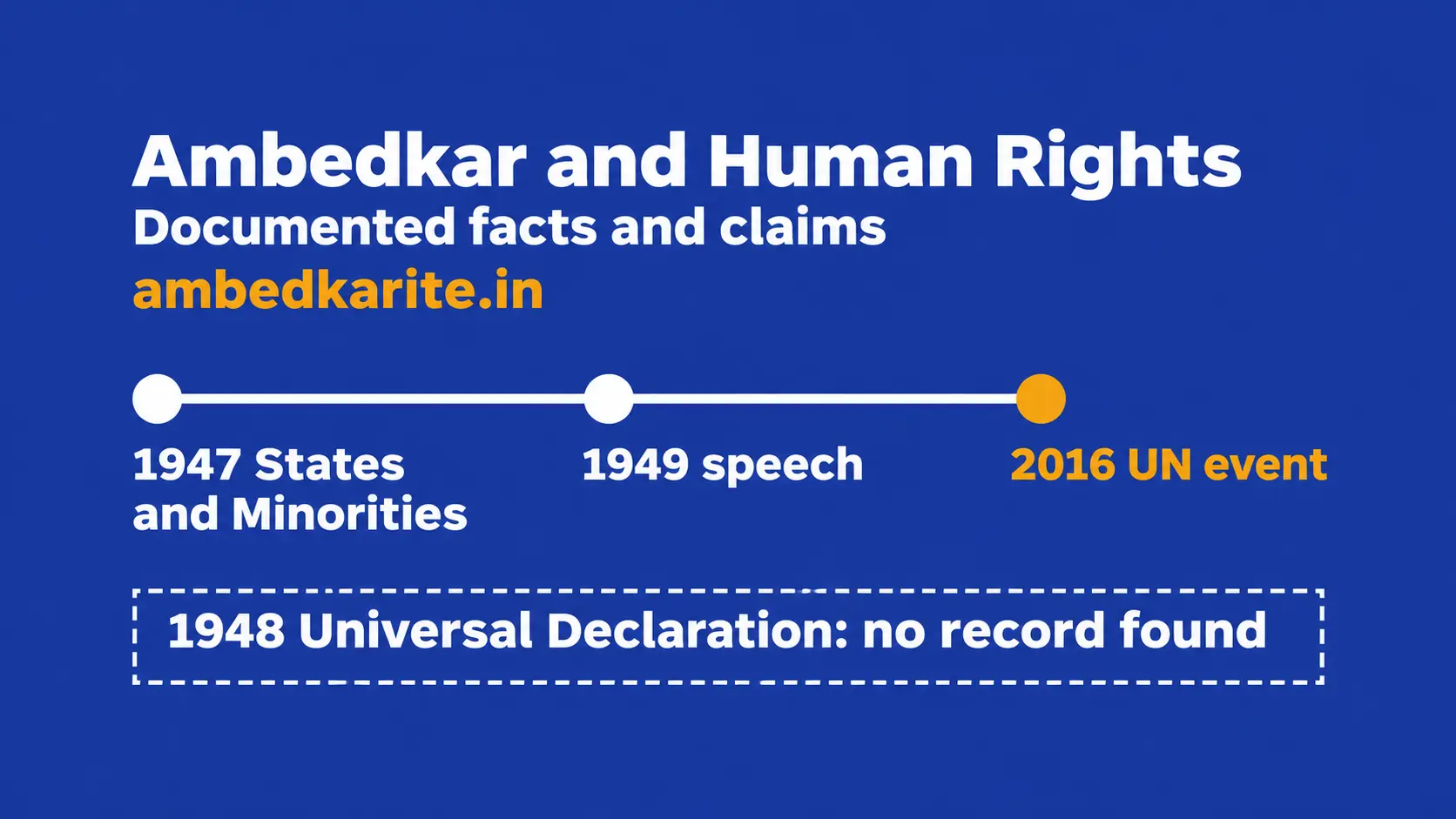
This guide separates the documented elements from the speculative elements in the ‘Ambedkar human rights’ claim. No evidence has been found to show that Ambedkar participated in the drafting of the Universal Declaration of Human Rights (UN General Assembly 1948). An event held by the United Nations in April 2016 to commemorate Ambedkar’s 125th birth anniversary was held at the UN Headquarters in New York (IDSN 2016). In 1947 Ambedkar suggested certain amendments to the provisions of the Constitution to safeguard the interests of the ‘States’ and the ‘Minorities’ (Constitution of India 2024). Some authors have referred to Ambedkar as a human rights theorist (Man in India 2024). Ambedkar was born in 1891 and died in 1956. He came from the ‘untouchables’ stratum of the society. This guide was written on the 28th of November 2026 and hence represents the state of the information available to the public at that time.
Ambedkar human rights: documented and claimed
The Constituent Assembly was the body that drafted India’s constitution between 1946 and 1950, and Ambedkar chaired its Drafting Committee (Constitution of India, 2024).
Regarding the human rights provisions in the Constitution, see our guides on Article 17 and on the proceedings of the Constituent Assembly.
Ambedkar UDHR: what no source shows
No sources show that Ambedkar had any role in the development of the Universal Declaration of Human Rights (UN General Assembly, 1948).
According to a journal article to be published in 2024, Ambedkar’s views on Fundamental Rights and Directive Principles of State Policy predated the Universal Declaration of Human Rights and supported them (Man in India, 2024). However, showing similarity does not mean influence.
Ambedkar UN event: April 13, 2016
In 2016, on the 125th birth anniversary of Ambedkar, the Indian Mission to the United Nations organized an event at the United Nations headquarters. The keynote address was delivered by then Administrator of the United Nations Development Programme, Helen Clark (IDSN, 2016). Some of the other speakers at this event credited Ambedkar with drafting the 2015 Sustainable Development Goals (IDSN, 2016). No United Nations resolution has been enacted to declare April 14 as International Equality Day (American Bazaar, 2016).
A commemoration is easy to mistake for a decision, so it helps to quote each source for what it actually says. Practicing that habit, and presenting a documented fact and a claim side by side, is part of the blogging lessons in the Ambedkarite Educational Program.
Ambedkar fundamental rights: States and Minorities
Ambedkar also wrote a work called ‘States and Minorities’ submitted to the Sub-Committee on Fundamental Rights in 1947 (Constitution of India, 2024). It contains suggestions on provisions of a ‘mini’ constitution with respect to the fundamental rights of citizens of India.
Section II supports economic democracy and state socialism. The date for the presentation of this section varies from February 27 to March 24, 1947. On November 25, 1949, Ambedkar stated that for true democracy to be achieved it is essential to also implement social and economic reforms to provide equality and fraternity to all citizens (Constitution of India, 2024).
According to an Article 17 Project essay, the most critical challenge during the drafting of the article was the one related to untouchability (Article 17 Project, 2025).
Views of Ambedkar as a human rights theorist: scholarly appreciation
One of the articles of 2024 states that the concepts of human rights enshrined in the Constitution of India are almost synonymous to the ones stated in the Universal Declaration of Human Rights (Man in India, 2024). The third world organizations including the UN, Human Rights Watch and Amnesty International have also endorsed Ambedkar’s views by recognizing caste inequality as human rights violation (Shikshan Sanshodhan, 2025).
There are several other articles and books which support Ambedkar’s views on human rights and dignity. Our study guides on the Annihilation of Caste provide analysis of this aspect of Ambedkar’s thought.
Ambedkar human rights: what each source shows
| Claim or document | Status | Basis | What it cannot show |
|---|---|---|---|
| States and Minorities (1947) | Documented | Memorandum to the Sub-Committee on Fundamental Rights; Article II on fundamental rights and remedies; state socialism and economic democracy | That the Constituent Assembly adopted its text (the Article 17 Project says it was a challenge to the draft) |
| Speech of November 25, 1949 | Documented | Constitution of India project: political democracy needs social democracy; liberty, equality and fraternity | Influence beyond India |
| The 2016 event at UN headquarters | Documented as a commemoration | IDSN: hosted by India’s Permanent Mission; keynote by Helen Clark; some speakers linked him to the 2015 agenda | A UN decision or text citing him; the “International Equality Day” plea was not granted, as far as found |
| Role in drafting the Universal Declaration (1948) | No source found | This article’s search | Not applicable |
| “Aligns with” the Universal Declaration | Claimed | Journal and review papers (2024, 2025) | Causal influence: alignment is not influence |
| “Human rights thinker” | Claimed (a label) | Man in India (2024) | A measure of influence |
Sources: Constitution of India project, 2024; Article 17 Project, 2025; IDSN, 2016; American Bazaar, 2016; Man in India, 2024; Shikshan Sanshodhan, 2025; UN General Assembly, 1948. This is general information, not legal advice.
Takeaway on Ambedkar and human rights
Ambedkar’s contribution to human rights is indicated in the 1947 Memorandum, the Constitution and the 2016 commemoration held by the United Nations (Constitution of India, 2024; IDSN, 2016). His contribution to the Universal Declaration of Human Rights (UDHR) remains uncertain (UN General Assembly, 1948). In 2016, the United Nations acknowledged Ambedkar as one of the architects of the Universal Declaration of Human Rights (IDSN, 2016). A study on the influence of Ambedkar’s ideas on human rights is yet to be undertaken (Man in India, 2024). Users of this research should critically assess the views expressed in each of the publications included herein.
Readers who want to learn to separate documented facts from claims and write clear, sourced explainers can start with the Ambedkarite Educational Program, a lifetime-access course at ₹297 (about $4 USD) that covers blogging, website building, email marketing, AI tools and Google AI, with all future courses included. The free Movement page is another place to begin.
This article draws on the Constitution of India project’s pages on Ambedkar and on States and Minorities, an Article 17 Project essay, the International Dalit Solidarity Network’s report of the 2016 UN event, a 2016 news report, and two journal and review papers. I did not read the full memorandum or find the UN’s own page for the event, and I found no record of any role in drafting the Universal Declaration. Each source’s claim is attributed to it.
Last updated: November 28, 2026
Frequently Asked Questions
Did Ambedkar put forward any ideas on fundamental rights in his writings on the State and on Minorities?
Yes. In particular, Ambedkar favored state socialism and economic democracy (Constitution of India, 2024).
His major contributions are in constitutional law. Evidence of wider influence is found in memorials and analytical works (Constitution of India, 2024; IDSN, 2016; Man in India, 2024).
Did Ambedkar take any active part in drafting the Universal Declaration of Human Rights?
This author has been unable to confirm this (UN General Assembly, 1948).
What was the nature of the 2016 UN event dedicated to Ambedkar?
This was a function organized by the Permanent Mission of India to the UN, to celebrate the 125th anniversary of his birth, with an address by Helen Clark (IDSN, 2016).
What were Ambedkar’s views on human rights?
He has propounded a theory of State socialism and economic democracy and suggested, among others, that governments should take measures to safeguard the fundamental rights of citizens (Constitution of India, 2024).
Would Ambedkar rightly deserve to be called a human rights philosopher?
This article has taken the view to consider him as such (Man in India, 2024).
Sources
- IDSN: Highlights, Dr. Ambedkar 125th Anniversary Celebrations, International Dalit Solidarity Network, 2016
- American Bazaar: Make Ambedkar Jayanti “World Equality Day”: Plea at the United Nations, April 14, 2016
- Constitution of India: States and Minorities (B.R. Ambedkar, 1947), Constitution of India project
- Constitution of India: B.R. Ambedkar, contribution to constitution making
- Article 17 Project: Article 17 in the Constituent Assembly: Part 1, January 26, 2025
- Man in India: Babasaheb Dr. B.R. Ambedkar’s Human Rights Movement, 2024
- Shikshan Sanshodhan: Dr. Bhimrao Ramji Ambedkar: A Review of His Struggle Against Caste Injustice and Legacy, 2025
- UN General Assembly: Universal Declaration of Human Rights, 1948