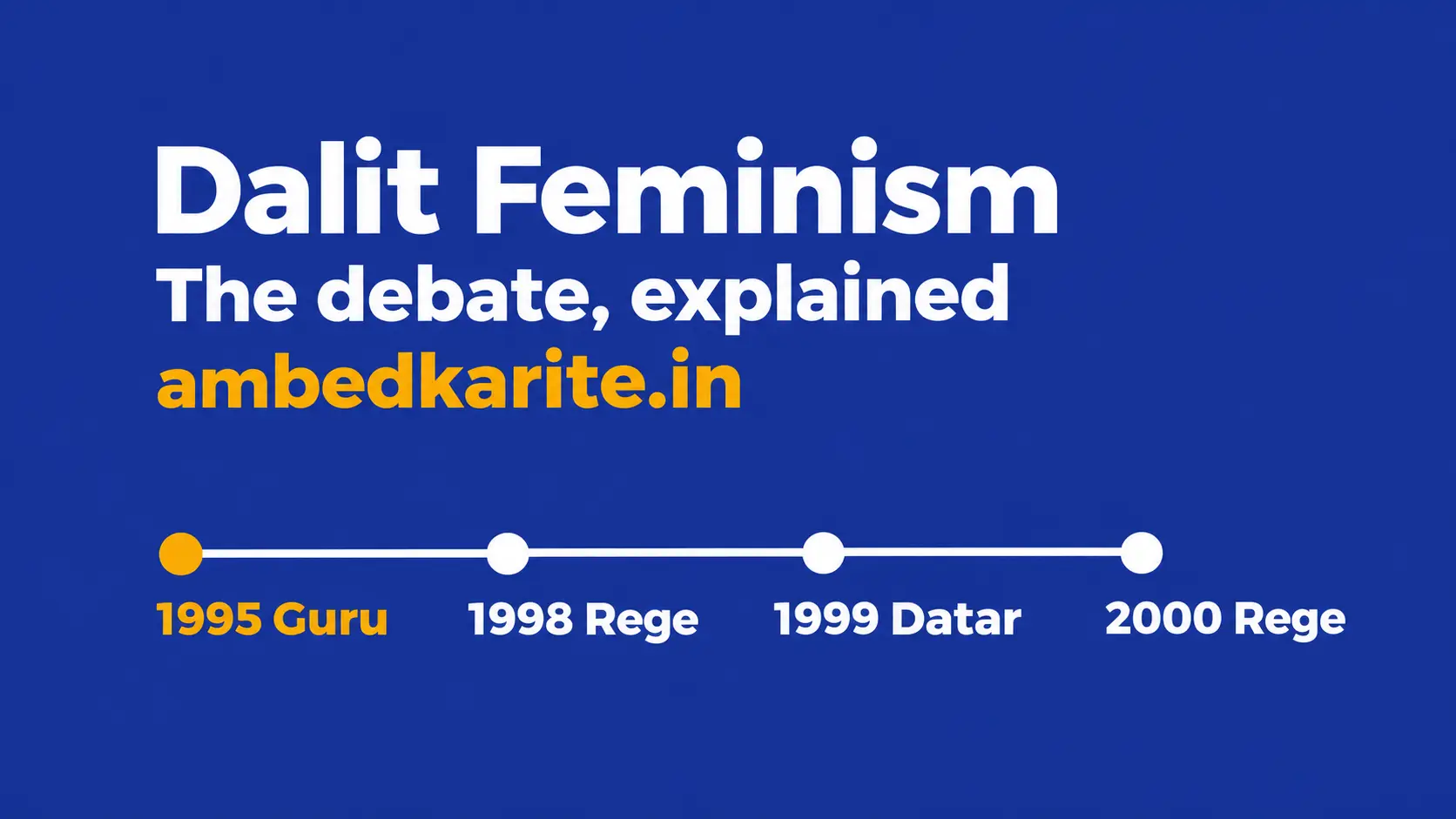
Dalit feminism emerged from early-1990s debates over how caste and gender oppression relate (EPW Engage, 2017). Beginning in the early 1990s, some Dalit women began establishing independent, autonomous organizations to highlight the issues unique to their condition as Dalit women. Debates surrounding these developments appeared in the Economic and Political Weekly (EPW) from 1992 onwards. Sharmila Rege’s 1998 article in EPW introduces the concept of Dalit feminism and provides an analysis of upper-caste feminism with regard to its treatment of Dalit women (EPW Engage, 2017). Gopal Guru in the same issue of EPW also wrote an article to support Rege’s argument (EPW Engage, 2017). Chhaya Datar’s article ‘On the Doublebind’ published in 1989 in EPW, anticipated several of the themes expressed in the articles referred to above (EPW Engage, 2017). For additional information on Dalit women and women of the Dalit community see our other guides.
Dalit feminism: what it is
The Economic and Political Weekly is an Indian journal of social science, and its archive holds the debate’s main articles (EPW Engage, 2017).
Guru’s article ‘Dalit Women Talk Differently’ (1995)
Gopal Guru wrote this article to examine the reasons for the differences between Dalit women and other women as well as between Dalit women and Dalit men (EPW Engage, 2017). He touches upon differences in their modes of oppression and the forms that resistance take.
The article was initially published in the Economic and Political Weekly from October 14- 21, 1995.
Rege sees that members of the upper castes tend to essentialize the experiences of Dalit women, arguing that only Dalit women are able to accurately express the issues faced by other Dalit women.
Rege’s essay (1998)
According to Sharmila Rege’s essay published in 1998 in the Economic and Political Weekly, upper caste feminists’ theoretical frame to incorporate Dalit women’s experiences has historically been inadequate (Economic and Political Weekly, 2017).
Rege draws from Ambedkar’s writings to show Dalit women have mainly been relegated to the margins of the social movements spearheaded to fight for their rights and interests.
Rege contends that since Dalit women have experienced ‘double oppression’ of both caste and gender, only Dalit women have the capacity to properly speak for Dalit women’s interests.
Journal debates like this one are hard to follow from titles alone, and a clear timeline helps readers see who answered whom. Building a simple timeline page for a research topic is part of the website building lessons of the Ambedkarite Educational Program.
Dalit Feminism
Guru critiqued both patriarchal tendencies within Dalit movements as well as the lack of focus on caste in feminist discourse (Contemporary Literary Review India, 2025).
Rege compiled Ambedkar’s writings on women and Brahmanism in her book, ‘Against the Madness of Manu’ (Feminism in India, 2023).
Dalit feminism adopts some aspects of Western feminism, particularly intersectionality to explain the various layers of oppression experienced by Dalit women (Arya and Rathore, 2020). Teaching resources state that Rege compared the role of the Dalit woman to that of the Black woman within the scope of Western feminism (IGNOU, 2022).
Guru, Rege and Crenshaw are cited in Arya and Rathore’s edited volume on Dalit feminist theory. The authors of these cited works do not particularly take issue with western feminism. Indian feminism is their main focus of criticism.
Where scholars have taken issue with each other’s work
Chhaya Datar wrote in 1999 that eco-feminism has the potential to offer an improved theory of liberation in comparison to Dalit feminism (Economic and Political Weekly, 2017). Responding to Datar’s criticism, in 2000, Rajula Parimala Rege wrote that the politically grounded standpoint theory of feminism is most appropriate to bring about the liberation of Dalit women (2017).
It is predicted that in 2026 a scholarly article will be published that recommends giving more recognition to Dalit women intellectuals and scholars (Kumar, 2026).
Dalit feminism: the debate at a glance
| Year | Author and work | Argument (as summarized) | Responded to |
|---|---|---|---|
| 1995 | Gopal Guru, “Dalit Women Talk Differently” | Dalit women’s experience differs from that of other women and of Dalit men; social location shapes perception, so non-Dalit women’s representation is less valid | Autonomous Dalit women’s organizing; the middle-class women’s movement |
| 1998 | Sharmila Rege, “Dalit Women Talk Differently: A Critique of ‘Difference’ and Towards a Dalit Feminist Standpoint Position” | “Difference” is inadequate for theorising caste and gender; makes the case for a Dalit feminist standpoint | Guru, and the limited position given to Dalit women in movements in Maharashtra |
| 1999 | Chhaya Datar, “Non-Brahmin Renderings of Feminism in Maharashtra” | Challenges the standpoint as a “superior” liberatory view; raises eco-feminism | Rege (1998) |
| 2000 | Sharmila Rege, “‘Real Feminism’ and Dalit Women” | Defends Dalit standpoint theory and feminist politics | Datar (1999) |
| 2006 | Sharmila Rege, Writing Caste, Writing Gender | Criticizes savarna feminism for addressing Dalit women without centering their voices | Mainstream feminism |
| 2020 | Arya and Rathore, Dalit Feminist Theory: A Reader | Collects Guru, Rege and Crenshaw, among others | The debate |
| 2026 | Akanksha Kumar, “Dalit Women as Knowledge Producers” | Argues for recognizing Dalit women as producers of knowledge | The debate |
Sources: EPW Engage, 2017; Rege, 2018; IJSSR, 2025; Arya and Rathore, 2020; Kumar, 2026. These are the scholars’ own positions as summarized by the sources.
Takeaway on Dalit feminism
What has to be emphasized here is that unlike Savarna feminism, Dalit feminism does not give primacy to praxis over theory. Therefore, arguments leveled against Dalit feminism by critics should be seen more as theories to be improved upon rather than completely rejected (Contemporary Literary Review India, 2025). Dalit women’s experiences of oppression differ from one another, therefore they will express their experiences of oppression in varying ways (International Journal of Social Science Research, 2025). Given that Dalit women’s experiences differ from both other women’s and from men’s, it can therefore be said that Dalit feminist theory is Intersectional (Arya and Rathore, 2020).
Readers should interpret theories of Dalit feminism as they see fit.
Readers who want to learn to read academic debates closely and write clear, sourced explainers can start with the Ambedkarite Educational Program, a lifetime-access course at ₹297 (about $4 USD) that covers blogging, website building, email marketing, AI tools and Google AI, with all future courses included. The free Movement page is another place to begin.
This article draws on the Economic and Political Weekly’s 2017 discussion page (summaries of the four main articles), course materials and journal articles on Dalit feminist thought, a 2020 reader and a 2026 article’s abstract. I did not read the four foundational articles in full, and I found no Dalit feminist source framing the debate as against “Western feminism” as such. Each scholar’s position is attributed to the scholar.
Last updated: November 28, 2026
Most Frequently Asked Questions
What is Dalit feminism?
This began with debates in the 1990s on the intersections of gender and caste. It was initiated by Dalit women activists and scholars including Gopal Guru and Sharmila Rege.
What do you mean by ‘savarna feminism’?
Rege uses this term to refer to the upper caste feminist movement in India which fails to include and give voice to Dalit women.
What is the Dalit feminist standpoint?
This is the viewpoint of Rege who says, in order to comprehensively examine and analyze the condition of Dalit women, feminist theories which are grounded in ‘difference’ should not be applied (EPW Engage 2017; IJSSR 2025).
What did Gopal Guru mean by ‘Dalit women talk differently’?
Guru claims Dalit women have a completely distinct set of experiences from women of other classes and castes, as do Dalit men.
How is Dalit feminism different from other feminist movements?
Ideas expressed in Dalit feminism are based on intersectionality which was first proposed by Kimberlé Crenshaw in 1989. Dalit feminists are largely critical of Indian upper caste feminists (Arya and Rathore, 2020).
Sources
- EPW Engage: The Dalit Feminist Standpoint: Revisiting a Debate on Feminism and Intersectionality, 2017
- Contemporary Literary Review India: Dalit feminist criticism, 2025
- Feminism in India: Book Review: Against the Madness of Manu, 2023
- Arya and Rathore: Dalit Feminist Theory: A Reader, 2020
- IGNOU: Poetry from the Margins, Unit 3: Jyoti Lanjewar, course material, 2022
- Kumar: Dalit Women as Knowledge Producers, 2026
- International Journal of Social Science Research: IJSSR, 2025