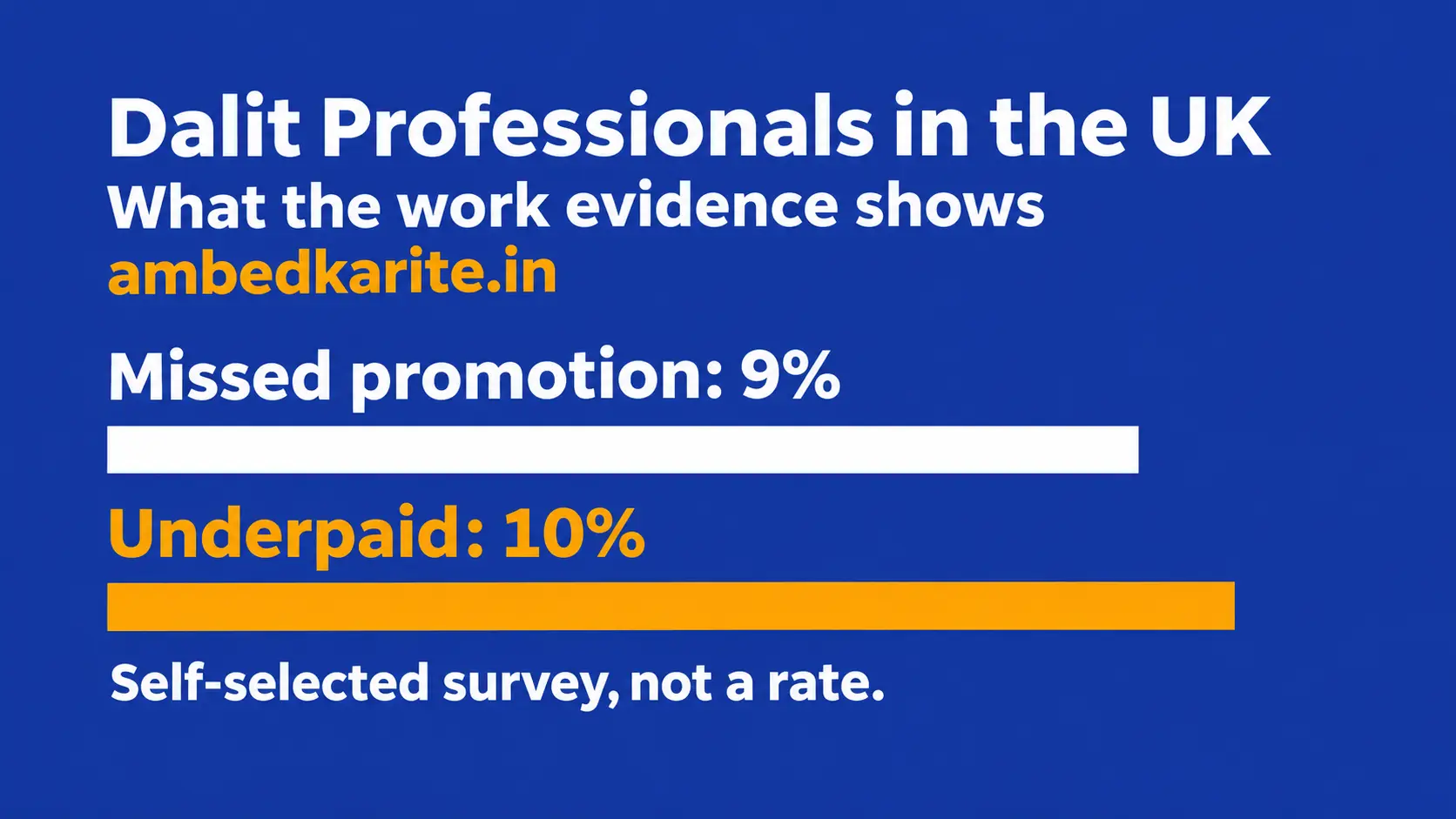
Dalit professionals UK evidence is thin: no study measures professionals as a group, and the main surveys are self-selected (NIESR, 2010). There is very little evidence on Dalit professionals in the UK. The main surveys have been self conducted (NIESR, 2010). In 2009, 9% of respondents to the ACDA survey stated they had been denied promotion at work due to their Dalit status and 10% stated they had been paid less compared to their colleagues at work (ACDA, 2009). The Dalit Solidarity UK (2006) report on caste surveyed 130 participants of the Dalit community. NIESR (2010) surveyed 29 participants in the UK through various campaign and religious activities to increase awareness of caste discrimination. While there are no legal duties on UK employers to address caste discrimination (Hansard, 2025), the Equality Act 2010 creates a duty on public authorities to protect people from caste discrimination. On 28 November 2026, this information will still represent the current position of the law.
Dalit professionals UK: what the evidence is
The Equality and Human Rights Commission is Britain’s equality regulator, and it published two research reports on caste in 2014 (EHRC, 2014).
Caste promotion UK: what the 2009 survey found
From employment, 9% of participants in this survey indicated they had not received a promotion and 10% had not been paid fairly due to their caste (ACDA 2009). Negative treatment by colleagues was reported by 45% of the participants, and 25% of the participants stated they had not been included in groups or networks at work (ACDA 2009).
ACDA is a campaign group (NIESR 2010) and therefore the views expressed in the survey do not reflect the situation of all Dalits working in the UK.
No Escape caste report: the 2006 survey
The first comprehensive report on caste discrimination published in the UK was ‘No Escape’ published in 2006 by the Dalit Solidarity Network UK (DSN UK 2006). From September 2005 to January 2006, 130 people associated with or representing Dalits completed a survey prepared by the DSN UK. Additional information was obtained from 22 individuals through in-depth interviews (Waughray 2009).
Of these two individuals, one stated that the discrimination at work took the form of refusal to promote him (Waughray 2009).
The 2006 and 2009 reports ran to many pages, and their key figures are easy to misquote. Practicing how to check a figure against its source, and how to present it with its sample size, is part of the blogging lessons in the Ambedkarite Educational Program.
Dalit employees UK: what NIESR found at work
In the workplace, NIESR (2010) found that participants who had experienced caste discrimination had also been the victim of bullying and harassment. Other examples include situations in which certain tasks were allocated to participants based on their caste. Participants also reported that they had not been promoted or recruited to higher positions within the organization. The 32 interviews formed the basis of this report. Of these interviews, 29 were undertaken by representatives of various campaign groups and 3 were carried out by the researchers on the street amongst the 78 participants approached for the study.
According to the report (NIESR, 2010) evidence from a single case study is not sufficient to prove discrimination based on caste. The report speculated on caste discrimination based on accounts of colleagues enquiring about the individuals’ caste, caste related jokes and the individual’s inability to secure a permanent position. In each of these examples, NIESR (2010) stated it was difficult to determine the rationale for the treatment meted out to the individuals concerned.
Employer’s legal obligation
Since 2013, the Equality Act has required the Secretary of State to add ‘caste’ to the protected characteristics in relation to race (Hansard, 2015). To date no order has been made.
In the absence of case law to provide guidance, in Chandhok v Tirkey we explain what is required of employers, employees and trade unions to demonstrate discrimination on grounds of caste.
The situation with professionals
No case studies of Dalit professionals have been undertaken to date and there are no known statistics concerning the earnings or employment progression of professionals from this group.
According to the ACDA they have settled a number of Employment Tribunal claims on behalf of Dalit professionals (Global Ambedkarites, 2025), however no judgments have been made public.
Diverging opinions were expressed by participants in the EHRC’s (EHRC, 2014) consultation process. Dalit community representatives described widespread discrimination faced by them. Representatives of the Hindu community denied such discrimination existed. No published evidence was provided to support claims of Dalits gaining access to professional employment.
Dalit professionals UK: what each source shows
| Source | Sample and method | What it reports on work | What it cannot show |
|---|---|---|---|
| No Escape (DSN UK, 2006) | Questionnaire of 130 Dalit individuals and organizations, plus 22 key interviews | Two employment case studies; discrimination at work described as discreet | A rate: it is not representative |
| Hidden Apartheid (ACDA, 2009) | Online questionnaire and focus groups; 71% of responses from Dalit respondents | 9% said they missed promotion; 10% underpaid; 45% negative treatment or comments; 25% excluded from networks | A rate for Dalit workers: the sample is self-selected |
| NIESR report (2010) | 32 interviews; 29 through campaign and religious groups | Bullying, recruitment, promotion, task allocation and dismissal examples | Proof: impossible from one account; extent: no representative survey |
| EHRC reports 91 and 92 (2014) | Socio-legal review; experts’ seminar and stakeholders’ workshop | Views diverged: Dalit groups cited widespread discrimination; Hindu representatives largely denied it | Measured prevalence |
| Surveys of professionals | None found | Not applicable | Not applicable |
| Tribunal decisions involving a professional on caste grounds | None found; ACDA says some cases settled | Not applicable | Not applicable |
Sources: Dalit Solidarity Network UK, 2006; Waughray, 2009; ACDA, 2009; NIESR, 2010; EHRC, 2014; Global Ambedkarites, 2025. This is general information, not legal advice.
Takeaway on Dalit Professionals in the UK
There are three qualitative studies on Dalit professionals in the UK from 2010, 2009 and 2006 (NIESR, 2010; ACDA, 2009). None of these studies defined ‘professionals’. According to the 2009 survey, 9% of participants believed they did not receive promotion and 10% believed they were underpaid (ACDA, 2009). In 2005 and 2006, 130 participants took part in the No Escape Caste Report survey. The 2010 NIESR study reported one participant experienced bullying and exclusion at work (NIESR, 2010). Employers in the UK have no legal obligation to amend their practices to eliminate caste discrimination.
Readers should interpret the findings of each study according to their own context.
Readers who want to learn to read survey reports closely and write clear, sourced explainers can start with the Ambedkarite Educational Program, a lifetime-access course at ₹297 (about $4 USD) that covers blogging, website building, email marketing, AI tools and Google AI, with all future courses included. The free Movement page is another place to begin.
This article draws on the Anti Caste Discrimination Alliance’s 2009 survey (through its published executive summary), a legal scholar’s account of the 2006 Dalit Solidarity Network UK report, NIESR’s 2010 study, summaries of the EHRC’s 2014 research reports and Hansard. I found no survey of Dalit professionals, no pay or promotion data by caste and no published tribunal decision involving a professional. Each source’s claims are attributed to it.
Last updated: November 28, 2026
Frequently Asked Questions
What did the 2009 survey say about caste promotion in the UK?
According to the ACDA survey, 9% of respondents had not been promoted and 10% had not been fairly compensated because of their caste (ACDA, 2009).
What is the No Escape Caste Report?
This was a questionnaire completed by 130 Dalit individuals and organizations published by the Dalit Solidarity Network UK in July 2006 (Dalit Solidarity Network UK, 2006).
What have NIESR’s studies uncovered regarding Dalits in the UK?
32 individuals were interviewed to ascertain experiences of caste discrimination at work. Evidence pointed to victims of caste discrimination being harassed and bullied, being denied promotion and training and being assigned inferior tasks (NIESR, 2010).
How should UK employers address Caste Discrimination?
Employers should abide by the regulations which prohibit race discrimination until such time that caste is separately identified in the UK’s equality legislation (Hansard, 2025). In the interim, to ensure they do not unlawfully discriminate against their employees on the basis of caste, employers should take legal advice.
Sources
- NIESR: Caste discrimination and harassment in Great Britain, Hilary Metcalf and Heather Rolfe, December 2010
- ACDA: Hidden Apartheid: Caste and Caste Discrimination in the UK, executive summary, November 2009
- Dalit Solidarity Network UK: No Escape: Caste Discrimination in the UK, July 2006
- Waughray: Caste Discrimination: A Twenty-First Century Challenge for UK Discrimination Law?, 2009
- EHRC: Caste in Britain: Experts’ Seminar and Stakeholders’ Workshop, Research Report 92, 2014
- Hansard: Westminster Hall, Equality Act 2010: Impact on British Society, September 10, 2025
- Global Ambedkarites: UK Lawmakers and Indian MP Unite in Call to Outlaw Caste Discrimination in Britain, September 2025