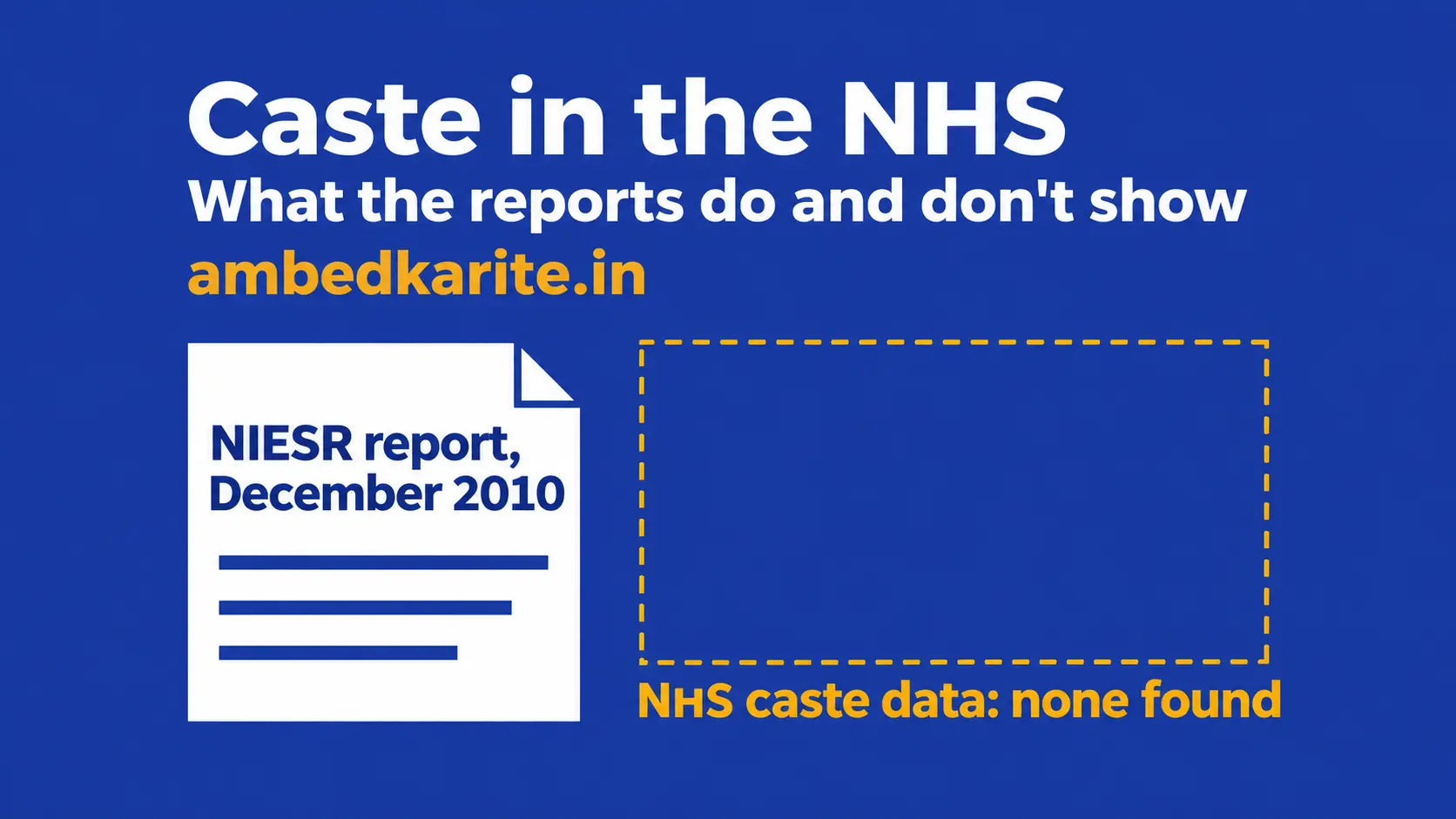
Caste discrimination NHS evidence, from the National Health Service in the United Kingdom, is thin, and this guide sets out what exists (NIESR, 2010). Resources documenting caste discrimination within the NHS are very limited. NIESR’s 2010 report indicated potential cases of caste discrimination at work, in services and in education. The NHS collects workforce equality data which includes ethnicity and religion (but not caste) and the 2024 NHS report did not identify any cases of caste discrimination amongst doctors working for the NHS. Global Ambedkarites (2025) have claimed that some NHS patients have taken the organisation to court to complain of caste discrimination and the NHS has settled out of court. We were unable to verify this claim or locate the court case in question. There are no published studies or reports conducted by the NHS on caste discrimination.
Dalits are formerly ‘untouchable’ communities who remain economically, socially and culturally disadvantaged.
Caste discrimination NHS: what the evidence is
An NHS trust is an organization that runs hospitals or other health services, and an employment tribunal is the body that hears workplace discrimination claims (NHS England, 2024).
For further information on Caste Discrimination in the UK please refer to our other guides.
To the best of our knowledge, there are no current, pending or past legal proceedings in the UK against the NHS for caste discrimination. This information was confirmed on 28th November 2026.
NIESR Caste Report 2010
In December 2010, Hilary Metcalf and Heather Rolfe of the National Institute of Economic and Social Research (NIESR) published a report commissioned by the Government Equalities Office. The report was largely qualitative and involved interviews with 32 people who had experienced caste discrimination (NIESR, 2010). Of these, 29 were referred to NIESR by campaign groups or religious communities (NIESR, 2010).
According to the report, proving or disproving an individual’s experience of caste discrimination would be virtually impossible (NIESR, 2010). To determine how widespread caste discrimination is, they suggested that a representative sample of the population should be surveyed (NIESR, 2010). Examples of caste discrimination described in the report include bullying at work, bias during the recruitment and promotion process and harassment of pupils at school (NIESR, 2010). Some representatives of the Hindu Forum of Britain and the Hindu Council UK who are opposed to anti-caste legislation also claimed that there is very little caste discrimination within the Hindu community (NIESR, 2010).
Caste data in the NHS
The 2024 Workforce Race Equality Standard (WREM) report, published by NHS England states that 28.6% of the total staff working across NHS trusts is composed of people from Black and Ethnic Minority backgrounds (NHS England, 2024). This report also gives the percentage of staff in each ethnic group who have experienced discrimination at work (NHS England, 2024).
In the reports I have consulted, there is no mention of collection of caste data by the NHS (NHS England, 2024). Therefore, the accounts of individuals who have experienced caste discrimination within the NHS remain the primary sources of evidence regarding this issue (NIESR, 2010).
Staff race data is published in long tables, and finding the right one takes time. AI tools, covered in the Ambedkarite Educational Program, can help locate a table, though every figure must still be checked against the source (NHS England, 2024).
Caste complaints against the NHS
Some of the cases taken on by the Anti Caste Discrimination Alliance (ACDA) have reportedly involved staff members of the NHS. These cases have been settled outside of court and therefore no public information is available about them (Global Ambedkarites, 2025).
One case studied by the National Institute of Economic and Social Research (NIESR) involved a member of staff on a healthcare team for an NHS trust. According to the report, this individual’s direct supervisor was changed after she raised concerns about his caste (NIESR, 2010). NIESR also quoted a hospital employee who had been subjected to 20 years of harassment from her coworkers on the catering team (NIESR, 2010).
Doctors and nurses: what is and is not known
There are very few, if any, published accounts of discrimination based on caste experienced by employees of the NHS (NIESR, 2010; NHS England, 2024). According to data compiled by the NHS England (2024) 48.7% of consultants working for NHS trusts are of black and minority ethnic backgrounds.
Without more specific information it is not possible to ascertain the extent to which members of the South Asian community working for the NHS may be victims of caste based discrimination.
What Employers of NHS Staff Must Do
In the 2018 consultation the government’s Equalities Office stated that judgement of Tirkey v Chandhok determined caste to be an element of race discrimination (Government Equalities Office, 2018). Therefore, an NHS employer must not discriminate against employees based on their caste. As with all employers, NHS employers must comply with the public sector equality duty.
As to whether caste discrimination would be successful in the Employment Tribunal that is for the Tribunal to decide. More information on the judgement in Tirkey v Chandhok can be found in the guide titled Chandhok v Tirkey.
Caste discrimination NHS: what each source shows
| Source | What it reports | What it cannot show | Source |
|---|---|---|---|
| NIESR report (December 2010) | Likely caste discrimination in work, services and pupil bullying; two cases in health settings; “little evidence” overall | Extent: it was qualitative, with a campaign-recruited sample; proof impossible from one account | NIESR, 2010 |
| NHS Workforce Race Equality Standard (2024) | 28.6% of trust staff from a black and minority ethnic background; discrimination by ethnicity | Caste: no caste measure found | NHS England, 2024 |
| Advocacy accounts (2025) | ACDA supported tribunal cases, including NHS cases settled out of court | Facts, outcomes or any employer response: settlements publish no findings | Global Ambedkarites, 2025 |
| Government consultation (2017 to 2018) | Views on exercising the duty or relying on case law | Extent: an “opportunity” sample that cannot be generalized | Government Equalities Office, 2018 |
| Data-based report on NHS doctors or nurses | None found | Not applicable | This article’s search |
| Published tribunal decision on caste by an NHS employer | None found | Not applicable | This article’s search |
Sources: NIESR, 2010; NHS England, 2024; Global Ambedkarites, 2025; Government Equalities Office, 2018. This is general information, not legal advice.
Information on Caste Discrimination within the NHS
Evidence specifically concerning discrimination of caste within the NHS is very limited (NIESR, 2010; NHS South East Clinical Networks, 2023). The report, Caste in the UK Workplace, published by NIESR, highlighted some instances of caste based discrimination (2010). Absence of data relating to caste within the NHS is probably because questions around ethnic origin do not distinguish caste within the data collection processes (NHS England, 2024). There are no publicly available records to confirm whether NHS staff have successfully taken action for caste discrimination (Global Ambedkarites, 2025). Additional information on caste discrimination by and within the NHS would be appropriate (NIESR, 2010; NHS England, 2024).
Readers who want to learn to read research reports and data tables closely and write clear, sourced explainers can start with the Ambedkarite Educational Program, a lifetime-access course at ₹297 (about $4 USD) that covers blogging, website building, email marketing, AI tools and Google AI, with all future courses included. The free Movement page is another place to begin.
This article draws on the 2010 NIESR report (read in full except its health-care chapter), NHS England’s 2024 race equality data, an advocacy outlet’s 2025 account, the government’s 2018 consultation response and a news report of NHS figures. I found no NHS-wide caste survey, caste measure or published tribunal decision, and no data-based report on doctors or nurses. Each source’s claims are attributed to it.
Last updated: November 28, 2026
Frequently Asked Questions
What follows are answers to the most common questions about caste and the NHS.
Is caste discrimination evident in the NHS?
Individual cases have been documented, for instance in the 2010 NIESR report. However, this article was unable to identify any caste specific questions or measures within NHS employee surveys, let alone any tribunals relating to caste within the NHS (NIESR, 2010; NHS England, 2024).
What does the NIESR report on caste say about the NHS?
The report states that, in the absence of more detailed information, it was not possible for them to determine whether or not caste was the main reason for the treatment of the Dalit member of staff in the NHS team (NIESR, 2010).
Is caste employment data collected by the NHS?
No caste employment data has been compiled by the NHS (NHS England, 2024).
Is there any data relating to complaints made to tribunals by NHS employees regarding discrimination on the grounds of caste?
According to Global Ambedkarites (2025) some cases have been settled out of court.
Are there cases of discrimination on the grounds of caste within the employment of NHS doctors?
This article has been unable to identify any data to support this claim (NIESR, 2010; NHS England, 2024).
Sources
- NIESR: Caste discrimination and harassment in Great Britain, Hilary Metcalf and Heather Rolfe, December 2010
- NHS England: NHS Workforce Race Equality Standard 2024 data analysis report for NHS trusts
- Global Ambedkarites: UK Lawmakers and Indian MP Unite in Call to Outlaw Caste Discrimination in Britain, September 2025
- Government Equalities Office: Caste in Great Britain and equality law, consultation response, 2018
- NHS South East Clinical Networks: Evidence of health inequalities across priority characteristics, 2023