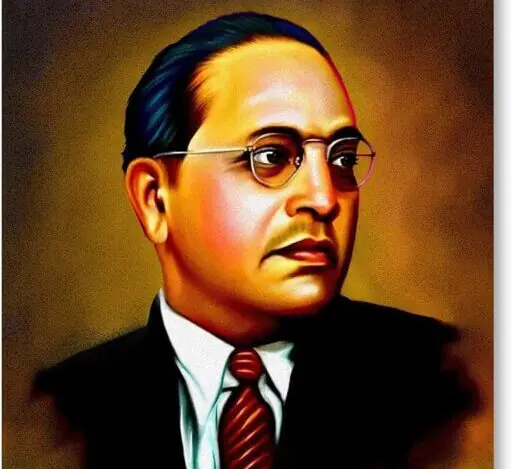
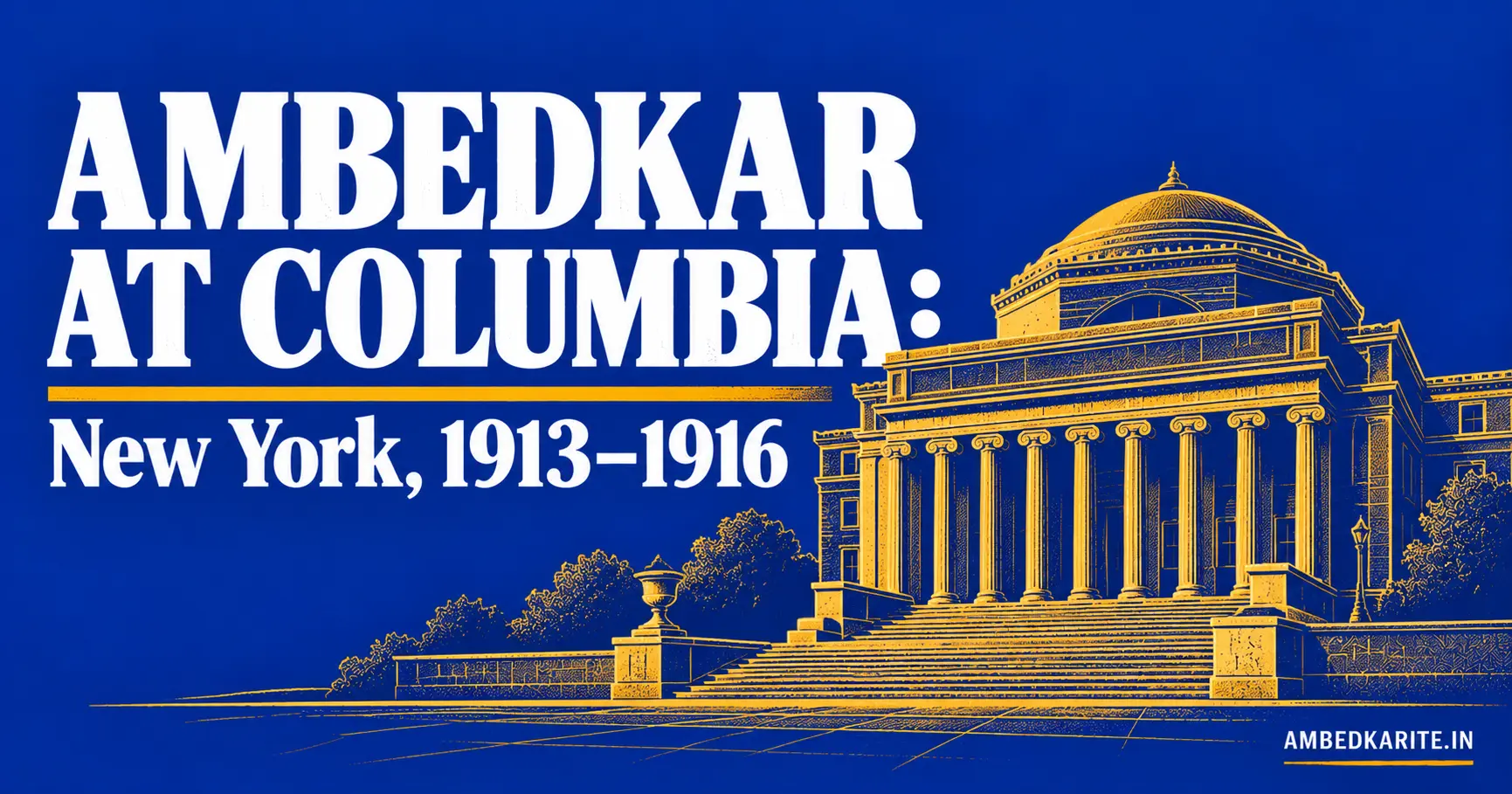
This document gives an account of Ambedkar’s time at Columbia. Many Western readers are surprised to learn of Ambedkar’s time at Columbia. His time at Columbia is commendable (Columbia University, ICLS Ambedkar Initiative). He came to New York in July 1913, as a young man who was born to a community which was socially regarded as untouchable in India (Columbia University, ICLS Ambedkar Initiative; The Beacon, 2018). His time at London also deserves mention. We will also mention how Columbia remembers him.
Ambedkar at Columbia
Ambedkar had already earned a degree in Economics and Political Science at Elphinstone College in Bombay. He was the first Dalit to study there (LSE History, Sue Donnelly). In 1913, he won a scholarship offered by Baroda State, which financed his studies in New York (LSE History).
Ambedkar’s degrees at Columbia
There are three entries in Columbia’s records (Columbia University, ICLS Ambedkar Initiative). They are a master’s degree in 1915, a PhD in 1927 and an honorary LL.D in 1952. The gap between 1915 and 1927 is explained in an academic paper. The paper says he completed his course work early, but the PhD was formally awarded him in 1927, after he presented his book on Provincial Finance in British India in 1925 as his thesis (Ambedkar’s Educational Odyssey, 1913-1927).
There is variability in thesis dates and titles. LSE says he wrote a thesis on India’s national dividend in 1916 (LSE History). For dates I will stick to Columbia’s records, avoiding titles where the record is unclear. For more information, please read our biography.
His teachers: Seligman, Dewey and others
Columbia says he studied with Edwin Seligman, James Shotwell, James Harvey Robinson and John Dewey (Columbia University, ICLS Ambedkar Initiative). Seligman was his doctoral supervisor (The Beacon, 2018). He kept in touch with Seligman (Frances Pritchett, citing Zelliot).
On Dewey, different sources, agree on his influence, but vary on the extent of it. Columbia’s Global Centers page calls Dewey his intellectual mentor (Columbia Global Centers). In Ambedkar’s own words, in a 1930 Alumni magazine, Dewey, Shotwell, Seligman and Robinson were his best friends, mentors and classmates respectively (Columbia Alumni News, December 1930, cited by Frances Pritchett).
So Dewey was, no doubt, one of the strongest influences on Ambedkar.
What New York gave him
After moving to New York at age 27, Ambedkar spent three years there, and said it was the time that allowed his potential to flower (Pritchett, citing Zelliot). A course at Barnard College (course BC 3825), explores Ambedkar’s time in New York as part of the public culture of the city from 1913-1916. It discusses his connection to W. E. B. Du Bois and Lala Lajpat Rai. We cover this connection in our article: Caste and Race in Isabel Wilkerson’s Caste.
For those new to his ideas, his 1936 speech is a good introduction to the time he spent in New York.
The LSE years
Ambedkar studied at the London School of Economics (LSE) next. He registered there in 1916 for his master’s degree and took classes with Halford Mackinder, G. Lowes Dickinson and L. T. Hobhouse. He also enrolled at the bar at Gray’s Inn. The first World War interrupted him. In 1917, he was called to India and served as Military Secretary in Baroda, and the University of London gave him leave of absence of up to 4 years (LSE History).
He worked as a professor of political economy at Sydenham College in Bombay (now Mumbai) from 1920 to 1923. During this time, Seligman wrote to LSE, recommending him to Prof. Herbert Foxwell. Foxwell said that at LSE, Ambedkar ‘conquered all the worlds’ there were to conquer, as he held a PhD by then (1920) (LSE History).
Ambedkar submitted his doctoral thesis ‘The Problem of the Rupee’ in March 1923. The examiners did not recommend it for acceptance. He resubmitted the thesis in August 1923 and it was accepted in November 1923. Reports say the examiners found it too anti-British to award Ambedkar the PhD. The LSE archivist says there is no evidence in his student file to show that his thesis was too anti-British. By the time he left for India in 1923, he had two doctorates and was also qualified to practice law (The Beacon, 2018).
Columbia University’s honor
The ICLS Ambedkar Initiative, headed by Prof. Anupama Rao, hosts the annual Ambedkar Lectures and a course on Columbia and Ambedkar that draws on the University’s Archives. It also publishes the B.R. Ambedkar book series. According to the University, it provides an opportunity to link Ambedkar’s legacy with the University’s work on anti-caste in justice and social equity and also with contemporary social justice and affirmative actions movements (Columbia University, ICLS Ambedkar Initiative).
Why this is important to those in the West
Ambedkar earned doctorates from universities in New York and London in the 1920s and is, therefore, part of the Western University story as well. He spent time studying American pragmatism and economics in order to construct an analysis of the caste order of Indian society.
Our information is relevant to Westerners because he saw the American/Western University systems as having an inherent bias that treats some communities as untouchable, and most people are unaware of that bias. For the systems he was attempting to change, caste/casteism is completely different from how the Western caste system is approached in the courts. We also address the term “Dalit” and explain the laws that have been passed to protect members of the caste system. ( For diaspora communities documenting this history themselves, the use of AI tools, blogging and email marketing are becoming essential. The Ambedkarite Educational Program was built to teach exactly these skills.)
Takeaway
There are many sources that show that Ambedkar had a documented presence at Columbia University, beginning in 1913, where he received his master’s in 1915 and his doctorate in 1927 and an honorary doctorate of laws in 1952. He studied at LSE and wrote his thesis under Dewey in 1923. There is some discrepancy with regard to the titles of his theses, as well as how much Dewey influenced him, and, therefore, careful writers should use the dates provided by the universities. Both Columbia and the LSE pay homage to him.
Frequently Asked Questions
Did Ambedkar study at Columbia University?
Yes. He entered in July 1913, earned a master’s in 1915 and a PhD in 1927, according to Columbia. The university also gave him an honorary LL.D. in 1952.
Who taught Ambedkar at Columbia?
Columbia names Edwin Seligman, James Shotwell, James Harvey Robinson and John Dewey. Seligman was his doctoral supervisor.
Did Ambedkar also study at the London School of Economics?
Yes. He first registered in 1916 and returned in 1920. His doctoral thesis, The Problem of the Rupee, was accepted in November 1923.
How many degrees did Ambedkar earn abroad?
He returned to India in 1923 with two doctorates and a barrister’s qualification, according to one source. Columbia dates its PhD to 1927, so counts vary by how the awards are dated.
Understanding caste is step one. Building digital independence is step two.
Ambedkarite communities around the world are using AI tools, blogging and email marketing to document their experiences, challenge discrimination and build platforms that cannot be silenced.
The Ambedkarite Educational Program teaches exactly these skills: AI tools, website building, email marketing, blogging and Google AI. Lifetime access is ₹297 (~$4 USD). All future courses are included free.
Or join the Movement free to start learning today.
SOURCES
- Columbia University (ICLS), Ambedkar Initiative
- Columbia Global Centers, “Bhimrao Ramji Ambedkar”
- LSE History, Sue Donnelly, “‘No More Worlds Here for Him to Conquer’,” January 2016
- Barnard College, course BC 3825
- Frances Pritchett, excerpt from Eleanor Zelliot (1991)
- The Beacon, “Portrait of a Scholar and Activist,” 2018
- ResearchGate, Ambedkar’s Educational Odyssey, 1913–1927