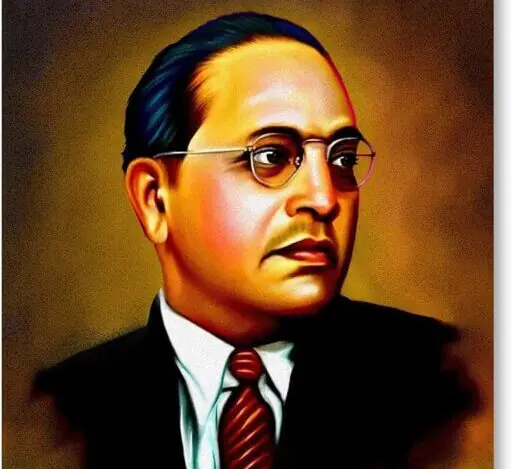
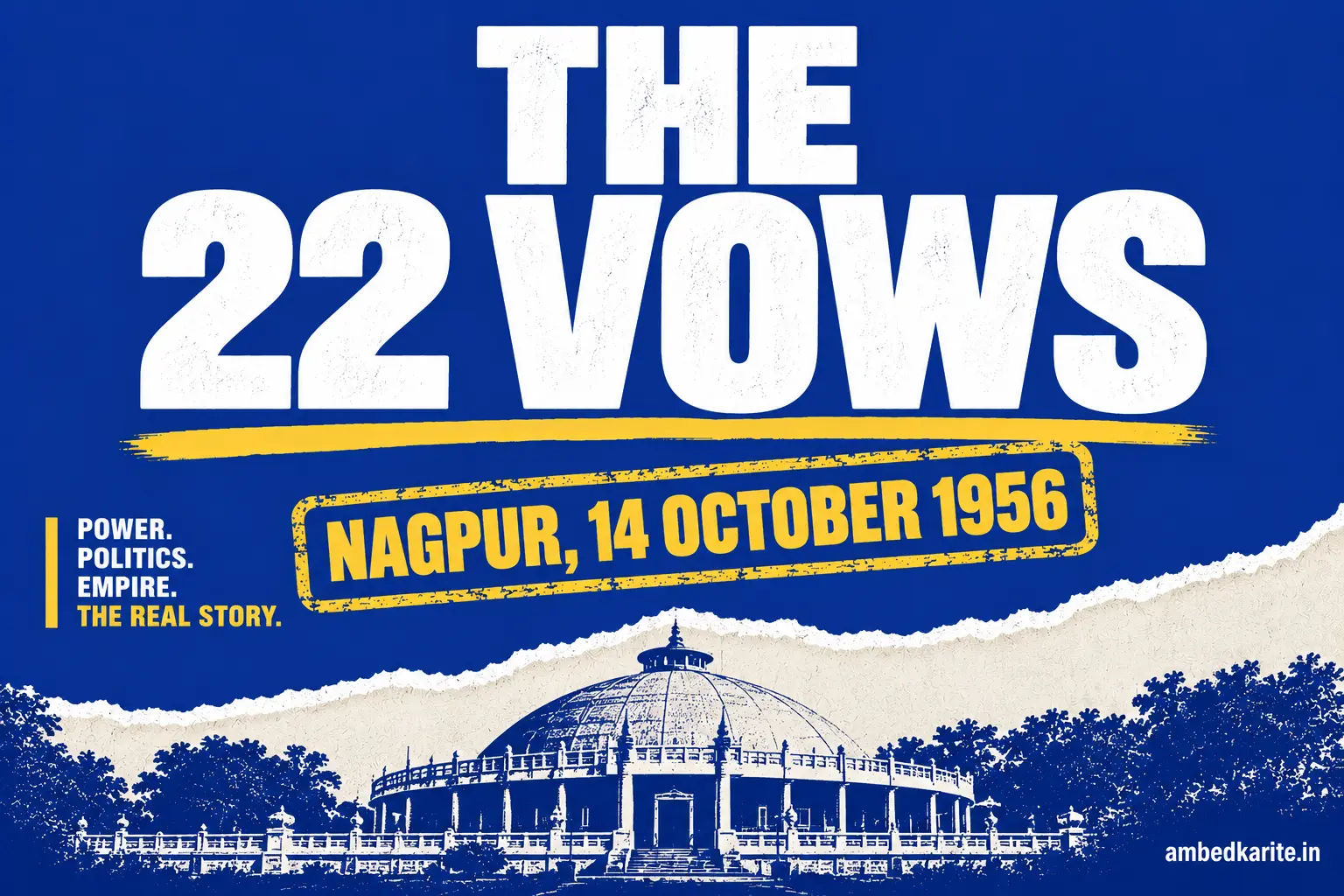
Poster-style graphic on Ambedkar 22 vows: the 14 October 1956 Nagpur ceremony and the full list | बाबासाहेब की 22 प्रतिज्ञाएँ: 14 अक्टूबर 1956 का नागपुर समारोह और पूरी सूची, नेवी-ब्लू पोस्टर ग्राफिक
The Ambedkar 22 vows are short and straight forward. Most people have only seen them as a poster. Here they are in order.
On October 14th 1956 in Nagpur, B. R. Ambedkar and his followers took the Three Refuges and the Five Precepts, and the 22 vows (The Telegraph, 2022). This post reports what the vows say and why he gave them. This post judges no faith and targets no community.
What are the Ambedkar 22 vows? When were they taken?
Ambedkar said he would leave Hinduism on 13th October 1935 at Yeola. There he said to a gathering, “I solemnly assure you that I will not die a Hindu” (The Caravan). In the next 20 years he urged Dalits to leave Hinduism and studied many religions (The Caravan). On 23rd September 1956 he announced he would convert on Dussehra that year (The Caravan).
The ceremony was held at Nagpur on 14th October 1956 which was Ashoka Vijayadashami that year (The Telegraph, 2022). Ambedkar was first initiated by Mahasthavir Chandramani, and then he initiated his followers (The Caravan). A second ceremony was held at Chandrapur on 16th October 1956 (Round Table India).
More ceremonies were scheduled including one at Mumbai in December. However, Ambedkar passed away on 6th December 1956 (Round Table India). The numbers vary. The Caravan states almost half a million people converted, and another Round Table India article states 800,000 converted (Round Table India). Be careful with your judgement of any lone numbers.
B.R. Ambedkar’s reasons for converting to Buddhism
The Caravan mentions rationality and social equality as aspects of Buddhism that Ambedkar appreciated (The Caravan). They also say he explained his move to Nagpur by stating his appreciation for the fact that the city gets its name from Nag people who spread Buddha’s teachings and not from any organization based there (The Caravan). According to The Telegraph, 2022, October 14 was Ashoka Vijayadashami that year.
Ambedkar outlined views on these issues in his writings decades earlier, so it was not something new in 1956. In 1916, he wrote, “There is not a single shred of evidence to prove that Manu existed” (Ambedkar, 15, Vol. 1, p. 16), which we discuss in detail in our post on Ambedkar’s Castes in India. In 1936, he wrote, “Caste is a division of labourers. It is not a division of persons,” (Ambedkar, Vol 1, editor’s note, p. xiv) which we summarize in our post on The Annihilation of Caste.
The 22 vows, explained in everyday language
I summarize each vow based on Round Table India. Read the exact wording from the Ambedkar Foundation’s document when quoting.
I. II. Beliefs about Gods and Incarnations
To not have faith in, nor worship, Brahma, Vishnu, or Mahesh. To not worship, Rama or Krishna, who are considered to be Incarnations.
Like Gauri and Ganapati and other Hindu gods and goddesses (Round Table India, 22 Vows).
Likewise not to accept the doctrine of incarnation of God (Round Table India, 22 Vows).
Likewise not to believe that the Buddha was the incarnation of Lord Vishnu (which the vow says is false propaganda) (Round Table India, 22 Vows).
As mentioned earlier these five vows define what a convert would not believe or worship. As per the report, these five define what the convert would not do or worship.
The next set of three vows, 6 to 8, are on rituals.
Not to perform shraddha or give pind-dan (Round Table India, 22 Vows).
Not to act against the principles and teachings of the Buddha (Round Table India, 22 Vows).
Not to allow ceremonies to be performed by Brahmins (Round Table India, 22 Vows).
The next two, vows 9 and 10, are on equality.
To believe in the equality of man (Round Table India, 22 Vows).
To work for equal rights (Round Table India, 22 Vows).
The pledge is similar to the one taken by the volunteers at Mahad in 1927 (SabrangIndia, 2017). The pledge rejected caste and untouchability. (See our post on Manusmriti Dahan Din, for detail on this event.)
The vows 11 to 18, are on daily conduct and the path followed by the Buddhist philosophy.
To tread upon the path of righteousness (Round Table India, 22 Vows).
To follow the paramitas as prescribed by the Buddha (Round Table India, 22 Vows).
To cultivate loving-kindness and goodness for all living beings and to protect them (Round Table India, 22 Vows).
Not to steal (Round Table India, 22 Vows).
Not to tell lies (Round Table India, 22 Vows).
Not to commit carnal sins (Round Table India, 22 Vows).
Not to take intoxicants (Round Table India, 22 Vows).
To practise the eightfold path and the compassion (Round Table India, 22 Vows).
Vows 14 to 17 are the Five Precepts, and the numbering varies. Published versions of the vows vary in different places and this is one of the places where a published version varies.
Vows 19 to 22: Declaration
To renounce Hinduism and take up Buddhism (Round Table India, 22 Vows).
To believe that Buddha’s Dhamma is the only true religion (Round Table India, 22 Vows).
To believe that the convert is having re-birth (Round Table India, 22 Vows).
To lead one’s life by the teachings and principles of the Buddha (Round Table India, 22 Vows).
Origins of the ambedkar 22 vows
The Telegraph states that the ceremony is described in BAWS Vol 17, Part III, in the chapter ‘The Buddha Dhamma will be the saviour of the world’ (The Telegraph, 2022). A Sri Lankan Buddhist paper states that Ambedkar prepared the vows for his own conversion and that these became part of the conversion rite in India (Budusarana, 2007).
Dhamma Bharat states that the first three of the ambedkar 22 vows survive in Ambedkar’s own handwriting in Marathi (Dhamma Bharat). I could not verify the handwritten page myself. For citations on this site, point to the Dr. Ambedkar Foundation’s volume, not to a poster.
What the ambedkar 22 vows are, and what they are not
Ambedkar wrote the 22 Vows as a means to facilitate the conversion to Buddhism of Untouchables, and for others to be able to practice the five essentials of Buddhism, which can be summarized as the Three Refuges and the three trained faculties.
‘The Buddha Dhamma will be the saviour of the world’ chapter of BAWS refers to a text titled ‘Samanadhikara’ or ‘Conditional Expounding’ (Part III, Chapter VII) which explains about rituals pertaining to lay Buddhists, one of which includes taking refuge in the Triple Gem (Third Refuge). This ‘savidana’ (the text explaining the condition) states that ‘there is none below it’. The 22 Vows are also a savidana (references). The 22 vows are essentially a ritual to take Refuge in the Triple Gem, as it is a savidana to teach lay people about Refuge and thus facilitates a means to achieve the Third Refuge.
The 22 vows and the ‘
They are personal vows taken by people when accepting Buddhism. In the conversion article published by Round Table India, it states that Ambedkar “appealed only to those who could willingly accept the vows and follow them with dedication” (Round Table India, conversion). So, they are not laws and are not directed to any person outside the Buddhist community.
They are read in different ways. In an article by Janata Weekly, the author says that they are not anti-Hindu (Janata Weekly). The same author states that the first two vows are against the exploitation of the Dalits in the name of deities (Janata Weekly). How much weight readers give to these interpretations is for them to decide.
Now, common questions about the 22 vows
Are they mandatory for all Buddhist converts? In India they are part of the conversion rituals (Budusarana, 2007). Various sources say they are mandatory (Dhamma Bharat) but I do not find a rule for it in any primary sources, so I won’t say they are.
Is there one official wording? I found none. The Telegraph says wording varies across reproductions (The Telegraph, 2022).
Are the 22 vows the same as the Five Precepts? No. The Five Precepts and the Three Refuges came first, and the 22 vows were added in the ceremony (The Telegraph, 2022).
The ambedkar 22 vows were administered at Nagpur on 14 October 1956, after the Three Refuges and Five Precepts (The Telegraph, 2022). They cover beliefs, rituals, equality, the Buddhist path and a final declaration (Round Table India, 22 Vows). Quote them from the Dr Ambedkar Foundation’s volume, since wording varies between lists.
Babasaheb gave us three words: Educate. Agitate. Organize.
Reading is Educate. Agitate and Organize start when you share a sourced page, not a screenshot.
Today, X bans accounts. Reels get shadowbanned. WhatsApp groups get reported. So Bahujans need their own platforms: emails, blogs, websites, AI tools.
The Ambedkarite Educational Program is made for exactly this. ₹297 lifetime, includes Prompt Engineering, Google AI, Website Building, Email Marketing, Blogging & SEO, Canva, plus all future courses free.
What are the ambedkar 22 vows? They are 22 oaths Ambedkar administered to converts at Nagpur on 14 October 1956, after the Three Refuges and Five Precepts (The Telegraph, 2022).
When and where were the 22 vows taken? At Deekshabhoomi, Nagpur, on 14 October 1956, with a second ceremony at Chandrapur on 16 October 1956 (The Telegraph, 2022; Round Table India).
Why did Ambedkar choose Buddhism? The Caravan says he settled on it for its indigeneity, rationality and commitment to social equality (The Caravan).
Is there an official text of the 22 vows? I found no single official wording. The Telegraph notes that the wording varies between reproductions (The Telegraph, 2022).
Where can I read about the ceremony in Ambedkar’s collected works? In BAWS Vol 17, Part III, in the chapter “The Buddha Dhamma will be the saviour of the world” (The Telegraph, 2022).
Sources
“Vows BJP and Arvind Kejriwal can’t gulp,” The Telegraph (Kolkata), 17 October 2022. Source for BAWS Vol 17, Part III, and the wording variation.
“Ambedkar’s conversion to Buddhism,” The Caravan, Editor’s Pick.
“22 Vows of Dr. Ambedkar” (the list of the vows), Round Table India.
“Countering Hindu Morality,” the conversion account (Nagpur and Chandrapur, 14 and 16 October 1956), Round Table India.
“Dhamma Chakra Pravartan Day: A symbol of Asserting our Identities,” Round Table India.