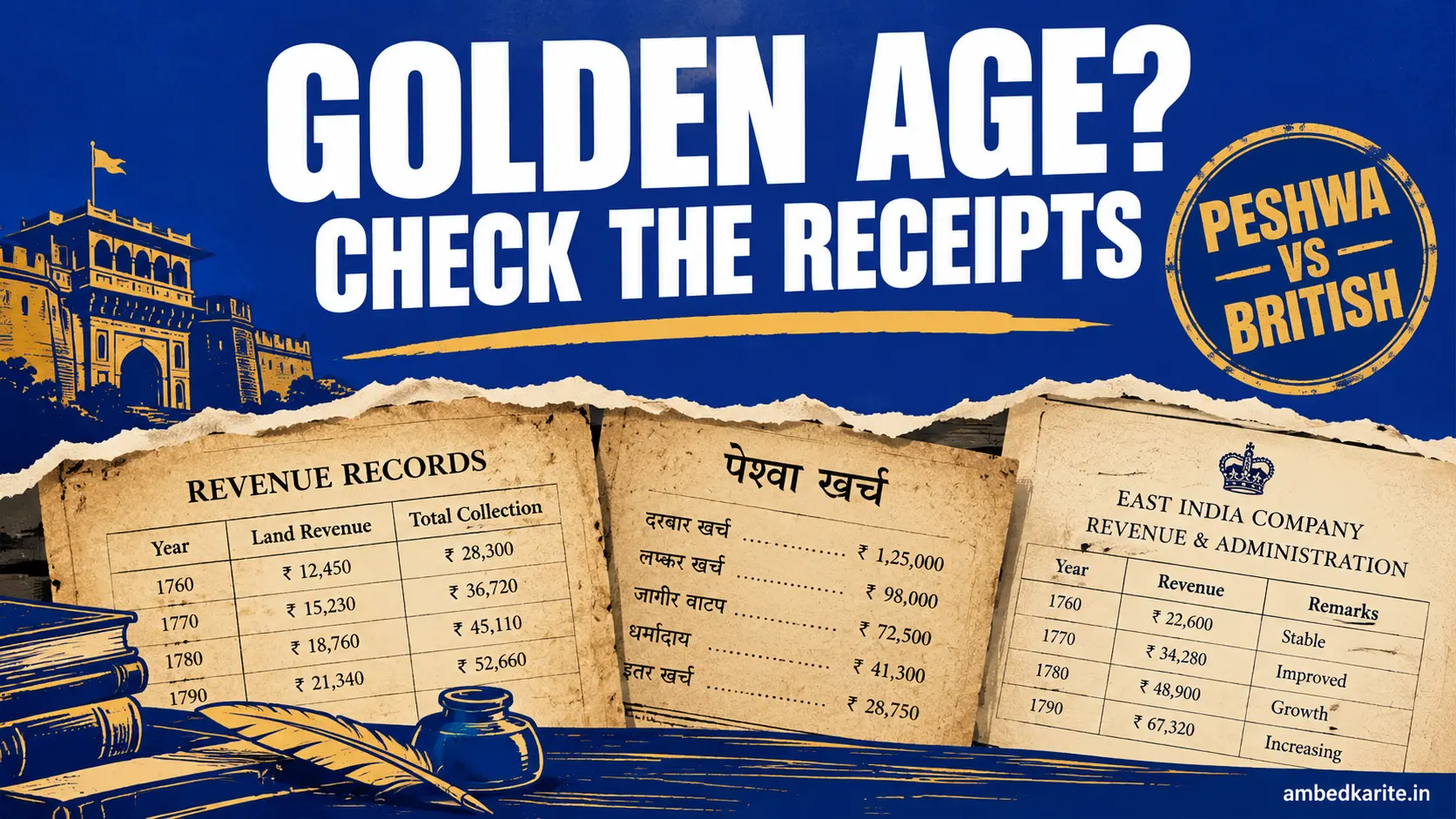
Poster-style graphic comparing Peshwa vs British rule: was it a golden age? What sources say | पेशवा शासन बनाम अंग्रेज़ी राज: क्या सच में स्वर्ण युग था? सबूतों पर पोस्टर स्टाइल ग्राफिक
Here’s a fun fact that ruins both sides of the Peshwa vs British debate 👇
Neither era was golden for everyone. A standard reference credits Peshwa administration with real gains in revenue, services and law and order (Encyclopedia of India, “Peshwai and Pentarchy”). Yet the same state took part in caste matters (Fukazawa, 1968).
Meanwhile, Company rule did its own damage (PARI summary of BAWS Vol 12). So who gets to call it golden? Let’s break it down.
The Peshwa vs British claim: a golden age, then ruin
Here is the strongest version of the Peshwa vs British golden age claim. The Marathas, especially under the Peshwas, were India’s major Hindu power before British conquest (Encyclopedia of India, “Peshwai and Pentarchy”). Under Nanasaheb Peshwa, the same entry notes a general improvement in revenue collection, services and law and order (Encyclopedia of India, “Peshwai and Pentarchy”). It also credits Madhav Rao I with steady revenue, welfare programs and respect for the Maratha judicial system (Encyclopedia of India, “Peshwai and Pentarchy”).
Then comes the sharpest card: Ambedkar himself. In his 1943 address on Ranade, he said a large majority in Maharashtra was stunned when the Maratha Empire fell (BAWS Vol 1, Ranade, Gandhi and Jinnah). He also called the Marathas a hardy people who knew liberty (BAWS Vol 1, Ranade, Gandhi and Jinnah). So the claim goes: even Babasaheb mourned the fall. That is fair to quote, so let’s read the rest of the passage.
Peshwa vs British: where the golden age claim falls apart
First, read the other half of that passage. Ambedkar says some people were glad to see “the cursed rule of the Brahmin Peshwa” end (BAWS Vol 1, Ranade, Gandhi and Jinnah). Still, in the printed address he never calls the Peshwa period golden (BAWS Vol 1, Ranade, Gandhi and Jinnah). In short, he describes shock at the fall, which is not the same as praise for the rule.
Second, ask: golden for whom? Ambedkar recorded street bans and a black thread for untouchables under the Peshwas (BAWS Vol 1, Annihilation of Caste). The pot and broom details are contested, as our Peshwa caste article explains. However, the state’s role is documented, because a 1968 study found the Maratha state sat inside caste matters (Fukazawa, 1968).
Third, take the Peshwa justice system. Judge Ramashastri Prabhune declared Raghunath Rao’s claim to the post illegal, and his name still stands for integrity in Maharashtra (Encyclopedia of India, “Peshwai and Pentarchy”). Both facts can be true. An honest judge in one case does not cancel rules that sorted people by birth (Fukazawa, 1968).
Fourth, the “British ruined it” line skips the Peshwa state’s own part. In 1756, Nanasaheb took Company help to destroy the Angre navy, which left the sea open to the English (Encyclopedia of India, “Peshwai and Pentarchy”). In 1802, Baji Rao II signed the Treaty of Bassein, which essentially ended the Peshwai (Encyclopedia of India, “Peshwai and Pentarchy”). Even before that, Panipat in 1761 cost the Marathas more than 100,000 men (Encyclopedia of India, “Peshwai and Pentarchy”).
Then vs now: the receipts
Here is how Peshwa vs British rule compares, row by row. Every row uses a sourced fact, so a row with no source is not here (Encyclopedia of India; BAWS Vol 1; PARI summary of BAWS Vol 12).
Question
Peshwa era
British era
Source
Who ruled?
Hereditary Peshwas of the Bhat family, the virtual rulers after 1749
East India Company, after Baji Rao II was removed in 1818
Ambedkar’s notes in BAWS Vol 12 say Company policy destroyed Indian industries and its land revenue laws ruined agriculture (PARI summary of BAWS Vol 12). For Mahars, the damage was personal. Ambedkar wrote that Mahar officers petitioned against orders issued in 1892 that banned Mahar recruitment in the army (BAWS Vol 1, Ranade, Gandhi and Jinnah). Also, Anand Teltumbde finds no evidence that Mahars gained relief once the Peshwai fell (The Wire, 2018).
Phule also attacked British administration, which he saw as top-heavy with European and Brahmin officials (O’Hanlon, Caste, Conflict and Ideology). So the honest frame is two unequal systems, not one golden age and one rescue. For the Koregaon side of this story, read our Battle of Bhima Koregaon explainer.
Why the golden age myth keeps coming back
A golden age is a comfortable story. It blames outsiders for every loss and skips the quarrels inside Pune (Encyclopedia of India, “Peshwai and Pentarchy”). It also leaves out caste, which the state helped police (Fukazawa, 1968).
However, the reverse story is just as lazy. Calling the British pure rescuers ignores Company damage (PARI summary of BAWS Vol 12). Receipts only travel if people can find them, and a sourced page beats a forwarded screenshot. (That’s exactly what the Ambedkarite Educational Program trains Ambedkarites for: Blogging & SEO, Website Building and Google AI.)
Takeaway
The Peshwa vs British story has no clean hero. Peshwa administration had real gains, but the state also took part in caste matters (Encyclopedia of India; Fukazawa, 1968). British rule brought its own economic and caste damage (PARI summary of BAWS Vol 12; BAWS Vol 1, Ranade, Gandhi and Jinnah). Read both columns before you share a Peshwa golden age post.
Babasaheb gave us three words: Educate. Agitate. Organize.
This blog was Educate. Agitate and Organize start when you publish what you learned.
Today, X bans accounts. Reels get shadowbanned. WhatsApp groups get reported. So Bahujans need their own platforms: emails, blogs, websites, AI tools.
The Ambedkarite Educational Program is made for exactly this. ₹297 lifetime, includes Prompt Engineering, Google AI, Website Building, Email Marketing, Blogging & SEO, Canva, plus all future courses free.
Was Peshwa rule good or bad? It was mixed. A reference work credits Peshwa administration with gains in revenue, services and law and order (Encyclopedia of India, “Peshwai and Pentarchy”). The same state also took part in caste matters (Fukazawa, 1968).
Peshwa vs British: which rule was better? The sources do not give a clean winner. Ambedkar wrote that Company policy damaged industry and agriculture (PARI summary of BAWS Vol 12). He also recorded caste rules under the Peshwas (BAWS Vol 1, Annihilation of Caste).
Did the British ruin the Peshwas? The decline began earlier. Panipat in 1761 cost the Marathas over 100,000 men, and Baji Rao II lost his post in 1818 (Encyclopedia of India, “Peshwai and Pentarchy”).
Did Ambedkar call Peshwa rule a golden age? In the printed 1943 Ranade address, he does not. He describes some people as glad at the end of Peshwa rule and a large majority as stunned (BAWS Vol 1, Ranade, Gandhi and Jinnah).
When did the Peshwa period end? It ran roughly 1713 to 1818, ending when Baji Rao II was removed (Encyclopedia of India, “Peshwai and Pentarchy”).
Further reading (listed in source 1’s bibliography, not read for this article): B. G. Gokhale, Poona in the Eighteenth Century (OUP, 1988); V. T. Gune, The Judicial System of the Marathas (1953).
What’s your take? Drop a comment below and share this article with someone who still believes the myth.