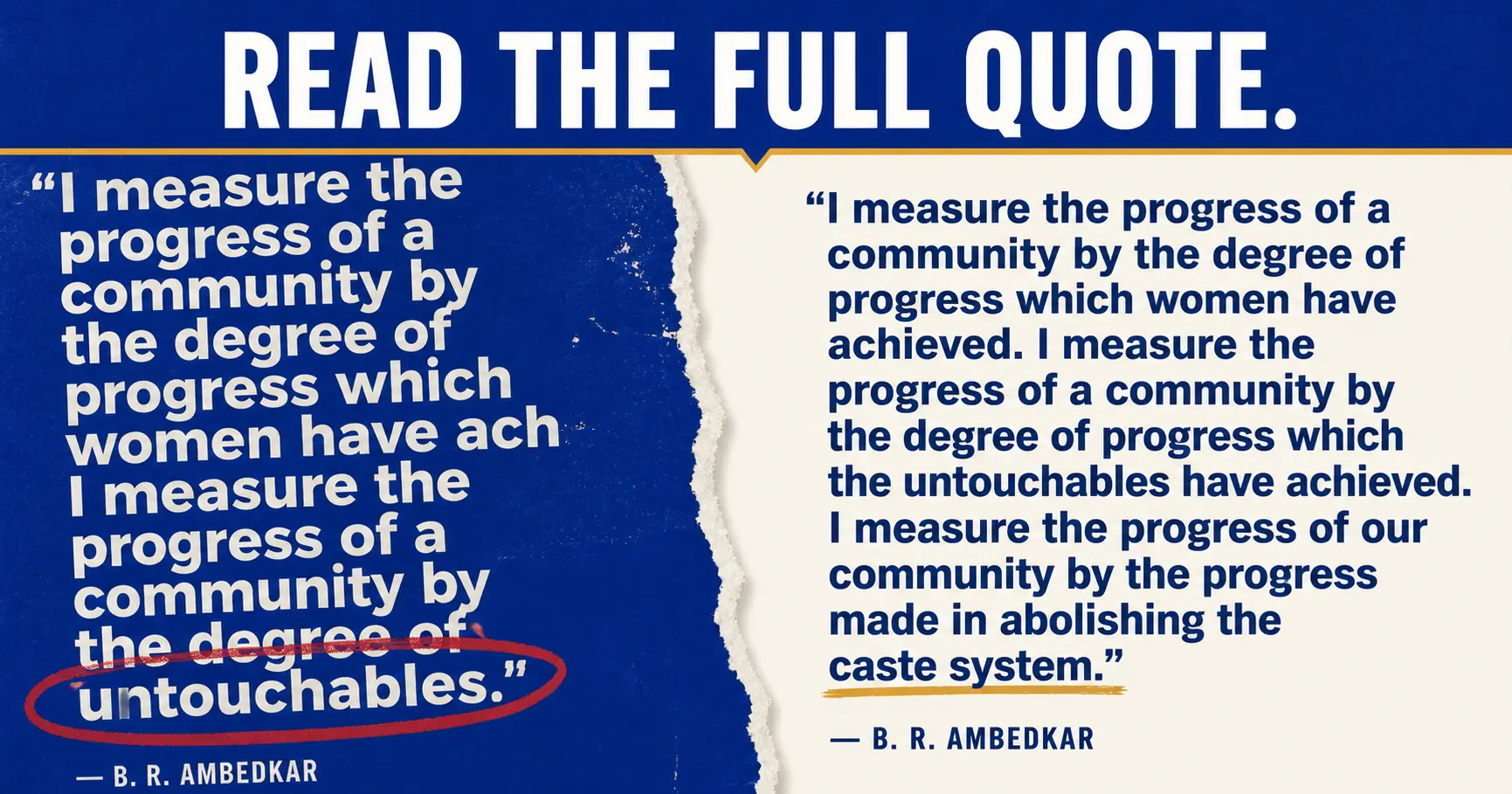
Dalits Helped The British? Dalits British conquer India? Read The Full Ambedkar Quote First
That poster below is doing rounds on X again. The “Britishers Raj” series. A real Ambedkar quote slapped on top. A laughing emoji asking “Traitors?”
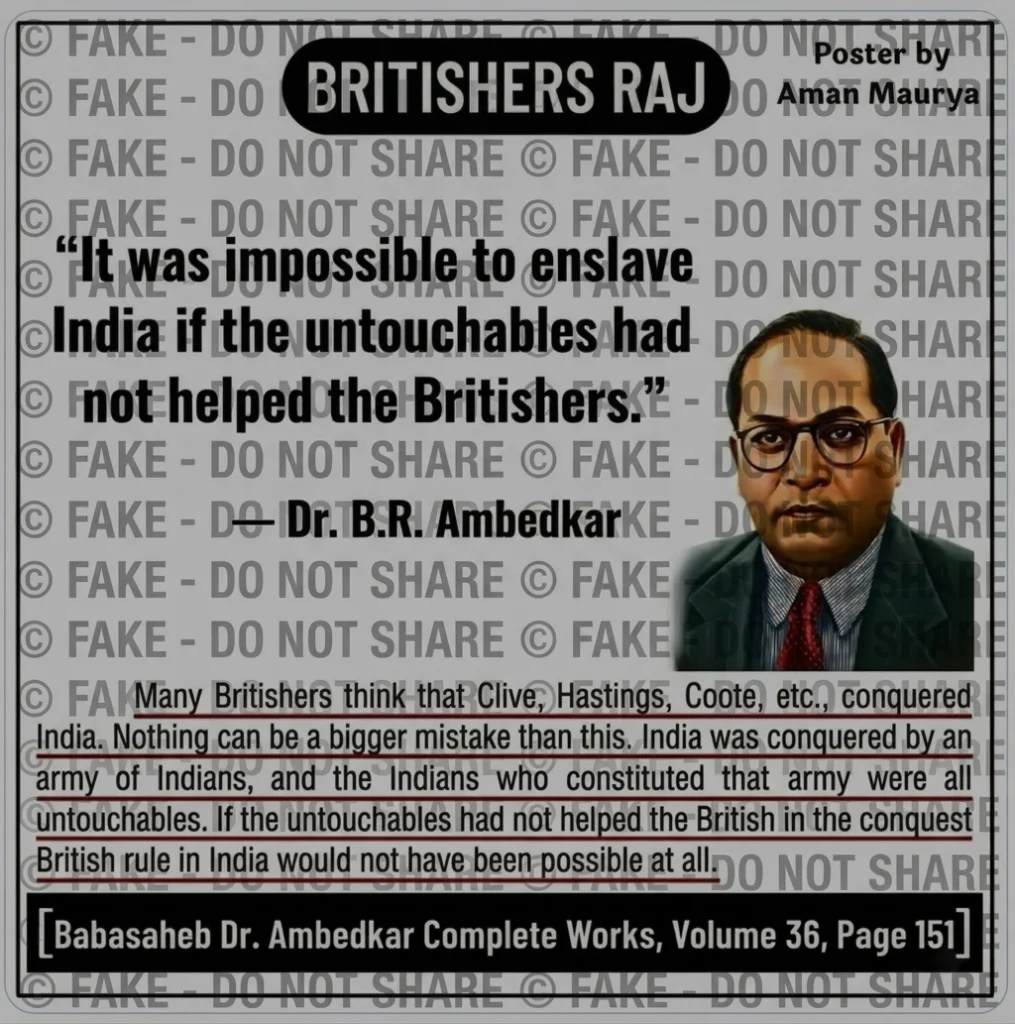
Here’s the catch. The quote is real. The framing is the lie 👇
The Claim — In Its Strongest Form
The poster pulls four lines from Babasaheb. He says:
“Many Britishers think that Clive, Hastings, Coote, etc., conquered India. Nothing can be a bigger mistake than this. India was conquered by an army of Indians, and the Indians who constituted that army were all untouchables. If the untouchables had not helped the British in the conquest, British rule in India would not have been possible at all.”
That’s the punch. It looks damning. Citation underneath says “Babasaheb Dr. Ambedkar Complete Works, Volume 36, Page 151” — official-sounding, hard to argue with.
The conclusion the poster wants you to draw: Ambedkar himself called Dalits the reason India fell. Therefore, Dalits = traitors. Therefore, anything Dalits ask for today (reservation, Bhima Koregaon, separate identity) is rich coming from “traitors.”
That’s the trap. Let’s spring it.
Where The Poster Falls Apart
Three problems. Big ones.
Problem 1: That citation is sus. The Government of Maharashtra’s official Babasaheb Ambedkar: Writings and Speeches (BAWS) series runs to 17 main volumes. There is no standard “Volume 36.” The actual quote appears in Ambedkar’s letter published in The Times of India on 18 June 1941, and in his 1946 writings on the Cabinet Mission. Before we even argue context — the source line itself is misleading.
Problem 2: They cropped the next paragraph. Ambedkar wasn’t shaming Dalits. The 1941 ToI letter was a case to the British government to recruit more Mahars into the army during World War 2. He argued that British exclusion of “lower castes” from the army post-1857 was a mistake — and that Mahars had a martial tradition the Crown was ignoring. Read with that intent, the line is a sales pitch for Mahar inclusion, not a confession of betrayal.
Problem 3: Ambedkar’s deeper point — over and over — was that the caste system, not Dalits, broke India. When millions of people are told for 2,000 years that they are subhuman, that they cannot enter the village, drink from the well, or learn to read — what exactly are they betraying when a foreign army shows up offering them a uniform and a salary?
Now let’s put it on a table.
📦 Myth vs Fact
| Myth | Fact |
|---|---|
| “Ambedkar said Dalits enslaved India” | He said the caste system enslaved India. Untouchables had no village, no well, no temple — what country did they owe loyalty to? |
| “Source: Volume 36, Page 151” | Official BAWS has 17 volumes. The quote is from Ambedkar’s Times of India letter (18 June 1941) and 1946 Cabinet Mission writings. |
| “Dalits were traitors” | Loyal to a system that made them tie a broom to their waist and a pot to their neck? That’s not loyalty. That’s slavery. |
| “British conquered with Mahar help” | Battle of Koregaon, 1 January 1818: 500 Mahar soldiers held off 28,000 Peshwa troops. That fight was against caste tyranny, not for the British. |
| “Only Dalits collaborated with the British” | Brahmin zamindars ran the British land tax system. Hindu Mahasabha + Muslim League formed coalition governments during Quit India 1942. Savarkar wrote 5–6 mercy petitions from Cellular Jail. RSS as an organisation skipped the freedom struggle. |
| “Mahars dishonoured India” | The Mahar Regiment is in the Indian Army today. Has fought in every major war since 1947. |
What The Record Actually Says
Open BAWS Volume 5, page 39. Ambedkar — in his own words — describes life under Peshwa rule:
“Under the rule of the Peshwas in Maratha country the untouchable was not allowed to use the public streets if a Hindu was coming along lest he should pollute the Hindu by his shadow… In Poona, the capital of the Peshwa, the untouchable was required to carry, strung from his waist, a broom to sweep away from behind the dust he treaded on lest a Hindu walking on the same should be polluted. In Poona, the untouchable was required to carry an earthen pot, hung in his neck wherever he went, for holding his spit lest his spit falling on earth should pollute a Hindu.”
That was the system Mahars walked away from.
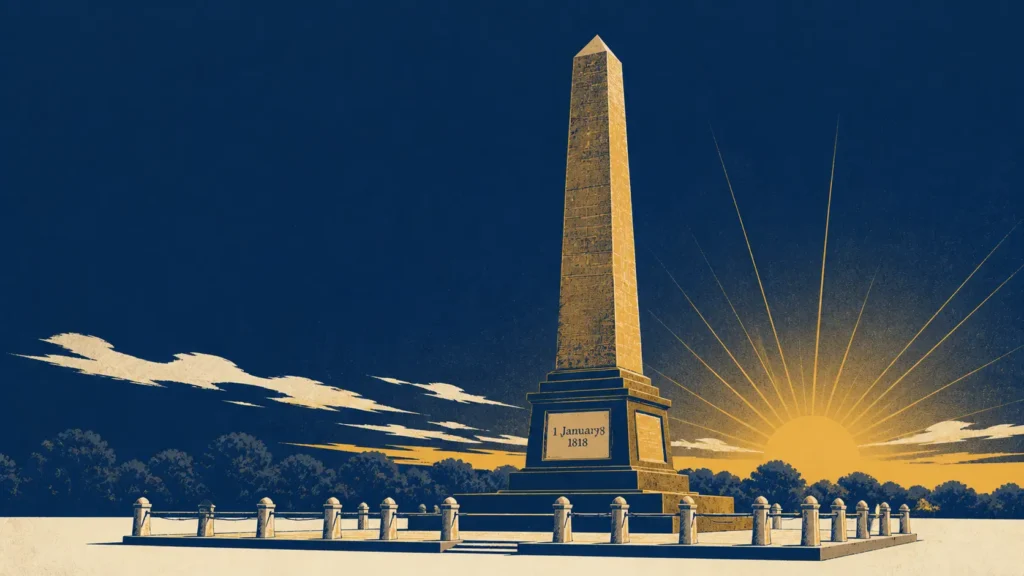
The Battle of Koregaon — what actually happened
1 January 1818. A force of 500 men of the 2nd Battalion, 1st Bombay Native Light Infantry — most of them Mahars — were marching from Shirur to reinforce the British garrison at Pune. They were intercepted at Koregaon by Peshwa Bajirao II’s army: 20,000 cavalry and 8,000 infantry.
For the next 12 hours, with no food and no water, those 500 men held the line. By nightfall, the Peshwa forces withdrew. The battle helped end Peshwa rule in Maharashtra.
For the Mahars, this was not “helping the British.” This was settling a 2,000-year-old account.
Ambedkar’s own family
Babasaheb’s father, Ramji Maloji Sakpal, served as Subedar Major in the British Army. His grandfather served too. Ambedkar grew up in army cantonments where caste rules were officially discouraged. The first time young Bhimrao stepped outside that bubble, the bullock cart driver kicked him off the cart for being an “untouchable.”
The British Army gave Mahars something the Peshwa never did — a chance at education, dignity, and a salary. That’s not a betrayal of India. That’s a generation of people refusing to die untouchable.
So Who Was Actually “Loyal” To The British?
Here’s the part the poster doesn’t want you to ask.
Savarkar’s mercy petitions. Vinayak Damodar Savarkar wrote at least five mercy petitions to the British Crown from Cellular Jail between 1911 and 1920. In one, he promised: “the Government may make whatever use they like of me… I am ready to serve the Government in any capacity they like.” That’s a primary document. National Archives of India.
Hindu Mahasabha + Muslim League coalitions during Quit India. When Gandhi launched Quit India in August 1942 and the entire Congress leadership was thrown in jail, Savarkar’s Hindu Mahasabha was running coalition governments with the Muslim League in Sindh, North-West Frontier Province, and Bengal. Shyama Prasad Mookerjee — later founder of Jana Sangh — was a finance minister in the Fazlul Haq government in Bengal while the rest of the country was being lathi-charged for asking the British to leave.
Savarkar’s slogan. During WW2, while Subhas Chandra Bose was raising the INA to fight the British, Savarkar’s slogan was “Hinduise all Politics and Militarise Hindudom” — and he asked Hindus to enlist in the British Army. Yes. Recruit Hindus FOR the British war effort. The Hindu Mahasabha set up “Hindu Militarisation Boards” for exactly this.
RSS. The organisation as a whole did not participate in any major action of the freedom struggle. That’s not Dalit propaganda. That’s the historical record, including the Kapur Commission of Inquiry (1970) and the writings of Sardar Patel.
Brahmin zamindars and princely states. The British land revenue system — Permanent Settlement, ryotwari — ran on upper-caste landholders who collected tax for the Crown. Most princely states that signed away sovereignty in the 18th and 19th centuries were ruled by upper-caste dynasties.
So the next time someone shares that “Britishers Raj” poster about Dalits, just one question: where’s the poster about all of this?
Spoiler: there isn’t one.
Why This Lie Keeps Coming Back
Because it works.
Frame Dalits as ungrateful traitors → reservation looks like a reward to enemies of the nation → Bhima Koregaon looks like a celebration of British victory → SC/ST political demands look like blackmail.
It’s a clean little funnel. And the only thing it needs is for you to not read the next paragraph of the quote.
Babasaheb saw this game coming. He spent his life leaving paper trails — speeches, books, newspaper articles, Constituent Assembly debates. The receipts are sitting in BAWS, free for anyone to read. The lie only survives because most people will never check.
That’s also why Bahujans need to own their digital infrastructure now. Mahars petitioned the British Army for re-enlistment from 1894 to 1910. Today the equivalent is petitioning Twitter not to shadowban your account, WhatsApp not to flag your forwards, Google not to push Hindutva blogs above yours. The fix is not crying. The fix is owning your own platforms — emails, blogs, websites, AI tools that train on Bahujan content. (That’s exactly what the Ambedkarite Educational Program trains Ambedkarites for.)
Takeaway
The quote is real. The framing is propaganda.
Mahars didn’t betray India. They walked out of a system that had already betrayed them, picked up a rifle, and ended Peshwa rule in 12 hours at Koregaon.
The next time someone shares that “Britishers Raj” poster — ask them to also share Savarkar’s mercy petitions. Watch the silence.
Frequently Asked Questions
Did Ambedkar say untouchables helped the British conquer India? Yes — but the context flips the meaning. Ambedkar wrote it in his June 1941 letter to The Times of India, where he was arguing that the British should recruit more Mahars into the army. He was making a case for inclusion based on Mahar martial history, not shaming Dalits.
What was the Battle of Koregaon? On 1 January 1818, around 500 Mahar-dominated soldiers of the British East India Company’s Bombay Native Light Infantry held off 28,000 Peshwa troops for 12 hours at Bhima Koregaon. The battle helped end Peshwa rule. Dalits commemorate it every year as a victory over caste tyranny — not as a celebration of the British.
Did upper castes also help the British? Yes, on a much larger scale. Brahmin zamindars ran the British land revenue system. The Hindu Mahasabha formed coalition governments with the Muslim League in 1942 during Quit India. Savarkar wrote at least five mercy petitions from Cellular Jail. The RSS as an organisation did not participate in any major freedom struggle action.
Where is the original Ambedkar quote about untouchables and the British? Ambedkar’s letter to The Times of India dated 18 June 1941, and his 1946 memorandum on the Cabinet Mission. Both are available through the Government of Maharashtra’s BAWS series. The “Volume 36” cited on the viral poster does not match any official BAWS volume.
Why are Dalits called traitors on social media? Because the framing serves a purpose. If you can convince people Dalits “helped enslave India,” you can paint reservation as a reward to traitors and Bhima Koregaon as a colonial celebration. It’s a delegitimisation tactic. The lie only works if the reader does not check the source.
Babasaheb Gave Us Three Words
Educate. Agitate. Organize.
Reading this blog is Educate. But what about Agitate and Organize?
Today, Bahujan voices get shadowbanned on X. Reels get muted. WhatsApp groups get reported. Search results get gamed. The fix isn’t crying about it — it’s the same fix Babasaheb chose in 1920 when he started Mooknayak. Own your platform.
📚 The Ambedkarite Educational Program is made for exactly this — ₹297 lifetime access. Includes Email Marketing, Website Building, Google AI, Blogging & SEO, Canva, Prompt Engineering. Future courses added free for existing learners.
Or join the Movement free — start with the email list.
What’s your take? Drop a comment below and share this article with someone who still believes the myth.
Sources
- The Times of India, 18 June 1941 — Ambedkar’s letter on Mahar recruitment in the British Army. Quoted in The Quint, “Ambedkar Jayanti: BR Ambedkar Wanted Dalits to Join British Army, His Letter Reveals,” 14 April 2018.
- Ambedkar, States and Minorities / Cabinet Mission writings (1946) — BAWS Vol 1, Government of Maharashtra Education Department.
- Ambedkar, Untouchables or the Children of India’s Ghetto, BAWS Volume 5, p. 39 — Government of Maharashtra Education Department.
- Richard B. White, “The Mahar Movement’s Military Component,” 1994. See Down To Earth, “How the Mahars’ Service as Colonial British Troops Laid the Foundation for B.R. Ambedkar’s Struggle for Dalit Equality,” 4 January 2025.
- Eleanor Zelliot, Dr. Ambedkar and the Mahar Movement, Ph.D. dissertation, University of Pennsylvania, 1969.
- V.D. Savarkar’s mercy petitions (1911, 1913, 1914, 1918, 1920) — National Archives of India. Reproduced in The Wire, “Bhagat Singh and Savarkar: Two Petitions That Tell Us the Difference Between Hind and Hindutva,” 23 March 2022.
- Linlithgow Papers / Zetland Papers, Vol 18, Reel No. 6 — letter from Viceroy Linlithgow to Secretary of State Zetland, 7 October 1939, on Hindu Mahasabha approach.
- Report of the Commission of Inquiry into Conspiracy to Murder Mahatma Gandhi (Kapur Commission), 1970, para 25.106.
- Babasaheb Ambedkar: Writings and Speeches, Government of Maharashtra Education Department, 17 volumes — accessible at https://www.mea.gov.in/ambedkar.htm and baws.in.
🔗 Internal Link Suggestions
(For when these articles go live on ambedkarite.in)
- Anchor: “Battle of Koregaon” → link to dedicated Bhima Koregaon explainer (when published)
- Anchor: “Manusmriti” or “caste system” → link to Manusmriti Dahan article (when published)
- Anchor: “Ambedkar’s own family” → link to Ambedkar family military legacy / Ramji Sakpal piece (when published)
- Anchor: “Mahar Regiment” → link to Mahar Regiment in independent India (when published)
🌐 External Link Suggestions (Tier 1/2)
- The Quint — full Ambedkar 1941 ToI letter analysis: https://www.thequint.com/news/india/ambedkar-on-battle-of-koregaon-mahars-letter
- Down To Earth — Mahar military history: https://www.downtoearth.org.in/governance/indias-own-buffalo-soldiers-how-the-mahars-service-as-colonial-british-troops-laid-the-foundation-for-b-r-ambedkars-struggle-for-dalit-equality
- The Wire — Savarkar mercy petitions: https://thewire.in/history/bhagat-singh-and-savarkar-a-tale-of-two-petitions
⚠️ Unverified Claims Log
These need a second eye before publishing. Decide to keep, refine, or drop.
- “Volume 36, Page 151” citation is fake — I claimed BAWS has 17 volumes and there’s no standard Volume 36. This is true for the Government of Maharashtra’s official BAWS. There exists a separately published “Babasaheb Dr. Ambedkar Complete Works” by other publishers that may use different numbering. Worth a recheck before going to print — current draft hedges with “official BAWS has 17 volumes” rather than calling the citation outright fake.
- Ramji Sakpal’s exact rank — Sources call him “Subedar Major.” Some say just “Subedar.” Used “Subedar Major” based on Zelliot and Keer biographies — verify with one more source.
- “500 Mahars vs 28,000” — Standard figure across most sources (20,000 cavalry + 8,000 infantry on Peshwa side). Some sources say 800 British troops total, of which Mahars were the dominant block. Used “around 500” to stay conservative.
- Shyama Prasad Mookerjee’s specific portfolio in Fazlul Haq cabinet — Said “finance minister.” Wikipedia and most sources confirm this. One source said just “minister” — kept “finance minister” but flagging.
- Mahar petition years (1894 to 1910) — From White’s “Mahar Movement’s Military Component.” The 1894 date is the earliest petition I found cited; some sources start the timeline at 1895. Used the more conservative range.
So dalits british conquer india answer is No.