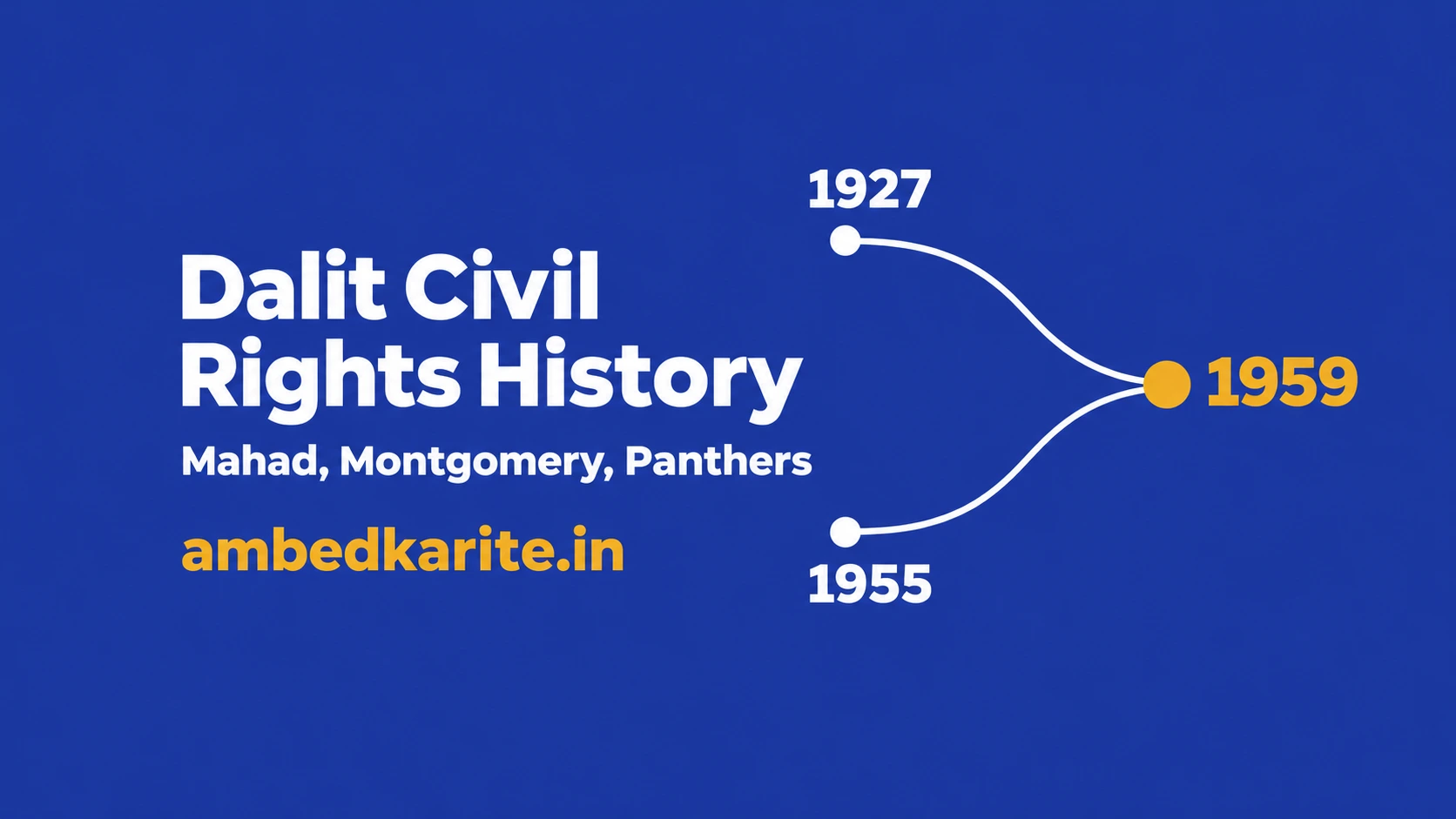
Dalit civil rights history includes struggles for water, temples and dignity that began before India’s 1950 Constitution (Teltumbde, 2022). The struggle of Dalits for their civil rights dates back to prior to the enactment of the Constitution of India, 1950. Parallels between Dalits and the African-Americans are evident in their struggles for the right to use public buses and water supply. The first of these struggles took place in 1972. The first direct action campaign by Dalits was the Mahad Satyagraha of 1927, and the bus boycott campaign led by Mahatma Gandhi in 1955 by the Dalits of India. The Dalit Panthers Movement was founded in 1972 in Bombay, India, modeled after the Black Panther Party of the US. In 1959, a principal in Kerala introduced Martin Luther King Jr. to the Dalits of India. Dalit is the term used to refer to people previously known as ‘untouchables’.
As of November 25, 2026, this is the extent of the available information to convey the views of both parties.
Dalit civil rights history: Mahad in 1927
Satyagraha is a word from Gandhi’s movement for nonviolent insistence on truth, and Ambedkar used it for the Mahad protest (Vision IAS, 2026).
Mahad Satyagraha was initiated by Dr. Ambedkar on 20th March 1927 to enable about 2500 Dalits to use the public water tank at Mahad. The Dalits of Mahad were denied access to the public water tank by the local municipality. Members of other castes performed ‘valu’ or purification ritual to ‘cleanse’ the tank after Dalits used the water. In December 1937 the Bombay High Court ruled in favour of the Dalits’ right to use the water of the tank.
Montgomery 1955: The Bus Boycott
Browder v. Gayle was the federal case that declared bus segregation in Montgomery unconstitutional (King Institute, 2025).
Rosa Parks’ arrest on December 1st of 1955 inspired the Montgomery bus boycott which began on December 5th (Supreme Court Historical Society 2026). The Montgomery Improvement Association, led by Martin Luther King Jr., oversaw the boycott (EBSCO 2021). segregation on the buses was ruled unconstitutional by the Supreme Court on November 13th, 1956 (King Institute 2025).
The boycott ended on December 20th, 1956, having lasted for 381 days (King Institute 2025).
Similarities between the Mahatma Gandhi and Martin Luther King Jr. boycotts
Like King’s campaign, the boycott led by Gandhi also attempted to end exclusion of certain people from using a public facility; in this case, public transportation in Montgomery, and a public water supply in Mahatma Gandhi’s case (The Mooknayak 2026). Both used nonviolent mass actions and legal proceedings to bring about change (Civilsdaily 2024).
In Montgomery, the Women’s Political Council spread the boycott call on flyers (Supreme Court Historical Society, 2026). Reaching people directly with a clear message is still the work of email marketing and blogging, both taught in the Ambedkarite Educational Program.
King and the Untouchables, 1959
Martin Luther King Jr. and his wife, Coretta, visited India between February 10th and March 10th of 1959 (King Institute 2025). On February 22th King spoke to the students of a school in Trivandrum whose students were mainly children of former ‘untouchables’ (King Institute 2025). King was surprised and annoyed by the school’s principle introducing him in that manner (King Institute 2025).
King then said “Yes, I am an untouchable”. He added that racial segregation in the US also ‘touches’ people with a sense of inferiority and stigmatizes them like the ‘untouchable’ class in India (King Institute 2025).
Dalit Panthers
The Black Panther Party was a US movement against racial oppression of African Americans that the Dalit Panthers took as a model (Samaj Weekly, 2026).
Same as Black Panthers
In 1972 Namdeo Dhasal, J.V. Pawar and Raja Dhale formed the Dalit Panthers in Bombay. The most widely accepted date for the formation of the group is the 29th of May 1972 (Hindus for Human Rights 2026). On the 15th of August the same year Raja Dhale wrote an article titled ‘Black Independence Day’ and compared it to Independence Day in India.
The name of the group was inspired by the Black Panther Party of the United States of America (Outlook India 2025). Like its American counterpart the Dalit Panthers also disbanded due to internal conflicts and crackdowns by the state (The Leaflet 2024).
Dalit Black Parallels
Wilkerson in her book Caste, draws comparisons between the US, India and Germany to demonstrate that in each of these countries, elements of the ‘caste’ system are at work (NPR 2020). Shridhar Pawar also writes that Dr. Ambedkar was influenced by Du Bois (The Leaflet 2024).
As Appadurai points out in his article, ‘caste’ has been part of society for a very long time, compared to ‘ race’ (Michigan Journal of Race and Law 2020). Dalit journalist Yashica Dutt has also expressed her frustration with Wilkerson’s overview of the ‘Caste’ system and its impact on the Dalit community (Michigan Journal of Race and Law 2020).
“ Parallels with the differences”
The laws that Montgomery was protesting were struck down by the federal court. Therefore, during the bus boycott, no segregation laws were in effect (King Institute, 2025). At Mahad, on the other hand, the municipality had already removed restrictions on use of the tank, and the obstacle was traditional social customs and caste prejudice of higher caste Hindus (The Mooknayak, 2026).
While both governments of India and the UN agree on descent being equivalent to race, their views on interpretation differ (CERD, 2007).
Dalit civil rights history: Mahad and Montgomery compared
| Mahad Satyagraha | Montgomery bus boycott | |
|---|---|---|
| Date | March 20, 1927 | December 5, 1955 to December 20, 1956 (381 days) |
| Goal | Dalits’ use of the public Chavdar tank | An end to bus segregation |
| Method | A procession and the drinking of water | A mass boycott of the buses |
| Organizers | A conference of Kolaba District Depressed Classes, chaired by B.R. Ambedkar | The Montgomery Improvement Association, led by Martin Luther King Jr. |
| Legal setting | Municipal and government resolutions had opened public tanks; the Bombay High Court ruled for the right in December 1937 | State and city laws required segregation; Browder v. Gayle declared them unconstitutional |
| Reaction | Caste Hindus performed a purification ritual at the tank | Violence against the boycott’s leaders and a long legal fight |
| Outcome | The right to use the tank was upheld | Montgomery buses were integrated on December 21, 1956 |
Sources: Feminism in India, 2017; The Mooknayak, 2026; Civilsdaily, 2024; Supreme Court of India, 2025; Supreme Court Historical Society, 2026; King Institute, 2025. The comparison is an analogy, not an equation.
Linked events, 1927 to 1977
| Date | What happened | Source |
|---|---|---|
| March 20, 1927 | Ambedkar leads a march to drink from the Chavdar tank at Mahad | Feminism in India, 2017 |
| December 1937 | The Bombay High Court rules that Dalits may use the tank | Civilsdaily, 2024 |
| December 5, 1955 | The Montgomery bus boycott begins | Supreme Court Historical Society, 2026 |
| December 20, 1956 | The boycott ends after 381 days | King Institute, 2025 |
| February 22, 1959 | King is introduced as a fellow untouchable at a Trivandrum school | King Institute, 2025 |
| May 29, 1972 | Dhasal and Pawar decide to found the Dalit Panthers, named after the Black Panthers | Hindus for Human Rights, 2026; Outlook India, 2025 |
| March 7, 1977 | The Dalit Panthers dissolve | The Leaflet, 2024 |
“What this means for the Dalit movement”
Scholars have called the Dalit struggle spearheaded by B.R. Ambedkar and his followers at Mahad in 1927 as the first organized Dalit movement (Teltumbde, 2022). Similarities in strategy and language between the Dalit and the Black movements are apparent (Michigan Journal of Race and Law, 2020). The Dalit Panthers were named after the Black Panthers in 1972 (Outlook India, 2025). King’s 1959 remark comparing the situation of Untouchables to that of Negroes in the US has also been cited by some scholars as the first time a public figure of King’s stature compared the conditions of the two groups (King Institute, 2025).
Movement histories survive when someone writes them down. Readers who want to learn to write clear, sourced histories of their own communities can start with the Ambedkarite Educational Program, a lifetime-access course at ₹297 (about $4 USD) that covers blogging, website building, email marketing, AI tools and Google AI, with all future courses included. The free Movement page is another place to begin.
This article draws on the King Institute’s account of King’s 1959 India visit and the Montgomery boycott, histories of the Mahad Satyagraha, first-person and web histories of the Dalit Panthers, and scholarship on the Dalit–Black comparison. Dates follow the sources cited, and parallels are presented as comparisons with their critics’ views.
Last updated: November 25, 2026
Frequently Asked Questions
What is Dalit Civil Rights History?
This refers to the historical struggle of Dalits to assert their rights and dignity. Some of these struggles include the Mahad Satyagraha of 1927 and the Temple Entry movements and others subsequently, including the formation of the Dalit Panthers in 1972 (Feminism in India 2017; Hindus for Human Rights 2026). Akbar Shah Teltumbde has called the Mahad Satyagraha, one of the first civil rights movements in history (Teltumbde 2022).
What are the Dalit-Black comparisons?
Comparable elements include use of mass non-violent protests to win claims to public goods, and use of a common vocabulary to describe elements of both caste and race discrimination. Critics of comparisons have stated that in some instances this comparison can be misleading (Michigan Journal of Race and Law 2020).
What is the connection between the Black and Dalit Panthers?
The Dalit Panthers was modeled after the Black Panther party of the US (Outlook India 2025). The former was founded in 1972 in Bombay.
What do the Montgomery Bus Boycott and the Mahad Satyagraha have in common?
Both were protest movements directed at gaining access to a particular public facility; participants in the Mahad Satyagraha protested to assert their right to use water contained in a public tank, and participants in the Montgomery Bus Boycott protested to assert their right to use public transport seating which was reserved for the white population (The Mooknayak 2026; King Institute 2025).
What was Martin Luther King’s view on untouchables?
King once stated “Yes, I am an untouchable” after he was introduced as such at a meeting in Kerala in 1959 (King Institute 2025).
Sources
- Routledge: Teltumbde, MAHAD: The Making of the First Dalit Revolt, 2022
- Feminism in India: The Significance of Mahad Satyagraha, 2017
- The Mooknayak: Mahad Satyagraha: The Struggle for Water, Dignity, and Human Rights
- Civilsdaily: Mahad Satyagraha
- Supreme Court of India: Centenary of Dr. B.R. Ambedkar’s enrolment as an advocate
- Vision IAS: Mahad Satyagraha, April 2026
- Supreme Court Historical Society: Browder v. Gayle
- King Institute, Stanford: Browder v. Gayle, 352 U.S. 903
- King Institute, Stanford: The Autobiography of Martin Luther King, Jr., Chapter 13, Pilgrimage to Nonviolence
- EBSCO Research Starters: Montgomery Bus Boycott
- Onmanorama: Martin Luther King’s tryst with truth in Kerala, 2019
- Outlook India: J.V. Pawar, Dalit Panthers: Founding A Movement
- Hindus for Human Rights: The Founding of the Dalit Panthers
- Samaj Weekly: Dalit Panthers: History, Role and Impact on Dalits
- The Leaflet: The Black Panther–Dalit Panther connection, 2024
- NPR: It’s More Than Racism: Isabel Wilkerson Explains America’s ‘Caste’ System, 2020
- Michigan Journal of Race and Law: Are Caste and Race Really Analogous?, 2020
- UN Human Rights: CERD concluding observations on India, 2007