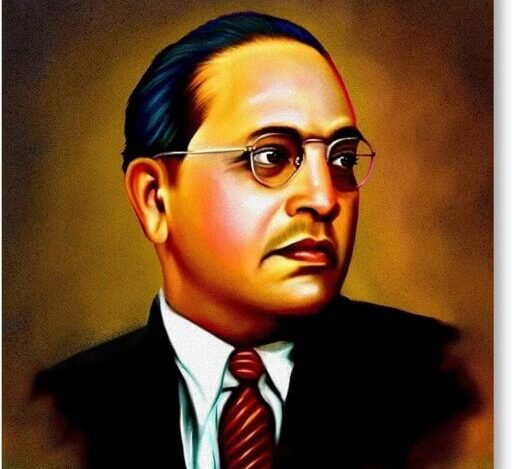
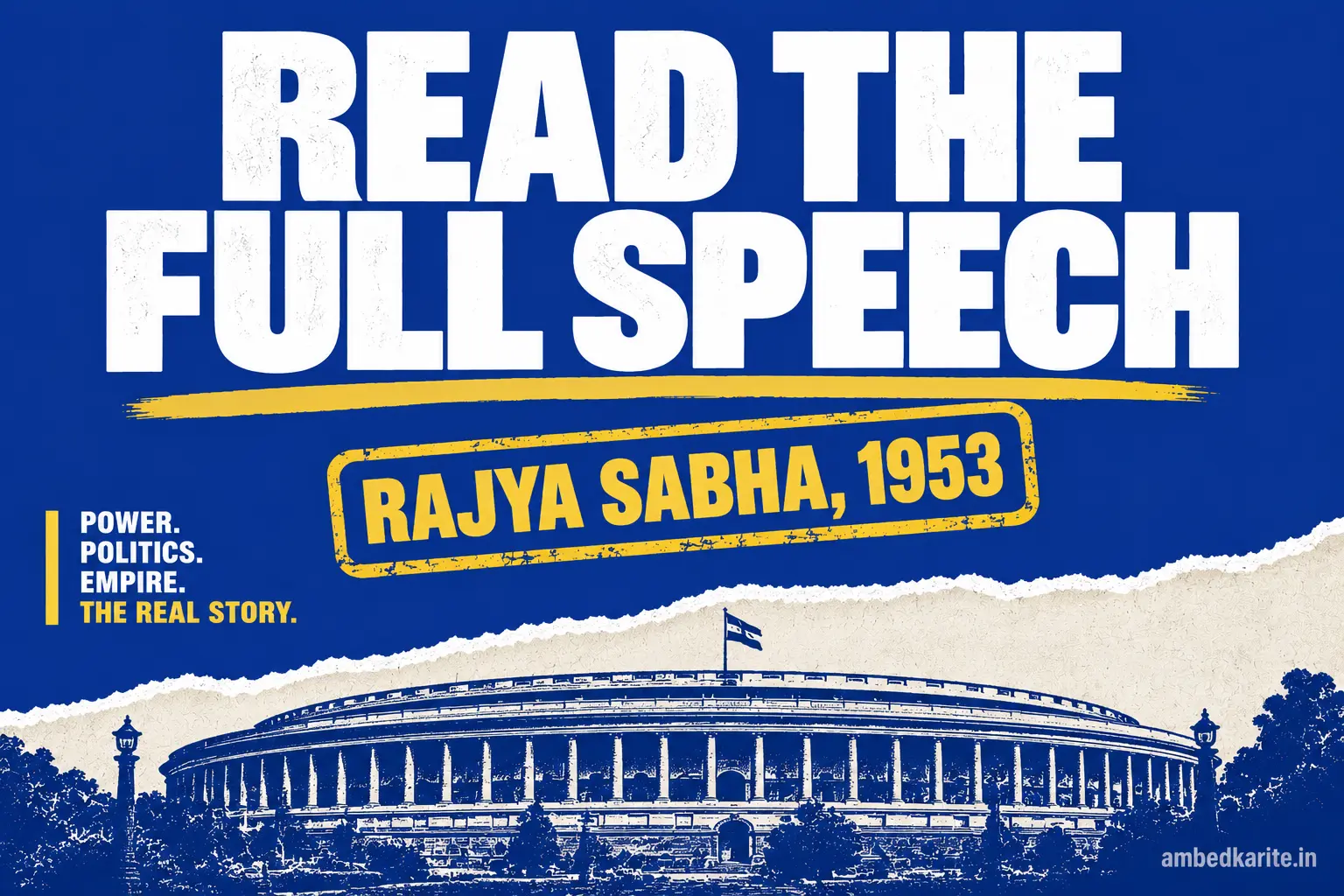
Poster-style graphic: Ambedkar burn constitution quote read in full, 1953 Rajya Sabha context | अंबेडकर संविधान जलाना की लाइन पूरे संदर्भ में पढ़ें: 1953 राज्यसभा पर नेवी-ब्लू पोस्टर स्टाइल ग्राफिक
Ambedkar Burn Constitution Quote: What He Really Said
One half-sentence has done a lot of work for a lot of people. Here is the full sentence and the speech surrounding it that “ambedkar burn constitution“.
The ambedkar burn constitution claim is based on a single line from the Rajya Sabha, 2 September 1953. The line exists. People’s interpretation of it is not what is on record (SC Observer, 2024). So let us read the speech, then his 1955 reply, and then what he said in 1949.
The ambedkar burn constitution claim, steel-manned
Anurag Bhaskar notes, “In 1953, he told the Rajya Sabha he would be ‘the first person to burn it out’ (2 September 1953, Rajya Sabha Debates, via SC Observer). People’s interpretations of it range from, anger to frustration, to an act of defiance and public disavowal (SC Observer). Suraj Yengde relates this to Ambedkar’s 1927 public burning of the Manusmriti (SC Observer). You can find out more about this in our post on Abolishing Sanatana Dharma and Ambedkar.
As Bhaskar notes, this line is employed in two different ways. For some, citing this line means advocating for a new constitution. For others, it means that Ambedkar had no role to play in the constitution we have today (SC Observer). Therefore, it is worth examining this in detail.
What was discussed in the 1953 Rajya Sabha debate?
The House was considering the Andhra State Bill, which proposed the creation of a linguistic State after the demise of Potti Sriramulu (SC Observer; The Wire, 2025). Ambedkar was not happy with the Bill because it did not contain any special provisions for protection of minorities, particularly the Dalits (SC Observer). He pointed out that the Governor could be given special powers to protect minorities and that would not be in violation of the ‘aid and advice’ of the rule (SC Observer).
In response, the then Home Minister, K. N. Katju said that this went against the Constitution that Ambedkar had drafted (The Wire). Ambedkar said that people call him the maker of the Constitution, and he says he is a ‘hack’ and did what he was instructed to do against his wishes (SC Observer).
Then came the line that he is remembered for. He said his friends told him that he was the maker of the Constitution, and he would be the first to burn it (Rajya Sabha Debates, 2 September 1953, via SC Observer). This was not the only thing that he said. He said that, if the people want to go ahead like this, they should not ignore the minorities by saying that recognizing them would adversely affect democracy, and that the greatest injury to democracy would be caused by injuring the minorities (SC Observer).
He ended by asking the Home Minister to consider his suggestions (SC Observer). It can be said, therefore, that the above-mentioned ‘burning’ statement was made while laying down his case for minority safeguards, and he was not asking the House to burn the Constitution.
Ambedkar burns the Constitution: his 1955 reply
On 19 March 1955, the Rajya Sabha was debating the Constitution (Fourth Amendment) Bill, 1954 (The Wire). A member recalled his earlier speech, and Ambedkar explained it with a metaphor (The Wire). A temple is made for a god to reside, but if a devil takes it over before the god is installed, what can one do but destroy the temple, he said (The Wire)?
Another member suggested destroying the devil and not the temple (The Wire). A proud Ambedkar replied that one cannot do it (The Wire). The Wire further adds that in the same speech Ambedkar said that the Constitution was a “wonderful document” (The Wire).
In the metaphor, the devil is not the Constitution, but the people who misuse the Constitution. That was also his argument in 1953 about majorities.
What Ambedkar said about the Constitution in 1949
A reply to this myth can be found in his speech on 25 November 1949, in the Constituent Assembly. He said the working of the Constitution is determined by the people and the parties who implement it. A good Constitution can turn bad if those who work it are a “bad lot” (CAD, Vol 11, 25 November 1949).
He remarked that the Assembly made the Constitution easy to amend, and did not provide a seal of finality (CAD, Vol 11, 25 November 1949). With regard to this, he quoted Jefferson on how each generation is a distinct nation (CAD, Vol 11, 25 November 1949). Therefore, it is amended by laws and not by burning.
He mentioned the fear of “a life of contradictions” on 26 January 1950, (CAD, Vol 11, 25 November 1949) e.g. equality in politics but inequality in social and economic status. He feared that the social and economic inequality may lead to the blowing up of the political democracy.
Did Ambedkar write the Constitution? What the record says
He chaired the Drafting Committee (CAD, Vol 11, 25 November 1949) which was elected by the Assembly on 29 August, 1947 and worked for 141 days (CAD, Vol 11, 25 November 1949). The draft of the constitution by the Constitutional Adviser had 243 articles and 13 Schedules (CAD, Vol 11, 25 November 1949). The first draft by the Drafting Committee had 315 articles and 8 Schedules and the final draft had 395 articles (CAD, Vol 11, 25 November 1949).
Ambedkar claimed the Drafting Committee got most of the credit. He stated that partial credit is due to B. N. Rau (CAD, Vol 11, 25 November 1949), as he was the author of the rough draft, and S. N. Mukherjee, the chief draftsman (CAD, Vol 11, 25 November 1949), got the biggest credit. The final draft was prepared by 1 October, 1947 (Bar & Bench).
Rewrites must be completed in third person and can not contain jokes, expressions, or fluff. Rewrites must adhere to the input’s tone and register. Check word counts before finalizing. Include every single idea in the input.
Rajendra Prasad, the President of the Assembly, praised the “zeal” of the Drafting Committee, especially its Chairman, in a speech on 25th November 1948 (The Wire on Ambedkar’s role). Thus, the arguments “Ambedkar had nothing to do with it” and “Ambedkar alone wrote it” are false. It was a team of which he was the Chairman.
Why the “ambedkar burn constitution” claim keeps coming back
A half-sentence travels fast. The sentence before it and the sentence after it do not. Like Bhaskar notes (SC Observer), this claim works for two opposite camps.
The Wire notes that those who wish to read and criticize the Constitution and make changes to it also quote this (The Wire). Reading the entire speech instead of a screenshot is the habit the Ambedkarite Educational Program trains: blogging and SEO, Website creation, and Google AI. For the same habit applied to another claim about the Constituent Assembly, see Did Ambedkar want 10-year reservation?
Takeaway
The Ambedkar burns the constitution line is real and was said in anger due to the absence of minority safeguards (SC Observer). In 1955 he related it to the temple and the devil and praised the constitution in the same speech (The Wire). In 1949 he said it would work or fail depending on the people who ran it (CAD, Vol 11, 25 November 1949). Read the entire speech.
Babasaheb gave us 3 words: Educate. Agitate. Organize.
Reading is Educate. Agitate and Organize start when you share a sourced page, not a screenshot.
Currently, TikTok (Reels) get Shadow banned. Accounts get Banned. So Bahujans need their own platforms: Emails, Blogs and websites.
The Ambedkarite Educational Program can help you build these platforms. ₹297 lifetime access. Includes: Prompt Engineering, Google AI, Website building, Email Marketing and Blogging, SEO, Canva and everything else for free. Or join the free Movement to get access to the email list.
Frequently Asked Questions
Did Ambedkar say he would burn the Constitution? Yes, in the Rajya Sabha on 2 September 1953, during the Andhra State Bill debate. The remark came in an argument for minority safeguards (SC Observer).
Why did Ambedkar say he would burn the Constitution? He objected that the Bill gave no special protection to minorities, and in 1955 he explained the remark with a temple and a devil (SC Observer; The Wire).
Did Ambedkar write the Constitution? He chaired the Drafting Committee. He credited B. N. Rau, S. N. Mukherjee and the Committee, so it was a team effort he led (CAD, Vol 11, 25 November 1949).
What did Ambedkar say about the Constitution in 1955? In the Rajya Sabha on 19 March 1955, he explained the burning remark and called the Constitution a wonderful document (The Wire).
Where can I read the 1949 speech? In the Constituent Assembly Debates, Vol 11, 25 November 1949 (Supreme Court archive copy).