Battle of Bhima Koregaon, explained with sources. What really happened in 1818, who fought, and why the “traitor” myth falls apart.
Here’s a fun fact that ruins everyone’s argument 👇
The battle of bhima koregaon is attacked from two sides at once. One side says Dalits were traitors who helped the British. The other side says nothing special happened there at all. Both camps can’t be right. And honestly, neither is.
So let’s go to the records.
What was the Battle of Bhima Koregaon?
On 1 January 1818, a small East India Company force was attacked at Koregaon Bhima, a village on the Bhima river near Pune (The Hindu, 2018). It was one of the last fights of the Third Anglo-Maratha War. The Company force held its ground for about twelve hours. Then the attackers pulled back.
That’s the skeleton. The fight over what it means has been running for 200 years.
Bhima Koregaon 1818 history — the 30-second version
Peshwa Baji Rao II had lost Pune to the Company and was moving to take it back. His camp held roughly 28,000 men — about 20,000 cavalry and 8,000 infantry (Indian Express, 2018).
Captain Francis Staunton was marching from Shirur with around 834 men to reinforce Pune. Roughly 500 of them came from the Mahar community (Indian Express, 2018). On the way, the two forces ran into each other.
The Peshwa did not send all 28,000. He sent about 2,000 — three infantry parties of 600 each, made up of Arab, Gosain and Maratha soldiers (Indian Express, 2018). Staunton dug into the village. Twelve hours later the Peshwa’s men withdrew, because a larger British column under General Smith was reported to be coming.
So the “500 Mahars killed 28,000 Brahmins” line you see on WhatsApp? That is not what happened. Drop it. The real story doesn’t need it.
The claim: what critics say about the Battle of Bhima Koregaon
Let’s put their case at its strongest, not its weakest. Here is the full charge sheet against the battle of bhima koregaon as a Dalit symbol:
- The battle had no clear winner. Even Mountstuart Elphinstone, the British Resident, called it a “small victory” for the Peshwa side (Indian Express, 2018).
- The Peshwa’s attacking force was mostly Arab mercenaries, not Brahmins. So it wasn’t Dalit vs Brahmin.
- Mahars served on both sides. Caste lines did not match army lines.
- The Mahar Regiment did not exist in 1818. It was raised in 1941 (Forefront for Ever: The History of the Mahar Regiment, V. Longer, 1981).
- Celebrating it means celebrating the people who colonised India.
That’s a serious list. Some of it is simply true. Let’s take it point by point.
Where the argument falls apart
“The battle was inconclusive”
Militarily, fine. Neither side destroyed the other, and Wikipedia-tier summaries list the result as inconclusive. But the pillar the British raised at the site in 1821 reads that Staunton’s force “accomplished one of the proudest triumphs of the British Army in the East” (Koregaon Pillar inscription, 1821).
Here’s the thing. The symbol was never about territory. Around 834 men, under-supplied and outnumbered, held a position against a force sent by an empire. Twenty-two of the names carved on that pillar carry the suffix “-nac”, used only by Mahar sepoys (Kumbhojkar, Economic and Political Weekly, 2012). That is the fact doing the work. Not the win-loss column.
“The Peshwa army was not all Brahmin”
Correct. The attacking parties were Arabs, Gosains and Marathas, and the Arabs took the heaviest casualties (Indian Express, 2018). Nobody serious claims a Brahmin infantry charge happened.
But the Peshwai was a regime, not a regiment. What Mahars were fighting was the government in Pune, its laws and its enforcement. You don’t need the ruler’s caste to be standing in the front line for the rule to be his.
“Mahars fought on both sides”
Also true, and worth saying out loud. Records note Mahars among the Peshwa’s infantry too. Caste did not sort people into neat armies in 1818.
Still, that cuts both ways. If Mahars had no grievance, the ones in Company service had no reason to hold a village for twelve hours against four-to-one odds. The grievance is documented. We’ll get to it.
“The Mahar Regiment didn’t exist in 1818”
Completely true. The Mahar Regiment was raised on 1 October 1941 at Belgaum (Forefront for Ever, 1981). In 1818 the Mahar soldiers were part of the 2nd Battalion, 1st Regiment Bombay Native Infantry.
Here’s the catch, though. The Mahar Regiment put the Koregaon Pillar on its own crest, and kept it there until Independence (Forefront for Ever, 1981). The regiment did not create the memory. The memory created the regiment’s badge.
“You’re celebrating colonialism”
This is the sharpest one, so let’s not dodge it. Ambedkar didn’t dodge it either — he answered it directly, which we’ll cover next.
Quick reality check on the alternative. In 1818 the “nationalist” option on offer was a state that legislated where an untouchable could walk and at what hour. Asking a community to die defending the regime that banned its shadow from public roads is not patriotism. It’s a demand for loyalty that was never reciprocated.
Did dalits help british conquer india? Ambedkar answered this himself
He did not hide from this question. He wrote it out in full.
In The Untouchables and the Pax Britannica, Ambedkar asks who actually filled the Company’s armies, and answers: the people who joined the army of the East India Company were the Untouchables of India. The men who fought with Clive at Plassey were Dusads, and the men who fought at Koregaon were Mahars (BAWS Vol 12, The Untouchables and the Pax Britannica). spi
Then he says the line nobody quotes. Treason or no treason, this act of the Untouchables was quite natural (BAWS Vol 12, The Untouchables and the Pax Britannica). spi
Read that again. He names the charge. He doesn’t deny the facts. He asks what loyalty a society earns when it denies you roads, water and schools.
And the same Ambedkar tore into British rule in that same manuscript, arguing the Raj did almost nothing to end untouchability and simply inherited the social order it conquered (BAWS Vol 12, The Untouchables and the Pax Britannica). The man was not a fan of the British. He was a fan of evidence.

Life under the Peshwai — the part nobody wants to quote
This is where the “it was just a colonial battle” argument runs out of road.
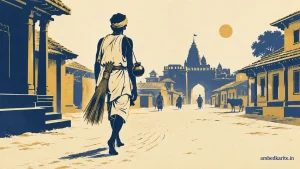
Ambedkar documented the rules in Annihilation of Caste: under the Peshwas, an untouchable could not use a public street if a Hindu was coming, in case his shadow caused pollution. In Poona he had to carry a broom strung from his waist to sweep away his own footprints, and an earthen pot hung from his neck to catch his spit (BAWS Vol 1, Annihilation of Caste).
That is not only an Ambedkarite source. R.V. Russell, the colonial Superintendent of Ethnography, recorded the same practice in The Tribes and Castes of the Central Provinces of India (Russell, 1916). Two very different authors. Same detail.
Now go back to 1818 and ask why mahar soldiers peshwa army service was so thin on the ground, and why the ones in Company uniform held that village all day.
You don’t fight for a state that measures your shadow.
A side note worth sitting with. Ambedkar found that 1894 petition for Mahar army recruitment years later, in a bundle of his father’s old papers (Forefront for Ever, 1981). His father was a soldier. His starting point was a document. Our generation’s version of that is different — the argument now gets won or lost on search results, feeds and AI answers, which is exactly the skill set the Ambedkarite Educational Program was put together for.
1892 — when the British dumped the Mahars too
If the British loved the Mahars, somebody forgot to tell the British.
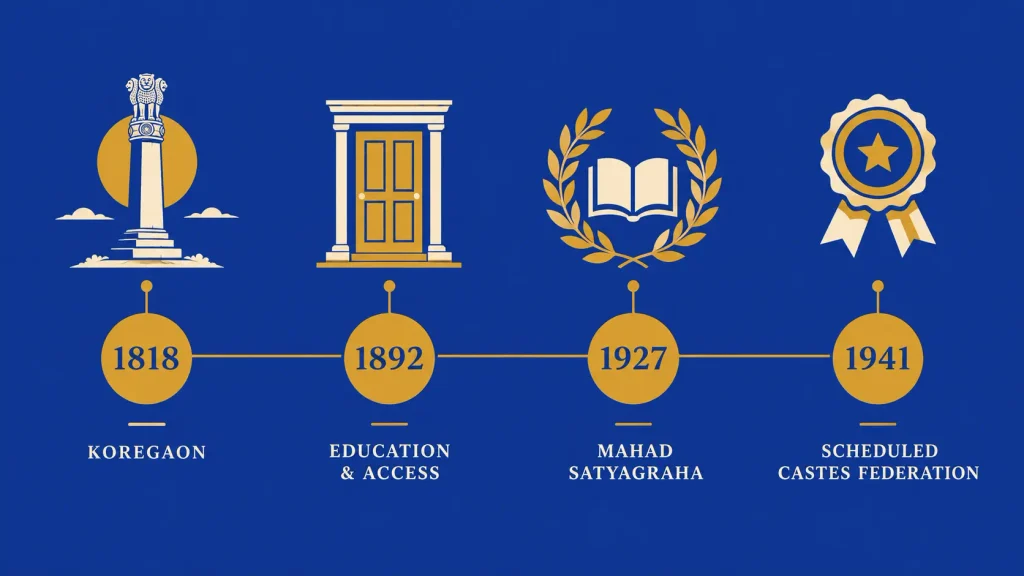
In May 1892 the Government of India stopped recruiting Mahars, reclassifying them as a “non-martial race” under the martial races doctrine (Kumbhojkar, Economic and Political Weekly, 2012). Before that, Mahars had made up roughly a fifth to a quarter of the entire Bombay Army.
Gopal Baba Walangkar, himself an ex-soldier, drafted a petition against the ban in 1894. Shivram Janba Kamble drafted another in 1904 (Forefront for Ever, 1981). Many Mahar pensioners refused to sign, scared of losing their pensions.
A Mahar battalion, the 111th Mahars, came up in June 1917 when the British ran short of men in the First World War. It was merged away in 1920 and disbanded in March 1921 (Forefront for Ever, 1981).
So the “British rewarded their Dalit allies” story collapses. The Company used them, then the Raj locked the door. That’s the whole arc.
Ambedkar reopened it himself. Appointed to the Viceroy’s Defence Advisory Committee in July 1941, he pushed for a Mahar regiment and called on Mahar youth to enlist. The 1st Battalion was raised at Belgaum on 1 October 1941 (Forefront for Ever, 1981).
Vijay stambh koregaon ambedkar connection — 1 January 1927
The pillar sat there for a century, mostly a British war memorial.
Then Shivram Janba Kamble invited Ambedkar to the anniversary gathering, and on 1 January 1927 Ambedkar stood at the Vijay Stambh and paid tribute (Indian History Collective, 2020). He kept coming back, year after year.
That one visit flipped the meaning. A colonial obelisk became a receipt — proof that the ancestors of people who were told they were unfit to carry arms had carried arms, and held.
Two and a half months later, on 20 March 1927, the same man led the Mahad Satyagraha for the right to drink water from a public tank (Indian Express, 2016). Same year. Same argument, different front.
Today lakhs gather at Koregaon Bhima every 1 January for Shaurya Diwas. It is one of the largest self-organised gatherings in the country (The Hindu, 2018).
What honest Ambedkarites should admit
Fact-first means fact-first even when it stings. Four corrections our own side should make:
- “500 Mahars defeated 28,000.” No. Around 834 Company troops, about 500 of them Mahar, held off roughly 2,000 attackers out of a 28,000-strong camp (Indian Express, 2018).
- “They killed 28,000 Peshwa soldiers.” No. Around 50 bodies were counted in the village, mostly Arab soldiers of the Peshwa’s force (Indian Express, 2018).
- “The Mahar Regiment won it.” No. That regiment was raised in 1941 (Forefront for Ever, 1981).
- “It was a clean caste war.” No. Mahars served on both sides, and the Arab battalion did most of the fighting for the Peshwa (Indian Express, 2018).
Anand Teltumbde has argued from within the movement that framing the battle purely as Mahars versus Brahmanical Peshwa rule is a myth that locks Dalits into identity politics (Teltumbde, cited in Janata Weekly, 2018). You don’t have to agree with him. But you should be able to answer him, and you can’t do that with a forward you never checked.
Here’s the thing: the symbol survives all four corrections. Ambedkar built it on documented valour and documented humiliation, not on a body count.
Why this myth keeps coming back
Follow the use, not the argument.
Calling the battle of bhima koregaon an act of treason does one job. It lets a community be labelled anti-national today for something its ancestors did under a government that treated them as pollution. It reframes a demand for dignity as a loyalty problem.
And the symbol is genuinely inconvenient. A memorial that proves “untouchables” fought and held a line destroys the entire premise of the caste order — the claim that they lacked that capacity in the first place (Kumbhojkar, Economic and Political Weekly, 2012).
So the loudest version of the attack never argues with Ambedkar’s actual paragraph. It argues with a WhatsApp forward. That’s the trick. Don’t fall for it.
A note of caution: the 2018 Koregaon Bhima violence and the Elgar Parishad case are still working their way through the courts (The Hindu, 2018). This article makes no claim about any living individual’s guilt or innocence. That’s for the courts.
Takeaway
The receipts on the battle of bhima koregaon are boring and public. Around 834 men held a village for twelve hours. Twenty-two Mahar names are carved on a pillar.
Ambedkar looked at that pillar in 1927 and read it as proof of capacity, not proof of loyalty to anyone.
Get the numbers right. Then the argument is unloseable. 💪
Babasaheb gave us three words: Educate. Agitate. Organize.
Reading this is “Educate.” But Agitate and Organize need tools. Walangkar’s weapon in 1894 was a petition. In 2026 the fight happens on search results, feeds and AI answers — and those get shaped by whoever learns to write, publish and rank.
The Ambedkarite Educational Program is built for exactly that — ₹297 lifetime, covering Prompt Engineering, Google AI, Website Building, Email Marketing, Blogging & SEO and Canva, with all future courses added free. If ₹297 is tight right now, use coupon KUNALLONHARE and take it free. Pay only if you can, and only if you think the work deserves support.
Or join the Movement free and start with the email list. 📚
What’s your take? Drop a comment below and share this article with someone who still believes the myth.
P.S. — If you want to earn while spreading this, there’s an affiliate program.
FREQUENTLY ASKED QUESTIONS
Who won the Battle of Bhima Koregaon?
Militarily it was indecisive. The Company force under Captain Staunton held the village for about twelve hours, and the Peshwa’s troops withdrew fearing a larger British column. Because the Third Anglo-Maratha War ended in a Peshwa defeat, it is recorded as a Company victory.
Did 500 Mahars really defeat 28,000 soldiers?
No. The Company force was about 834 men, roughly 500 of them Mahar. The Peshwa’s camp held 28,000, but only about 2,000 were sent to attack. Around 50 bodies were counted after the fight, mostly Arab soldiers.
Why do Dalits celebrate Bhima Koregaon?
Twenty-two Mahar names appear on the Koregaon Pillar. For a community told it was unfit to bear arms, that is physical proof of the opposite. Ambedkar visited the Vijay Stambh on 1 January 1927 and turned it into an annual Shaurya Diwas gathering.
Did Dalits betray India by fighting for the British?
Ambedkar addressed this directly in The Untouchables and the Pax Britannica, writing that treason or not, the act was natural given how Indian society treated untouchables. He also attacked British rule in the same manuscript for doing nothing to end untouchability.
Was the Peshwa army at Bhima Koregaon all Brahmin?
No. The attacking force was made up of Arab, Gosain and Maratha soldiers, and the Arab battalion took the heaviest losses. The conflict was with the Peshwa regime and its caste laws, not with an infantry line sorted by caste.
EXTERNAL LINKS (verified, Tier 1–3)
- BAWS Vol 12, The Untouchables and the Pax Britannica (full text PDF) — https://www.bhsbs.org/wp-content/uploads/2018/04/the-untouchables-and-the-pax-britannica.pdf
- Indian Express — “Battle of Koregaon: Why the Dalits hate Peshwas and celebrate this British ‘victory'” — https://indianexpress.com/article/research/battle-of-koregaon-dalits-mahar-maratha-peshwa-maharashtra-protests-5010172/
- Indian History Collective — “The Contesting Memories of Bhima-Koregaon” — https://indianhistorycollective.com/the-contesting-memories-of-bhima-koregaon/
- Forward Press — “The end of the Peshwai at the hands of the Mahars and Mangs” — https://www.forwardpress.in/2015/01/the-end-of-the-peshwai-at-the-hands-of-the-mahars-and-mangs/