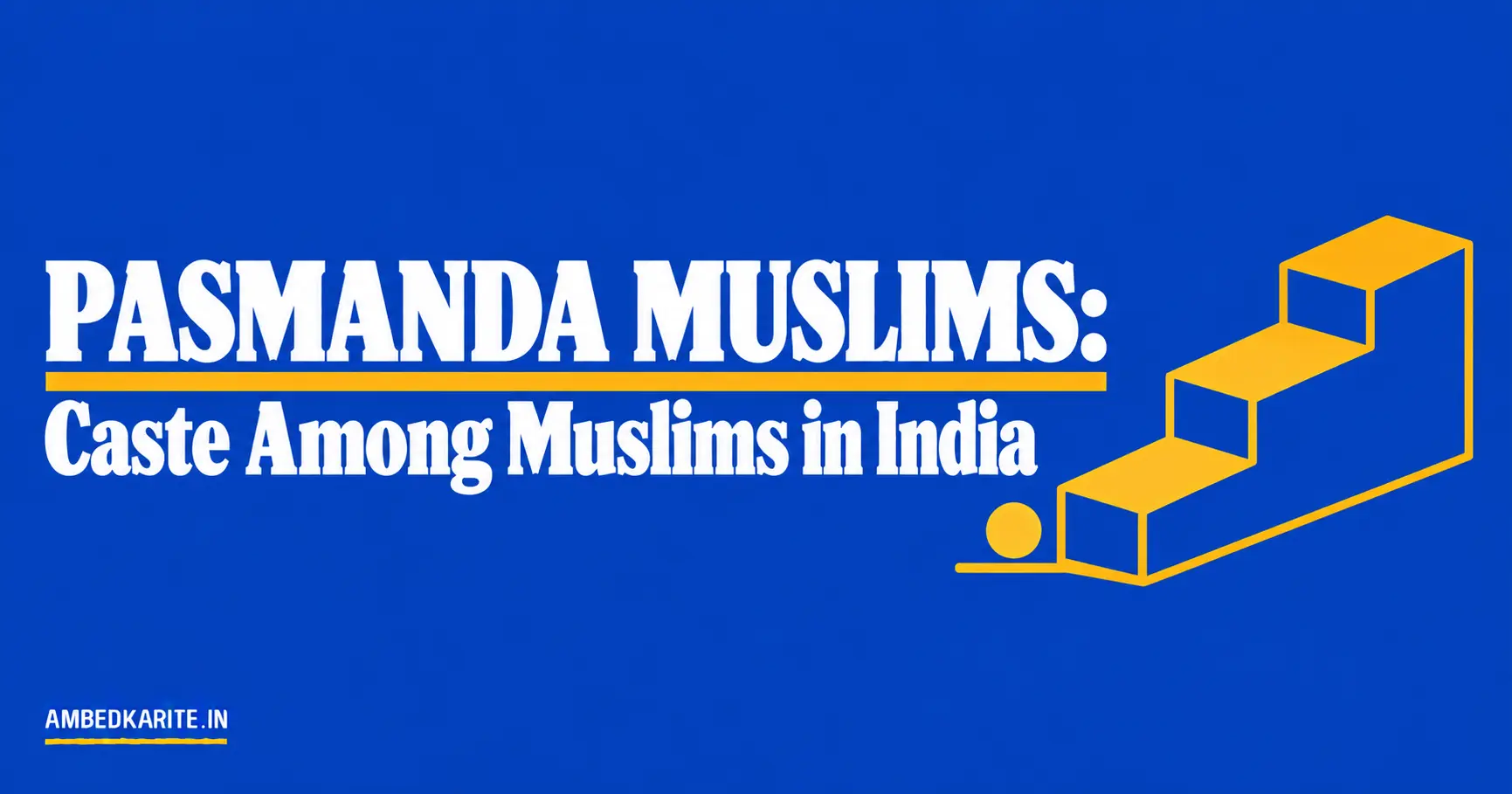
In India, Pasmanda refers to backward, Dalit and tribal Muslims. The term is derived from a Persian phrase meaning “those left behind” (Shankar IAS, “The Pasmanda Muslims”). The term shows that caste is not restricted to the Hindu community. This article explains the meaning of Pasmanda, the traditional divisions of Indian Muslims, the movement behind this term, reports of various government commissions, the legal aspects of the term and the various arguments surrounding it. The article quotes each passage. This is a politically charged topic, therefore, to maintain neutrality, the author mentions where she has cited various passages.
What does Pasmanda mean?
There are two Persian words, “pas” and “manda”, which combine to mean “those who have been left behind” (Mainstream Weekly, “Mapping Pasmanda Politics in India”). The term is used for the depressed classes among Muslims, and backward, Dalit and tribal Muslims use it for an umbrella identity (Shankar IAS; IAS Gyan, “Pasmanda Muslims”). The term was coined in 1998 by Ali Anwar Ansari, when he founded the Pasmanda Muslim Mahaz (Shankar IAS; Wikipedia, “Ali Anwar”).
Ashraf, Ajlaf and Arzal among Muslims in India
Scholars and various commissions have described Indian Muslim society as divided into broad status groups, or biradaris. The three categories most often cited are:
- Ashraf. Muslims of foreign descent from Arabia, Persia, Turkey or Afghanistan, or upper-caste converts from Hinduism (Shankar IAS).
- Ajlaf. Middle-caste converts from Hinduism who have occupied ritually clean professions such as weavers, tailors and vegetable sellers (IAS Gyan).
- Arzal. The lowest group described as “untouchable” castes. Their occupations include scavenging, washing clothes, barbering and butchering (IAS Gyan). Arzal means “degraded” (Wikipedia, “Persecution of minority Muslim groups”).
Pasmanda is usually defined as the combination of Ajlaf (backward Muslims) and Arzal (Dalit Muslims) (Mainstream Weekly, citing the Sachar Committee Report). The All India Pasmanda Muslim Mahaz also states that while some people deny the existence of such a structure in Indian Muslim society, they believe it is perfectly true (AIPMM, “Pasmanda Muslim community”). Wikipedia states that Ambedkar and other anti-caste activists referred to Arzal as untouchables (Wikipedia, “Persecution of minority Muslim groups”). For comparative explanation of the Hindu system, please see our guide on who the Dalits are and our guide on how the system works.
The Pasmanda movement
The All India Pasmanda Muslim Mahaz was founded in 1998 by journalist, and later Rajya Sabha member, Ali Anwar (AIPMM; Wikipedia, “Pasmanda Muslim Mahaz”). His writing led to the publication of Masawat ki Jang (Fight for Equality), in which he claims that Indian Muslims are not a homogeneous community, and that existing organisations serve the upper caste Muslims (Wikipedia, “Ali Anwar”). As explained elsewhere, Mahaz was created as an umbrella organization to represent the interests of Dalit and backward Muslim communities (Wikipedia, “Pasmanda Muslim Mahaz”).
One of its demands has been to include Dalit Muslims and Christians in the Scheduled Castes list, as has been done in the case of Dalit Buddhists and Dalit Sikhs (Wikipedia, “Ali Anwar”). Anwar has also said that Pasmanda should be understood in class terms than in caste terms (Mainstream Weekly). The movement has had internal conflicts. Anwar’s support for a seat-sharing alliance with the BJP has drawn criticism from various other Muslim organizations, including those within the Mahaz (Wikipedia, “Ali Anwar”), and the AIPMM said that its activities were weakened after he was elected to the Rajya Sabha on an NDA ticket (AIPMM).
What the commissions said
The 2006 report of the Sachar Committee, set up to examine the condition of Indian Muslims, states that several studies have shown the existence of descent-based stratification among Muslims (Round Table India, “The Pasmanda Muslim Question and the BJP”). The report estimated the OBC and SC/ST Muslims to be 40 per cent in 2004-05 (Shankar IAS). The Ranganath Misra Commission (2007) observed that if any social or vocational class is ignored in the Scheduled Castes due to their religion, it will be automatically be viewed that they are socially backward classes, even if their religion is not at all recognizing the system of caste (Round Table India). Our article on Other Backward Classes summarizes the class that a number of Muslim communities come under.
The legal position
As per The Constitution (Scheduled Castes) Order, 1950, only Hindus, Sikhs and Buddhists can be classified as Scheduled Castes. Thus, Dalit Muslims are out of this list. Refer our guide to scheduled castes. In March 2026, the Supreme Court ruled in a case on conversion to Christianity that a person loses his/her status of a Scheduled Caste if he/she converts to a religion other than Hinduism, Sikhism and Buddhism (SCC Online; The Wire). A separate case challenging this provision is pending before the Court (as of now). Refer our guide to caste reservation in India for information on quotas.
How many Pasmanda Muslims are there?
As per various activist groups, 80-85% of the Muslim population is Pasmanda Muslims (Shankar IAS; Round Table India). AIPMM puts the figure of the Ashraf at 15% (AIPMM). These are estimates and not official figures, as caste has not been captured in Census for Muslim community. The figure of the Sachar Committee, which says 40% of OBC/SC/ST Muslims are below poverty line, is also different from this, as it captures a narrower legal definition. Census 2027 will capture caste (Our guide to OBC).
The dispute
Not everyone agrees with the Pasmanda interpretation. Some members of the Ashraf or upper strata have said that Pasmanda politics splits the Muslim community, and a writer cited in Mainstream Weekly has argued that casteism among Indian Muslims does not exist, thus reservation should be given to all Muslims on the basis of economic conditions (Mainstream Weekly, citing Hassan, 2012). Supporters of the Pasmanda movement have said they agree with social stratification by caste (Mainstream Weekly). Another view has been that the term “Pasmanda” is too wide, and is not fair to the bottom most groups (Round Table India).
Politics has also entered this debate. The Prime Minister has reportedly told the BJP national executive in 2022, to reach out to the Pasmanda Muslims in Uttar Pradesh and Bihar (Shankar IAS). There are scholarships on the party’s endeavors to tackle the “lower castes” amongst the non-Hindus and proposed national commissions for such castes for the Muslims and Christians (Round Table India). Please see the log.
Beyond Hinduism
Debates such as the Pasmanda debate demonstrate how the caste system cuts across the various religions of the South Asia region. Our posts on the Ravidassia and Bahujan reflect on the caste system amongst Sikhs and various other communities respectively. The IAS Gyan website notes that Islam in theory does not support a social hierarchy, however, there are numerous caste structures within the Muslim community in India. (Note to self: Documenting and blogging your history is very important. Learn how to do this.)
Takeaway
Pasmanda Muslims refer to backward (Ajlaf), Dalit (Arzal) and tribal Muslims in India and translates to “those left behind.” It gained prominence in 1998 with the founding of the Pasmanda Muslim Mahaz by Ali Anwar. The Ranganath Misra Commission and the Sachar Committee observed and documented caste-like structures in the Muslim community. However, within this system, Dalit Muslims are excluded from the Scheduled Caste status. Rough estimates say that 80-85% of the Muslim community in India fall within the Pasmanda category, and have not been documented.
Frequently Asked Questions
Who are the Pasmanda Muslims?
The name for backward, Dalit and tribal Muslims in India. It comes from a Persian phrase meaning “those left behind” and was first used in 1998 by Ali Anwar Ansari.
Is there caste among Muslims in India?
Scholars, government commissions and Pasmanda activists say there is a caste-like structure, usually described as Ashraf, Ajlaf and Arzal. Some people deny that caste exists among Muslims.
What do Ashraf, Ajlaf and Arzal mean?
Ashraf are Muslims who claim foreign descent or upper-caste origin. Ajlaf are middle-caste converts in occupations seen as clean. Arzal are the lowest group, historically described as untouchable.
Can Dalit Muslims get Scheduled Caste status?
Not under the 1950 Order, which limits it to Hindus, Sikhs and Buddhists. A challenge to this rule was pending when last reported.
What did the Sachar Committee say?
It reported in 2006 that studies point to descent-based stratification among Muslims, and it put OBC and SC/ST Muslims at 40 per cent in 2004–05.
Understanding caste is step one. Building digital independence is step two.
Ambedkarite communities around the world are using AI tools, blogging and email marketing to document their experiences, challenge discrimination and build platforms that cannot be silenced.
The Ambedkarite Educational Program teaches exactly these skills: AI tools, website building, email marketing, blogging and Google AI. Lifetime access is ₹297 (~$4 USD). All future courses are included free.
Or join the Movement free to start learning today.
SOURCES
- Shankar IAS, “The Pasmanda Muslims”
- IAS Gyan, “Pasmanda Muslims”
- Round Table India, “The Pasmanda Muslim Question and the BJP”
- Mainstream Weekly, Shamsher Alam, “Mapping Pasmanda Politics in India: Demands and Challenges”
- All India Pasmanda Muslim Mahaz, “Pasmanda Muslim community and their social, economic, and religious conditions”
- Wikipedia, “Ali Anwar”
- Wikipedia, “Pasmanda Muslim Mahaz”
- Wikipedia, “Persecution of minority Muslim groups” (section on castes among Indian Muslims)
- SCC Online, “Conversion to Christianity ends Scheduled Caste status,” March 25, 2026