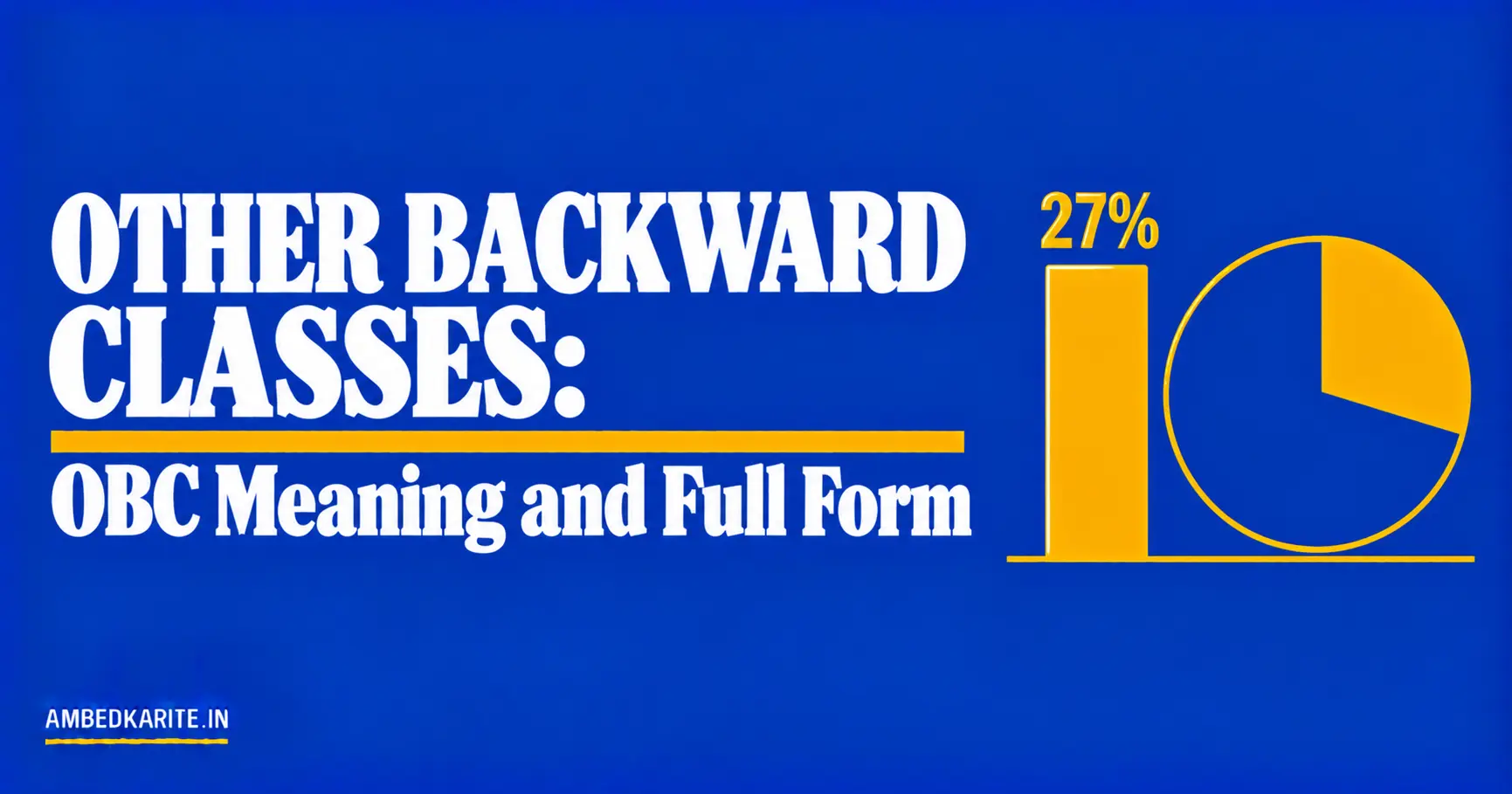
Officially, Other backward classes (OBCs) is the term used to classify the castes and tribes that the Constitution classifies as backward. According to the Constitution of India, OBCs constitute 27 percent of the total seats reserved for Central government jobs and Higher education (Wikipedia, “Mandal Commission”). In Indian law, OBCs fall below Scheduled Castes (SCs) and above the general class. This guide explains what OBC means, its derivation, who creates the list, the “creamy layer” rule, and why estimating the OBC population is not an exact science. This guide does not offer legal advice.
What does OBC mean?
The official definition of OBC can be found in our article on caste reservation in India. Other backward classes (OBCs) is a legal term used to describe the “backward classes” defined in the Constitution of India. Article 15(4) allows special provisions for the State to make reservations for socially or educationally backward classes of citizens. Article 340 allows the President to appoint a commission to evaluate the status of backward classes (Gandhi & Peace Studies, “Other Backward Classes (OBCs) in India”). For more on quotas in India, see our article on caste reservation in India.
Two commissions
The Kalelkar Commission (1953-1955). The First Backward Classes Commission was constituted on 29 January 1953 under Article 340 and K. K. Kalelkar (Wikipedia, “Kalelkar Commission”). It submitted its report on 30 March 1955 and stated that there were 2,399 backward castes and communities (Wikipedia). The Nehru government rejected the report (Anantam IAS, “Mandal Commission”).
The Mandal Commission (1979-1980). The second Backward Classes Commission was constituted on 1 January 1979 under B.P. Mandal and submitted its report in December 1980 (Anantam IAS). It identified 3,743 castes as socially and educationally backward, estimated that they constituted around 52 per cent of the total population of India, and recommended a 27 per cent quota in central government jobs and educational institutions (Anantam IAS; ILearn CANA, “30 years since OBC reservations”). In one exam prep source, I found 1,257 castes, and I have used the figure that was given by most sources. Please see the log.
The recommendations were implemented in August 1990 (ILearn CANA, “30 years since OBC reservations”). In 2006, the implementation of the Mandal Commission recommendations was extended to higher educational institutions (Wikipedia, “Mandal Commission”).
The 1992 ruling and creamy layer
In Indra Sawhney v. Union of India (1992), the Supreme Court upheld the 27 per cent reservation, set a 50 per cent ceiling on total reservation except in extraordinary situations, and held that the “creamy layer” should be excluded (Gandhi & Peace Studies; Wikipedia, “Mandal Commission”). Our Caste Reservation in India section gives more details on the ruling.
OBC creamy layer
The creamy layer is the affluent section of an Other Backward Classes (OBC) group, which is not eligible for quota benefits. A committee, headed by Justice Ram Nandan Prasad, was set up to identify this layer after the ruling (ILearn CANA). The criterion for this layer is the income level of the family. An estimate puts the present ceiling at family income of ₹8 lakh per annum (Wikipedia, “Mandal Commission”). This figure has been revised from time to time since 1993, when it was ₹1 lakh (Anantam IAS). One may have to verify with the Department of Personnel and Training for the current status.
Who makes the OBC list?
The National Commission for Backward Classes (NCBC) was established by an Act of Parliament in 1993, after the Indra Sawhney Judgment (ILearn CANA; Anantam IAS, “National Commission for Backward Classes”). It was given constitutional status by the 102nd Amendment of 2018, by adding Article 338B (Vajiram & Ravi, “Other Backward Classes”). The 105th Amendment of 2021 devolved the power to state governments to make lists of OBCs (Anantam IAS). There is one Central OBC list, including entries of all states (ILearn CANA).
Sub-categorisation
Many say benefits are primarily enjoyed by certain groups. The Rohini Commission (October 2, 2017, commissioned to examine sub-categorisation of OBCs) found that about 97% of the reservation benefits were monopolised by about 25% of the OBC castes (Vajiram & Ravi). The latest report states that its recommendations have not been fully acted upon (Anantam IAS). Our article on Schedule Castes contains further information on a similar judgment regarding sub-classification within that List.
How many OBCs are there?
Exact numbers are not available, as India has not carried out a census to count them. The figure of 52% (Mandal Commission) was an extrapolation from the 1931 census (Anantam IAS), and has been the subject of debate, given there has been no caste data in censuses after 1931 (Gandhi & Peace Studies). The recent (2023) Bihar state caste survey states that EBCs and OBCs put together account for 63.13% of the state’s population (DeepMentor, quoting the Bihar Caste Based Survey 2023). It is, however, a state survey and not a national one.
This is subject to change. On April 30, 2025, the Union Cabinet’s committee on political affairs approved the inclusion of caste in the next census with a reference date of March 1, 2027 (The Tribune; Anantam IAS, “Census 2027”). It is the first such census since the 1931 census (The Mooknayak). In the 2027 census, caste will be surveyed through an open-ended question (The Wire). A pre-test conducted by the census committee ended on July 20, 2026 and the final questionnaire was released in September 2026 (Anantam IAS, July 2026). Our article on caste census debates covers the major arguments.
Comparing OBC, SC and ST
| OBC | Scheduled Castes | Scheduled Tribes | |
|---|---|---|---|
| Legal basis | Articles 15(4), 16(4), 340; NCBC lists | Article 341 | Article 342 |
| Central quota | 27% | 15% | 7.5% |
| Creamy layer | Yes | Not applicable | Not applicable |
| Population estimate | About 52% (Mandal, excluding SC and ST) | About 16.6% (2011 Census) | About 8.6% (2011 Census) |
The creamy layer row reflects the position described in our article on caste-based reservation in India. In 2024, four judges ruled that the creamy layer be applied to Scheduled Castes and Scheduled Tribes, without making it an order. Our articles on Scheduled Castes and Scheduled Tribes and Adivasis describe the other two classes.
How OBC fits with caste and varna
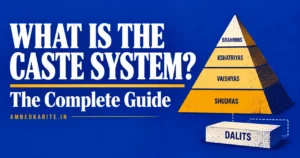
OBC is a legal category and does not exactly correlate with the 4 Varnas. The main differences between the legal categories and the older social model are explained in our post on the Varna System. Our post on Bahujan shows how OBCs, Scheduled Castes and Scheduled Tribes are grouped in various political usages.
Importance beyond India
For readers in the USA and UK, OBCs illustrate how the Indian state and legal system has attempted to interrogate caste as a quantifiable social category, where as the census question shows how it has tried to collect data on the subject. Our post on Caste in the law of other countries explains how different laws treat the subject compared to the West. (For communities documenting their own history, skills in blogging, AI tools and email marketing have become essential. The Ambedkarite Educational Program was built to teach these skills.)
Takeaway
Other backward classes is the legal name for socially and educationally backward castes that are not Scheduled Castes or Scheduled Tribes. They have a 27 per cent central quota after the Mandal Commission (1980) and the Indra Sawhney ruling (1992), and the creamy layer is excluded. The central list is overseen by the National Commission for Backward Classes, which has had constitutional status since 2018, and states keep their own lists. The Mandal estimate of 52 per cent is old, and Census 2027 is due to count caste for the first time since 1931.
Frequently Asked Questions
What does OBC mean?
OBC stands for Other Backward Classes. It is the official name for castes and communities that the Constitution treats as socially and educationally backward, other than Scheduled Castes and Scheduled Tribes.
What is the OBC full form?
Other Backward Classes. The term comes from the Constitution’s provisions on backward classes, including Articles 15(4), 16(4) and 340.
How much reservation do OBCs get?
At the central level, 27 per cent in government jobs and higher education, following the Mandal Commission. States set their own quotas.
What is the OBC creamy layer?
It is the economically advanced section of OBC groups, which is excluded from the quota. It is set by family income, and one source puts the current ceiling at ₹8 lakh a year.
How many OBCs are there in India?
No census has counted them. The Mandal Commission estimated about 52 per cent in 1980, based on 1931 data. Census 2027 is due to enumerate caste.
Understanding caste is step one. Building digital independence is step two.
Ambedkarite communities around the world are using AI tools, blogging and email marketing to document their experiences, challenge discrimination and build platforms that cannot be silenced.
The Ambedkarite Educational Program teaches exactly these skills: AI tools, website building, email marketing, blogging and Google AI. Lifetime access is ₹297 (~$4 USD). All future courses are included free.
Or join the Movement free to start learning today.
SOURCES
- Wikipedia, “Mandal Commission”
- Wikipedia, “Kalelkar Commission”
- Anantam IAS, “Mandal Commission: OBC Reservation Report & 1990 Implementation”
- Anantam IAS, “National Commission for Backward Classes”
- Anantam IAS, “Census 2027”
- Anantam IAS, current affairs, July 7, 2026
- Vajiram & Ravi, “Other Backward Classes (OBCs), Background, Creamy Layer Concept”
- Gandhi & Peace Studies, “Other Backward Classes (OBCs) in India”
- ILearn CANA, “30 years since OBC reservations”
- DeepMentor, “Mandal Commission and OBC Mobilisation”
- The Tribune, “Caste census exercise to begin from March 1, 2027”
- The Mooknayak, “Govt debunks reports claiming caste enumeration not included in Census 2027”
- The Wire, “Govt departments differed over use of OBC list for caste enumeration in Census”
- Constitution of India, Articles 15, 16, 338B and 340 (link: legislative.gov.in)