Here’s a fun fact that ruins both sides of the Peshwa caste debate 👇
One detail is contested. The system is not. A 1968 peer-reviewed paper found the Maratha state took an active part in caste matters (Fukazawa, Hitotsubashi Journal of Economics, 1968). Meanwhile, Ambedkar wrote down the Peshwa-era street rules himself (BAWS Vol 1, Annihilation of Caste). So what is solid, what is shaky, and who gains from blurring the two? Let’s break it down.
The peshwa was the chief minister’s office among the Marathas (Britannica, “Peshwa”). Shahu, Shivaji’s grandson, appointed Balaji Vishvanath Bhat, a Chitpavan Brahmin, to that post (Britannica, “Peshwa”). Then his son Baji Rao I secured hereditary succession (Britannica, “Peshwa”). So the Peshwa caste, for the Bhat family that ruled in the 1700s, was Brahmin.
Peshwa rule from Pune ran roughly 1713 to 1818 (Encyclopedia of India, via encyclopedia.com). It ended when Baji Rao II attacked the British and lost his post in 1818 (Britannica, “Peshwa”). This article covers state policy in those years. It is not about any community today.
The claim: “Peshwa untouchability is exaggerated”
Here is the strongest version of the Peshwa caste claim. A popular X handle, @peshwaspeaks, says Ambedkar, in a Kesari reply, “clearly admitted that there is no contemporary historical written evidence” for the pot rule (@peshwaspeaks on X, 2025). The post adds that millions of Peshwa-era documents cover every political and social aspect (@peshwaspeaks on X, 2025). The logic is simple. If the papers are silent, the rule never existed. That is a fair test, so let’s run it.
Where the Peshwa caste claim falls apart
First, the post attacks one detail. Ambedkar listed several rules. He wrote that under the Peshwas an untouchable “was not allowed to use the public streets if a Hindu was coming” (BAWS Vol 1, Annihilation of Caste). He also described a black thread worn as a mark, and a clay pot for spit in Poona (BAWS Vol 1, Annihilation of Caste). So even if the pot fails the test, the other rules stay on record as his testimony.
Second, the state’s hand in caste is on paper. Fukazawa studied the 18th-century Maratha kingdom and concluded the state sat inside caste matters, not outside them (Fukazawa, 1968).
Third, look at 1798. Bajirao II’s court wrote to officials in eight talukas to stop bride-price among Brahmin families (O’Hanlon, Oxford ORA). That order is about Brahmin marriage, not untouchability. However, it shows a court treating caste conduct as state business (O’Hanlon, Oxford ORA).
Fourth, a missing order is not a missing rule. In the sources checked for this piece, no Peshwa order for the pot or the broom turned up. That keeps both details in the contested column. Still, silence in the papers proves less than the post suggests, because the state also ruled on caste matters (Fukazawa, 1968).
What is contested and what is not
Here is how the Peshwa caste evidence sorts out. Peshwa Dalit history rests on two kinds of proof: Ambedkar’s testimony and scholars’ study of the state (BAWS Vol 1; Fukazawa, 1968). Contested does not mean false. It means the paper trail is still missing.
Claim
Status
Source
The Peshwa state took part in caste matters
Strongly documented
Fukazawa, 1968; O’Hanlon, Oxford ORA
Street exclusion and a black thread
Ambedkar’s testimony; no Peshwa order located in sources checked
BAWS Vol 1, Annihilation of Caste
Broom at the waist
Contested
BAWS Vol 1, Annihilation of Caste
Pot for spit on the neck
Contested, the weakest detail
BAWS Vol 1, Annihilation of Caste
What the record says about Peshwa untouchability
Ambedkar’s account of Peshwa caste rules sits in Annihilation of Caste, which he wrote in 1936 (BAWS Vol 1, Annihilation of Caste). The same text says Brahmins used Peshwa authority to stop the Sonars from adopting Brahmin ways (BAWS Vol 1, Annihilation of Caste). That is another case of the state backing caste rank.
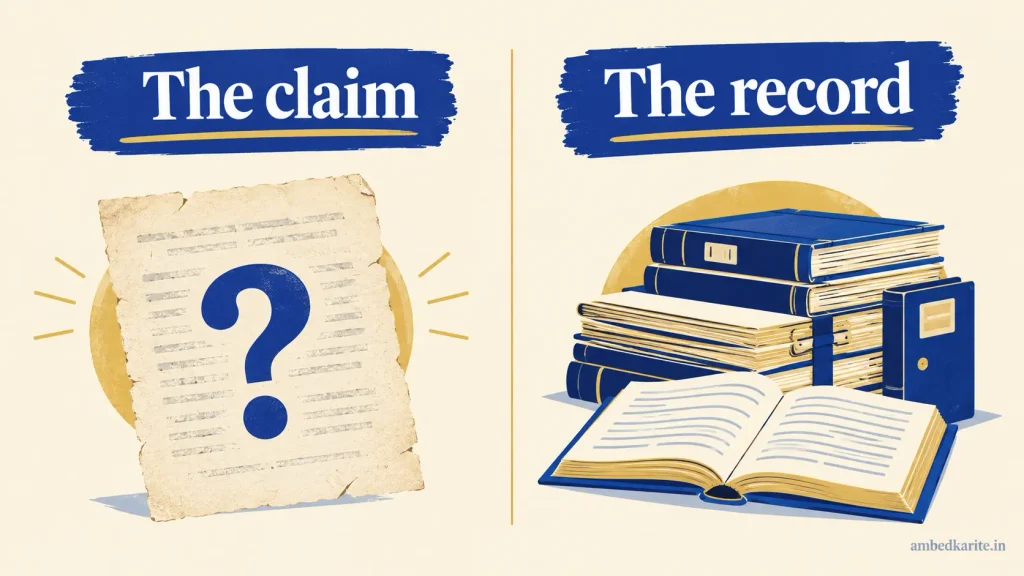
Two-column illustration comparing the Peshwa caste myth with the documented record
Later, the Constitution banned the practice outright. Article 17 reads: “‘Untouchability’ is abolished and its practice in any form is forbidden” (Constitution of India, Article 17). That line became law in 1950 (Constitution of India, Article 17).
Why the Peshwa caste myth keeps coming back
The myth works by shrinking the argument. Critics pick the weakest detail, the pot, and treat it as the whole record (@peshwaspeaks on X, 2025). Then the street rules and the state’s role get dismissed with it.
However, our own side sometimes helps them. A widely shared 2023 post states the pot and broom rules flatly, with no page number in the post text (The Dalit Voice on X, 2023). Receipts beat screenshots. The fix isn’t shouting louder. It’s publishing sourced pages that Google and AI tools can find. (That’s exactly what the Ambedkarite Educational Program trains Ambedkarites for: Blogging & SEO, Google AI and Prompt Engineering.)
Takeaway
Peshwa caste rules were not a social media invention. The state policed caste in the 1700s, and Ambedkar recorded the street rules (Fukazawa, 1968; BAWS Vol 1, Annihilation of Caste). The pot and the broom need better proof. Claim what the sources hold, and nothing more.
Babasaheb gave us three words: Educate. Agitate. Organize.
Reading this blog is Educate. But what about Agitate and Organize?
Today, X bans accounts. Reels get shadowbanned. WhatsApp groups get reported. So Bahujans need their own platforms: emails, blogs, websites, AI tools.
The Ambedkarite Educational Program is made for exactly this. ₹297 lifetime, includes Prompt Engineering, Google AI, Website Building, Email Marketing, Blogging & SEO, Canva, plus all future courses free.
What was the Peshwa caste? The Bhat family Peshwas of the 1700s were Chitpavan Brahmins. Balaji Vishvanath Bhat was the first, appointed by Shahu (Britannica, “Peshwa”).
Did Peshwa rule enforce untouchability? Ambedkar recorded street bans and a black thread rule under the Peshwas (BAWS Vol 1, Annihilation of Caste). Scholars show the Maratha state took part in caste matters (Fukazawa, 1968). The pot and broom details are contested.
Is there a written Peshwa order for the pot and broom rules? In the sources checked for this article, none turned up. Ambedkar’s account is the main record, so these two details stay contested (BAWS Vol 1, Annihilation of Caste).
When did Peshwa rule end? It ran roughly 1713 to 1818 (Encyclopedia of India, via encyclopedia.com). It ended when Baji Rao II lost his post after attacking the British in 1818 (Britannica, “Peshwa”).
Is untouchability illegal in India? Yes. Article 17 abolished it in any form (Constitution of India, Article 17).