Indian Constitution influence abroad is documented mainly in court judgments on the basic structure doctrine, not in the drafting record of any one person (Kenya Supreme Court, 2022; Constituent Assembly Debates, 1949). The influence of the Indian Constitution on other countries has mostly been seen in judgments implemented by foreign courts using the ‘basic structure’ doctrine. In 1949, Ambedkar stated that the credit given to him should actually have been given to someone else (Constituent Assembly Debates, 1949). The Ambedkar Drafting Committee met for 141 days, but the majority of the work was done by B.N. Rau and S.N. Mukherjee (Constituent Assembly Debates, 1949). The Bangladeshi ‘basic structure’ doctrine was established by the 2011 judgment in the case of Anwar Hossain Chowdhury (IJIRL, 2025). Claims of India’s influence on the Constitution of Nepal also remain speculative (Legal Service India, 2024).
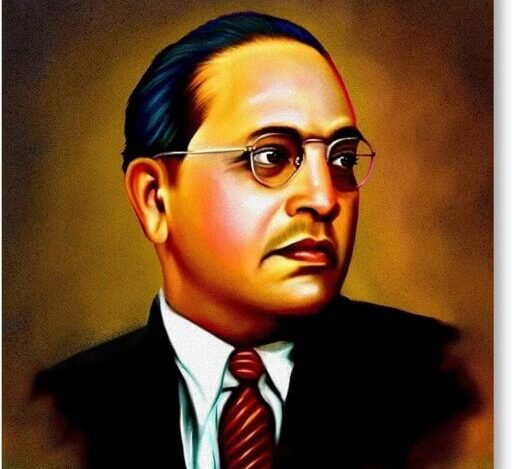
B.R. Ambedkar (1891-1956) was the first Dalit to chair the Constituent Assembly of India and led the drafting of the Indian Constitution (Prakash, 2024). Dalits are formerly known as ‘untouchables’, a term that is now generally considered pejorative. This report has been created to provide general information as of November 28, 2026. It should not be construed as legal advice.
Indian Constitution influence abroad: what is documented
A constitutional amendment is a change to a constitution’s text, and the basic structure doctrine limits which amendments a court will accept (Kenya Supreme Court, 2022).
“Ambedkar Drafting Committee: Who made the Constitution?”
Ambedkar chaired the drafting committee and stated in the Assembly that they met for 141 days to frame the Constitution (Constituent Assembly Debates, 1949). He further stated that prior to their sittings, Sir B.N. Rau had prepared a ‘skeleton draft’ which was completed and discussed by the committee (Constituent Assembly Debates, 1949). S.N. Mukherjee was the chief draftsman of the committee.
On another occasion Ambedkar said that it was not right to give him (Ambedkar) credit and that it should go to Mukherjee (Constituent Assembly Debates, 1949). Ambedkar further stated that he came to the Assembly to represent the Dalits (Constituent Assembly Debates, 1949).
Thus, in the view of Ambedkar himself, the ‘Ambedkar constitution influence’ refers to the work of the entire committee and not of Ambedkar individually (Constituent Assembly Debates, 1949). One of the information sites states that during the drafting of the Indian Constitution, Rau gave advice to the committee and Mukherjee was the chief draftsman (Anantam IAS, 2026).
This article didn’t find any supporting evidence to state that Ambedkar‘s work influenced any foreign constitution.
A court judgment is the best proof of what a court decided, and a news summary or a study site is only a pointer to it. Learning to find the judgment itself, and to cite its court, number and date, is part of the blogging lessons in the Ambedkarite Educational Program.
Doctrine of Immunity of Basic Structure
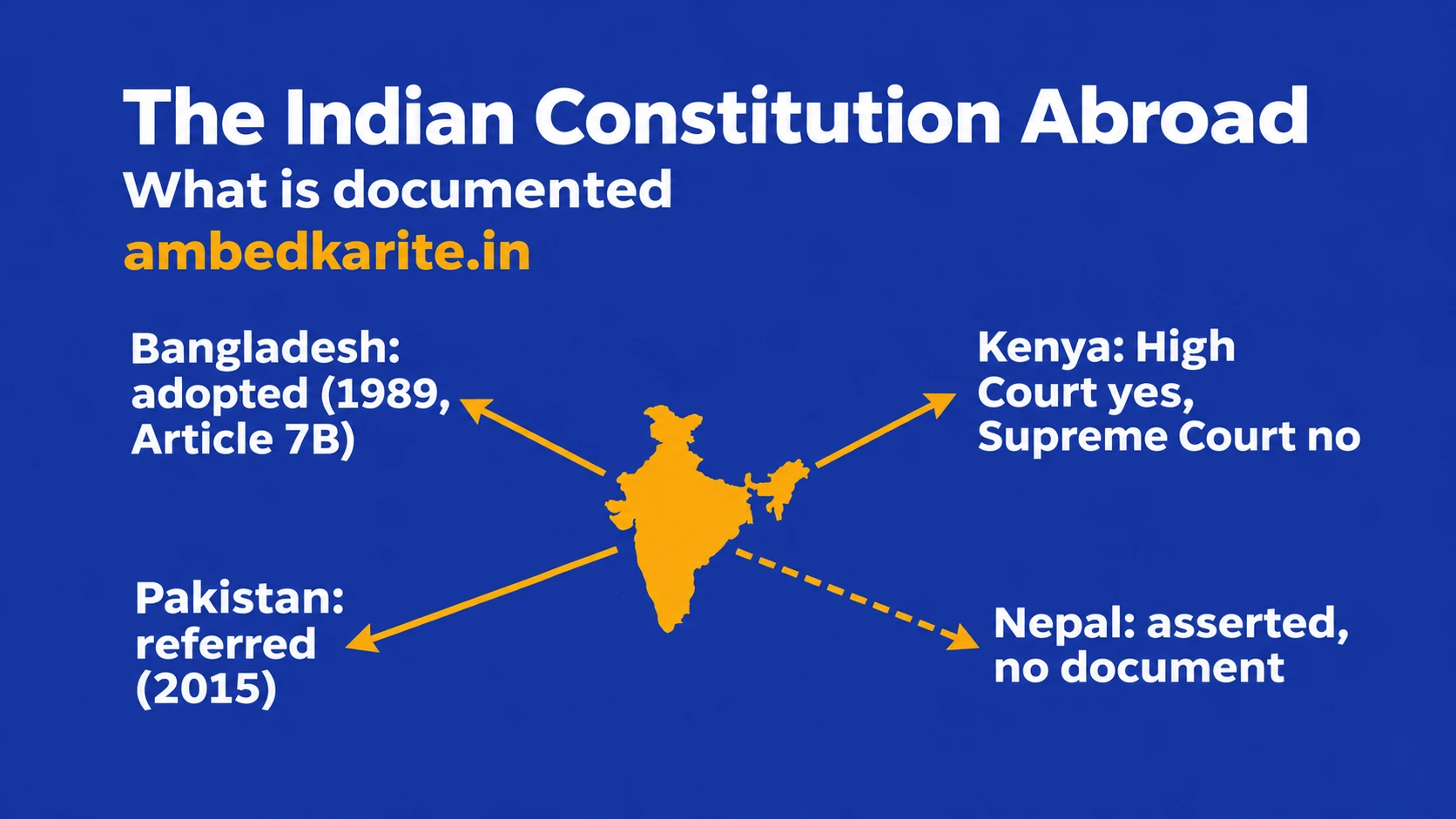
In the landmark case of Kesavananda Bharati v. State of Kerala (1973), the Indian Supreme Court declined to strike down certain amendments to the Constitution made by the Indian Parliament on the ground that these amendments had the effect of modifying the basic structure of the Constitution (Kenya Supreme Court, 2022). Subsequently, the Doctrine was adopted by the Supreme Court of Bangladesh in the case of Anwar Hossain Chowdhury v. Bangladesh (1989).
Later the 15th Amendment to the Constitution of Bangladesh, 2011 incorporated this doctrine in Article 7B of the Constitution of Bangladesh (IJIRL, 2025). In 2015, according to one blog post, the judges of the Supreme Court of Pakistan referred to a couple of decisions of the Indian Supreme Court in order to devise principles to limit the unbridled power of Parliament to amend the Constitution of Pakistan (Legal Pilgrim, 2025).
The High Court of Kenya held on the 13th May, 2021 that the basic structure doctrine of the Indian Constitution should apply in Kenya (Kenya Supreme Court, 2022). However, on the 31st March 2022 the Supreme Court of Kenya held by the majority that this doctrine should not be applied to Kenya (Kenya Supreme Court, 2022).
Nepal and South Africa
According to one website, similar to the Indian Constitution, the new Constitution of Nepal, also provides for fundamental rights of citizens and a system of federalism (Legal Service India, 2024). No evidence has been provided by the website to substantiate its claims and this article was unable to validate the claims.
One journal article states that while South Africa did not officially implement the basic structure doctrine, aspects of it are present in their constitution (IJIRL, 2025). Other constitutions listed on the same site are those of Bangladesh (1972) and Fiji (2013) (Legal Service India, 2024).
What no source shows
What is not referenced in the literature I found is the extent to which foreign courts have relied on Indian judgments to interpret constitutions. In interpreting constitutions judges rely on a multitude of sources and citations do not necessarily indicate reliance.
Indian Constitution influence abroad: what each source shows
| Country or claim | What the sources say | Status | What it cannot show |
|---|---|---|---|
| India (origin) | Kesavananda Bharati v. State of Kerala (1973): amendment power cannot destroy the basic structure | Documented | That foreign courts follow it |
| Bangladesh | Anwar Hossain Chowdhury v. Bangladesh (1989 BLD (Spl.) 1) adopted the doctrine, citing Indian precedent; Article 7B added in 2011 | Documented (via a journal paper) | The judgments’ full text: not read |
| Pakistan | Supreme Court referred to Indian precedents in 2015 but said it would develop its own version (one legal blog) | Reported | Which judgment: not verified |
| Kenya, High Court | May 13, 2021: the doctrine applies, relying on Kesavananda | Documented | The final position |
| Kenya, Supreme Court | March 31, 2022: the doctrine does not apply, by a majority (one dissent) | Documented | Any later change: not checked |
| South Africa | A journal paper describes a subtle alignment, without explicit adoption | Described | Influence: alignment is not influence |
| Nepal (2015), Bangladesh (1972), Fiji (2013) | A legal education site says India influenced them | Asserted | Any document, drafting record or judgment |
| Ambedkar’s own drafting abroad | None found | Not applicable | Not applicable |
Sources: Constituent Assembly Debates, 1949; Kenya Supreme Court, 2022; IJIRL, 2025; Legal Pilgrim, 2025; Legal Service India, 2024. This is general information, not legal advice.
Takeaway on the Indian Constitution’s influence abroad
Many judges in foreign jurisdictions opine upon the ‘basic structure’ of constitutions and some judges have openly acknowledged the Indian Constitution as an influence.
The Judges of the Kenyan Supreme Court relied on the Indian basic structure doctrine to interpret the Kenyan Constitution (Kenya Supreme Court, 2022). While interpreting the Constitution of Bangladesh, Justice Chowdhury relied on the Indian basic structure doctrine to affirm the right to property of citizens of Bangladesh (IJIRL, 2025). Influence of the Indian Constitution on the constitution of Nepal is also claimed by some writers but is not documented in the literature I found (Legal Service India, 2024).
read each claim seperately.
Readers who want to learn to read court judgments and constitutional debates closely and write clear, sourced explainers can start with the Ambedkarite Educational Program, a lifetime-access course at ₹297 (about $4 USD) that covers blogging, website building, email marketing, AI tools and Google AI, with all future courses included. The free Movement page is another place to begin.
This article draws on the Constituent Assembly Debates (Volume XI, 25 November 1949), the Kenya Supreme Court’s 2022 judgment, a 2025 journal paper on the basic structure doctrine, a legal blog, a legal education site and a study site. I did not read the judgments from Bangladesh and Pakistan, and I found no source showing Ambedkar’s own drafting shaping a foreign constitution. Each source’s claims are attributed to it.
Last updated: November 28, 2026
Frequently Asked Questions
What role did Ambedkar play in the drafting of the Constitution?
During 1949 proceedings of the Constituent Assembly, Ambedkar stated that the credit that many people attributed to him should, in reality, be shared by B.N. Rau and S.N. Mukherjee (Constituent Assembly Debates, 1949).
What is the Ambedkar Drafting Committee?
This is the committee chaired by Ambedkar which the members of the Constituent Assembly appointed to draft the Constitution of India. It sat for 141 days (Constituent Assembly Debates, 1949).
Has Bangladesh adopted the ‘Basic Structure’ doctrine?
The Supreme Court of Bangladesh, in the case of ‘Anwar Hossain Chowdhury v. Bangladesh’ adopted this doctrine to strike down the Eighth Amendment Act, 1982 (IJIRL, 2025). The 15th Amendment of 2011 added Article 7B to the Constitution.
Has India shaped the Constitution of Nepal?
According to one legal education website, yes (Legal Service India, 2024). However, I could not validate this.
Generally speaking, the Constitution of Nepal, adopted on November 9, 1990, was largely based on the Constitution of India and the features of parliamentary democracy.
Sources
- Constituent Assembly Debates: Official Report, Volume XI, November 14 to 26, 1949 (Parliament of India)
- Kenya Supreme Court: Attorney General and 2 others v Ndii and 79 others, [2022] KESC 8 (KLR), March 31, 2022
- IJIRL: A Study on the Doctrine of Basic Structure Across Jurisdictions, 2025
- Legal Pilgrim: Cross-Pollination in India’s Jurisprudential Evolution, 2025
- Legal Service India: Indian Constitution: Key Features, Strengths, Weaknesses, Influence of other Constitutions Over It, Its Influence Over Other Constitutions and Evaluation, 2024
- Anantam IAS: Making of the Indian Constitution, 2026
- Prakash: A “Life of Contradictions,” The New York Review of Books, June 20, 2024