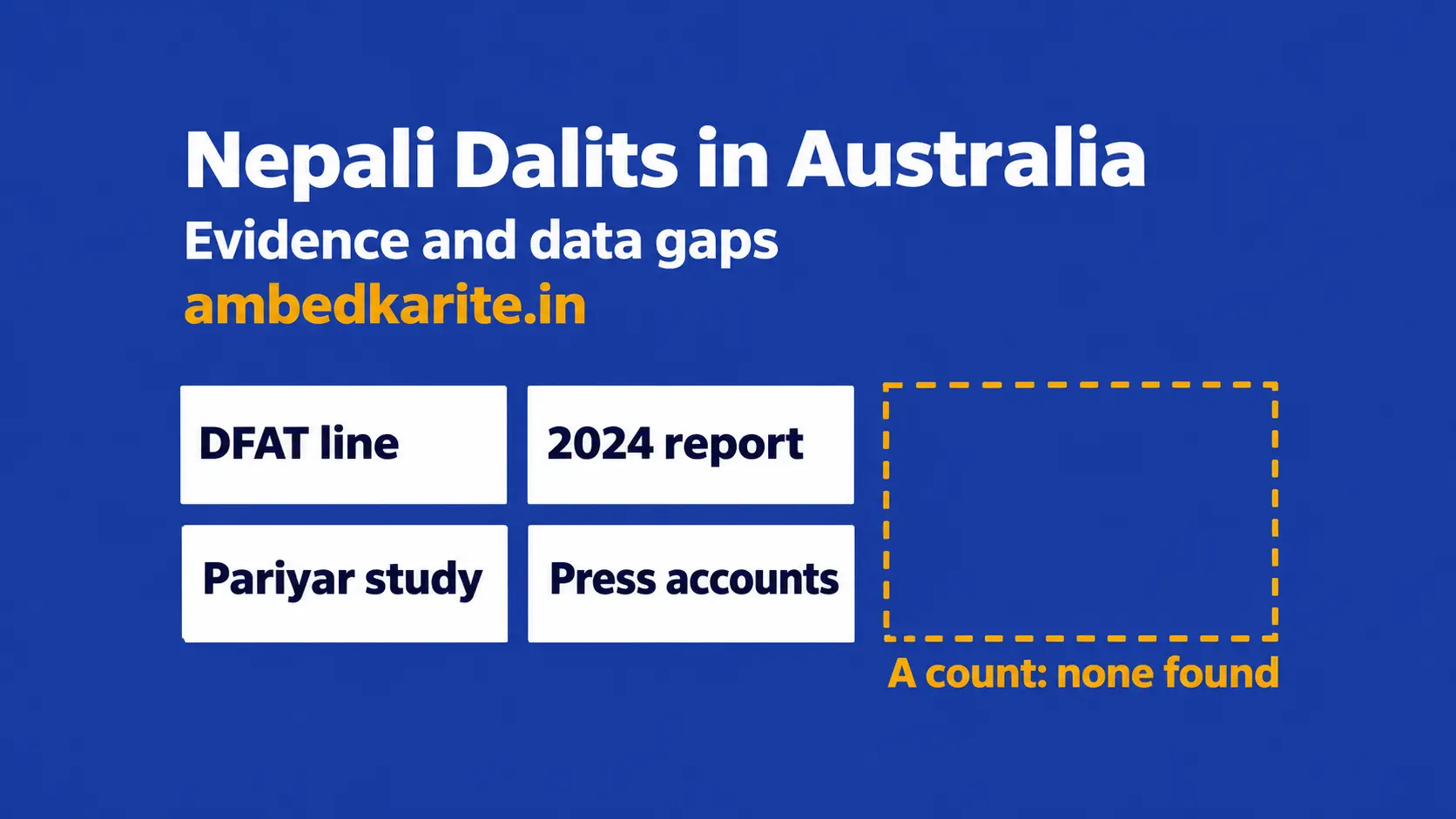
Nepali Dalits Australia evidence is mostly individual accounts and one ethnographic study, and this article found no count of caste discrimination (Pariyar, 2019). Most of the available evidence on Nepali Dalits in Australia comes in the form of individual case studies (Pariyar 2019). There are also no figures on the level of caste-based discrimination in the Nepalese community living in Australia. The 2026 report by the Australian Department of Foreign Affairs and Trade (DFAT) mentions instances of discrimination against Dalits in some sections of the Nepalese diaspora living in Australia (2026). M. P. Pariyar’s 2019 study has also shown that members of the Dalit community, while living outside Nepal, still adhere to caste restrictions in their social interactions including marriage (2019). As of 2021, there were 122,506 people of Nepalese origin living in Australia (ANU 2024). No figures are available on the number of Dalits living in this population. The majority of Nepalese emigrants to Australia are young (ANU 2024). ‘Dalit’ is a term used by members of formerly ‘untouchable’ castes to describe themselves.
Nepali Dalits Australia: what the evidence is
In Nepal, DFAT says caste-based discrimination is illegal and the caste system was officially abolished in 1963 (DFAT, 2026).
This information has been collated to provide general information to the public. It should not be construed as legal advice. Last updated on 28 November 2026.
What sources reveal about Nepali Caste Discrimination in Australia
As reported by DFAT in 2026, there are instances of Nepalis practicing caste discrimination within diaspora communities across the world including in Australia (DFAT, 2026). The report does not provide any numbers to support this claim and this article has only read the excerpt mentioned above of the report.
The longer and more in depth report on caste discrimination in Australia, published in 2024 by the University of Oxford, interviewed 146 participants of caste affected communities and created 600 pages of evidence (University of Oxford, 2024). Funding for this report was provided by the Australian Human Rights Commission and the Federation of Ethnic Communities’ Councils of Australia.
According to the FECCA report, participants mentioned they had been assaulted, excluded and deprived of employment opportunities (Bapuji, 2025). No case studies of Nepalis have been documented in these reports. ABC News published an article in 2021 stating that an unnamed Nepali man of Dalit origin was evicted from his rental home in Brisbane by the landlord after learning of his caste (ABC News, 2021).
Findings of the Mitra Pariyar Study
An ethnographic study by Mitra Pariyar was published in 2019 by the name ‘Travelling Castes: Nepalese Immigrants in Australia’ in the journal ‘South Asian Diaspora’ (Pariyar, 2019). The study outlines some of the reasons for Nepali immigrants moving to Australia and the caste dynamics they establish once migrated. (Pariyar, 2019).
Pariyar has identified some of the international dimensions of caste in his research. These include diaspora organization to perpetuate caste in family and marriage functions and transnational political activities (Pariyar, 2019).
His study does not attempt to calculate frequency of these activities.
Researchers publish in journals that many readers never open, while community findings reach readers through websites. Building a simple site to share sourced findings in plain language is covered by the website building lessons of the Ambedkarite Educational Program.
The South China Morning Post has reported that the Nepalese Hindu Society of Australia has trained and appointed lower caste members as priests (South China Morning Post, 2021). Lower caste Nepalis living in Australia have often been denied the opportunity to live and work within the community (South China Morning Post, 2021).
Dalit Nepali diaspora: who the community is
The number of people of Nepalese origin living in Australia has increased rapidly in recent years. According to the 2021 census 250,963 people residing in Australia claimed Nepalese ancestry (Cultural Atlas, 2025). Of these 122,506 were born in Nepal (ANU, 2024). The 2016 census reported 54,760 people of Nepalese origin living in Australia at that time (Demog Blog, 2022). The Nepalese community is predominantly young with the median age of 29.1 years and 87% of the community between 15 and 39 years of age (Home Affairs, 2025; ANU, 2024).
Students and new arrivals: what is not known
Given that many migrants from Nepal initially come to Australia to study, or to take up skilled employment (Demog Blog, 2022), there is very little information on students of Dalit origin. Nor have there been any studies undertaken to determine caste among international students.
There have only been 27 reported cases of Nepali-American Dalits living in the San Francisco Bay Area. Of those 27 people, 24 stated they have experienced discrimination based on their caste by members of the Nepali diaspora. These cases were documented in a small scale study done outside of Australia. Therefore, they do not necessarily apply to the situation in this country.
What is the applicable law?
There is no federal law in Australia which mentions caste. The Queensland Anti-Discrimination Act mentions caste within race (Queensland Parliament, 2024), and the Fair Work Act of Australia prohibits discrimination based on social origin (Fair Work Act of Australia, 2009).
Our guide to caste discrimination recommends that employers and employees not discriminate based on social origin, as mentioned in the Fair Work Act of Australia, and to report any incidents of discrimination based on social origin to the relevant authorities.
Nepali Dalits Australia: what each source shows
| Source | What it reports | What it cannot show | Source |
|---|---|---|---|
| DFAT Nepal report (September 2026) | Caste discrimination occurred in diaspora communities, including in Australia | A rate, a group or a source: one line; only excerpts read | DFAT, 2026 |
| Caste in Australia report (2024) | 146 interviews with participants from caste-oppressed communities; 600 pages of evidence; discrimination across employment, education, housing and social life | Nepali-specific findings: it covers South Asian communities generally | University of Oxford, 2024 |
| FECCA report (2024) | Participants described physical assault, children treated as untouchables and socioeconomic boycotts | Nepali-specific findings; frequency | Bapuji, 2025 |
| Pariyar study (2019) | Caste kept its force abroad in domestic, ritual, religious, marriage and transnational life | A rate: it is ethnographic | Pariyar, 2019 |
| Press accounts (2021) | An anonymous Nepali Dalit man evicted in Brisbane; a Cairns man who changed his surname | Anything beyond individual accounts | ABC News, 2021 |
| Census and Home Affairs data (2021) | 122,506 Nepal-born; 138,463 Nepali ancestry; median age 29.1; 53% in New South Wales | Caste: it is not recorded | Home Affairs, 2025; ANU, 2024 |
| Nepali Dalit students | No data found | Not applicable | This article’s search |
Sources: DFAT, 2026; University of Oxford, 2024; Bapuji, 2025; Pariyar, 2019; ABC News, 2021; Home Affairs, 2025; ANU, 2024. This is general information, not legal advice.
Takeaway on Nepali Dalits in Australia
Evidence regarding Nepali Dalits living in Australia is very limited, consisting of just a few accounts and one ethnographic study. None of these reports have documented incidences of discrimination based on caste. Two reports mention cases of Nepali Dalits living in Australia. The first report was published by DFAT in 2026 and the second by University of Oxford in 2024. Neither of these reports mention the number of cases involving Nepali Dalits living in Australia. The study conducted by Mitra Pariyar on Nepali migrants in Australia found that caste based discrimination continues to exist amongst this community (Pariyar, 2019). As of 2019, the Nepalese born population in Australia was 122,506 (Australian National University, 2019), however there are no statistics on Dalit Nepalese Australians.
Readers who want to learn to read research studies and government reports closely and write clear, sourced explainers can start with the Ambedkarite Educational Program, a lifetime-access course at ₹297 (about $4 USD) that covers blogging, website building, email marketing, AI tools and Google AI, with all future courses included. The free Movement page is another place to begin.
This article draws on Mitra Pariyar’s 2019 study (abstract), the Department of Foreign Affairs and Trade’s 2026 Nepal report (excerpts), the Caste in Australia project (through a university news item), a South China Morning Post and an ABC News report, and census-based population figures. I found no survey of Nepali Dalits in Australia, no data on Nepali Dalit students and no decision. Each source’s claims are attributed to it.
Last updated: November 28, 2026
Frequently Asked Questions
What information is available on Dalits in Australia?
There are very few studies available and the majority of the information is anecdotal. This article did not find any evidence of case of caste discrimination against Nepalis in Australia (Pariyar, 2019; DFAT, 2026).
Is discrimination of Nepalis based on caste present in Australia?
Discrimination based on caste has been reported to exist within the Nepali diaspora including in Australia (DFAT, 2026). A 2024 study on ‘Caste in Australia’ also does not include any information on the Nepali community.
What did the study ‘Caste in Nepali Society and Beyond’ conclude?
The study found that caste affects various aspects of Nepali’s everyday life including, household activities, religious ceremonies and marriages, as well as politics (Pariyar, 2019).
Who does the term ‘Dalit Nepali diaspora’ refer to?
This term has been used to describe the 122,506 Nepalis living in Australia as at 2021 (ANU, 2024). The majority of whom reside in the state of New South Wales. Information is not available to say how many of these people belong to the Dalit community.
Do any universities in Australia have Nepali Dalit students?
As of now there is very little information to answer this question (Demog Blog, 2022).
Sources
- Pariyar: Travelling castes: Nepalese immigrants in Australia, South Asian Diaspora, 2019
- DFAT: Country Information Report Nepal, September 23, 2026
- University of Oxford: Asang Wankhede Leads Study on Caste Discrimination in Australia, 2024
- Bapuji: Caste in Australia (resource page quoting the FECCA report), 2025
- South China Morning Post: South Asian migrants face caste discrimination even in Australia, US, UK, New Zealand, 2021
- ABC News: They’ve left South Asia, but they can’t escape the discrimination and division of its caste system, February 11, 2021
- ANU: Diaspora Humanitarians, Nepal briefing, 2024
- Home Affairs: Country profile, Nepal, 2025
- Demog Blog: The Nepalese population in Australia has doubled since 2016, 2022
- Cultural Atlas: Nepalese culture: population statistics, 2025
- Queensland Parliament: Respect at Work and Other Matters Amendment Act 2024