
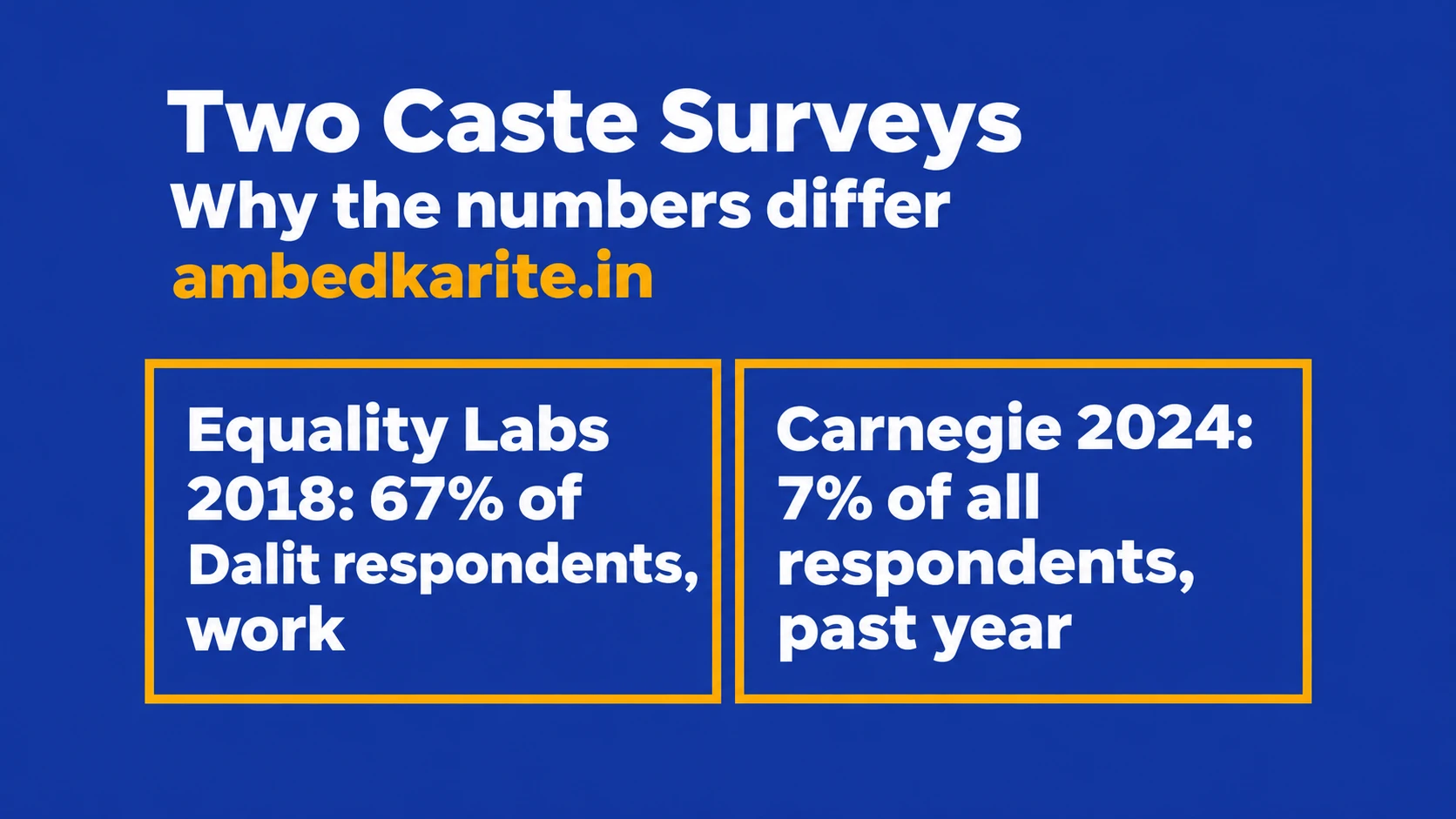
The Equality Labs Carnegie survey debate is about two studies that count caste discrimination very differently (Equality Labs, 2018; Carnegie Endowment, 2025). The debate between Equality Labs and the Carnegie Endowment centers on two surveys with vastly different findings on caste-based discrimination. “Untouchables” are now referred to as Dalits. The Equality Labs 2018 survey reported that 67% of Dalits respondents had recently experienced workplace discrimination. The Carnegie Endowment’s 2024 online survey of 1,206 Indian Americans, conducted through YouGov, found that 7% of respondents experienced caste-based discrimination in the last year. Previously, in 2020, 5% of respondents of a different Carnegie survey reported similar experience with caste-based discrimination. Due to differences in methodology of these surveys, direct comparisons of the results are not feasible. The Hindu American Foundation, which is against any legislation to outlaw caste discrimination, has criticized the Equality Labs 2018 survey.
This comparison of the surveys was last updated on November 26, 2026.
Equality Labs and Carnegie: two surveys compared
Equality Labs describes itself as a South Asian American human rights and technology group (Equality Labs, 2018). The Carnegie Endowment for International Peace is a research institute whose South Asia program ran the Indian American Attitudes Survey, and it says it takes no institutional positions on policy (Carnegie Endowment, 2025).
Equality Labs’ 2018 Survey
In 2018 Equality Labs published ‘Caste in the United States’. Based on a web survey of 47 questions targeting members of the South Asian diaspora. Participants were shared through email lists and social media. The survey was endorsed by anti-caste organizations, and initial responses numbered 1534 of which 330 were removed ‘for quality control’ resulting in a final sample size of 1200.
Of this sample 24% were Dalits and 33% were Brahmins. Of the Dalits in the sample 67% reported having experienced caste related workplace discrimination.
Equality Labs spread its survey through community listservs and organizations (Equality Labs, 2018). An email list is still how many groups reach supporters directly, and building one is covered in the email marketing lessons of the Ambedkarite Educational Program.
The Carnegie Indian American Attitudes Survey
Between the 18th and the 15th of October 2024, YouGov, on behalf of the Carnegie Endowment, conducted a survey of 1206 participants of Indian origin residing in the USA. The margin of error for this sample was +/- 3%. Prior responses have been conducted with samplings of 1200 participants each. The 2020 survey was conducted in September with a margin of error of +/- 2.8%.
CARNEGIE 7% CASTE FIGURE
In 2024, 49% of the participants in the Carnegie survey reported having experienced discrimination in the last year. Of those, 31% reported discrimination based on skin color and 7% based on caste (Carnegie Endowment, 2025). In 2020, the figure was 5% (Carnegie Endowment, 2021). That year, participants who experienced caste based discrimination named both non-Indians and Indians equally (Carnegie Endowment, 2021).
Carnegie also stated that another South Asian group may be the real basis of the participants’ experience. Support and justification for anti-caste laws was expressed 77% of the time with 11% opposed (Carnegie Endowment, 2025).
METHODOLOGY OF CASTE SURVEYS
Equality Labs and Carnegie ask different questions to arrive at their figures. Equality Labs asks specifically about members of that caste group, while Carnegie asks about the whole population (Equality Labs, 2018; Carnegie Endowment, 2025). Also, Equality Labs uses a time frame of ‘at any point’ while Carnegie uses ‘in the last one year’ time frame (Equality Labs, 2018; Carnegie Endowment, 2025). Further, Equality Labs’survey included people of South Asian descent in general, while Carnegie’s was restricted to people of Indian descent (Equality Labs, 2018; Carnegie Endowment, 2025).
Of the participants in the 2024 Carnegie survey, 2% represented the Scheduled Caste (Carnegie Endowment, 2025), approximately 25 people. Equality Labs’ survey of the same year, estimated 290 respondents representing 24% of the sample, to have experienced discrimination based on caste. 2020 Carnegie survey participants of Hindu faith were the only respondents asked to identify their caste (Seattle City Clerk, 2023).
What each side claims
Carnegie states that Equality Labs’ sample frame may have captured people most passionate about caste and, therefore, may not be representative of the population as a whole. Carnegie also states that whether or not there is case based discrimination in the US is still up for debate (Carnegie Endowment 2021).
The Unscientific nature of Equality Labs’ survey has also been criticized by the Hindu American Foundation, which opposes legislation against caste discrimination. This organization also supports Carnegie’s findings are inconclusive (Hindu American Foundation 2025). In Seattle city records, Equality Labs defends its survey stating that it was specific to caste (Seattle City Clerk 2023).
What neither survey addresses
Neither survey contains any definition of or example of what may constitute case based discrimination. Likewise, neither survey assesses whether any of the incidents would be legally actionable. According to Carnegie’s 2020 report, very few participants identified as members of Scheduled Castes and members of other communities outside of Hinduism were not asked about their views on caste (Carnegie Endowment 2021).
Most likely both surveys are accurate with respect to the populations they assessed. I was unable to locate more recent equivalent surveys on Indian American communities.
Equality Labs Carnegie survey: key differences
| Feature | Equality Labs (2018) | Carnegie (2020) | Carnegie (2024) |
|—|-
Frequently Asked Questions
What is the Equality Labs/Carnegie Surveys debate about?
They differ dramatically in the questions they ask and the samples they use to frame their queries (Equality Labs, 2018; Carnegie Endowment, 2025).
Equality Labs’ web-based survey began with 1,534 participants of which 1,200 were selected for analysis (2018). Of these 67% stated they had experienced caste-based discrimination at their place of employment.
What is the Carnegie Indian American Attitudes Survey?
Also known as the Carnegie Survey of Indian Americans, this survey was conducted by YouGov in 2020 and 2024. The 2024 iteration of the survey gathered data from 1,206 participants on which 7% of respondents reported having experienced caste discrimination in the last year (2025).
What do the 2024 Carnegie survey findings mean?
Of the 1,206 participants in the survey, 7% expressed having experienced caste discrimination in the last year. In the 2020 iteration of the same survey, 5% of participants reported having experienced caste discrimination (2025, 2021).
What accounts for the difference in these figures?
Differences in participant population and sampling methods explain the variation in these figures (2025, 2018).
In general, not legality, Indian Americans are opposed to the enactment of caste based discrimination laws by the US government.
Sources
- Equality Labs: Caste in the United States: A Survey of Caste Among South Asian Americans, 2018 (copy in Seattle city records)
- Carnegie Endowment: How Indian Americans Live: Results From the 2024 Indian American Attitudes Survey, July 7, 2025
- Carnegie Endowment: Social Realities of Indian Americans: Results From the 2020 Indian American Attitudes Survey, June 9, 2021
- Hindu American Foundation: Carnegie’s latest survey fails to ask useful questions on caste discrimination and potential solutions, 2025
- Seattle City Clerk: Response to criticism of the Equality Labs survey, Seattle city records, 2023