The World Bank caste India record is mixed (World Bank, 2012; Alt News, 2025). The record of the World Bank on caste in India is questionable (2012, World Bank; 2025, Alt News). Research conducted by the World Bank in 2011 tracked members of lower castes and tribes as well as women throughout India (2012, World Bank). In July 2025 the Indian government claimed that India was ranked fourth worldwide in terms of equality based on a report published by the World Bank (2025, Alt News). The Gini coefficient for India is reported to be 25.5 (2025, Alt News). Critics of the coefficient state that to accurately assess inequality based on caste in India one would need to create multiple coefficients. ‘Dalit’ is the term used to describe formerly ‘untouchable’ castes. Below, we provide general information as of the 26th November 2026, and should not be construed as financial advice.
What the World Bank says about caste in India
The Gini index measures how far a distribution of income or consumption departs from perfect equality, where 0 means full equality and 1 means complete disparity (The Tribune, 2025).
World Bank social exclusion: the 2011 report
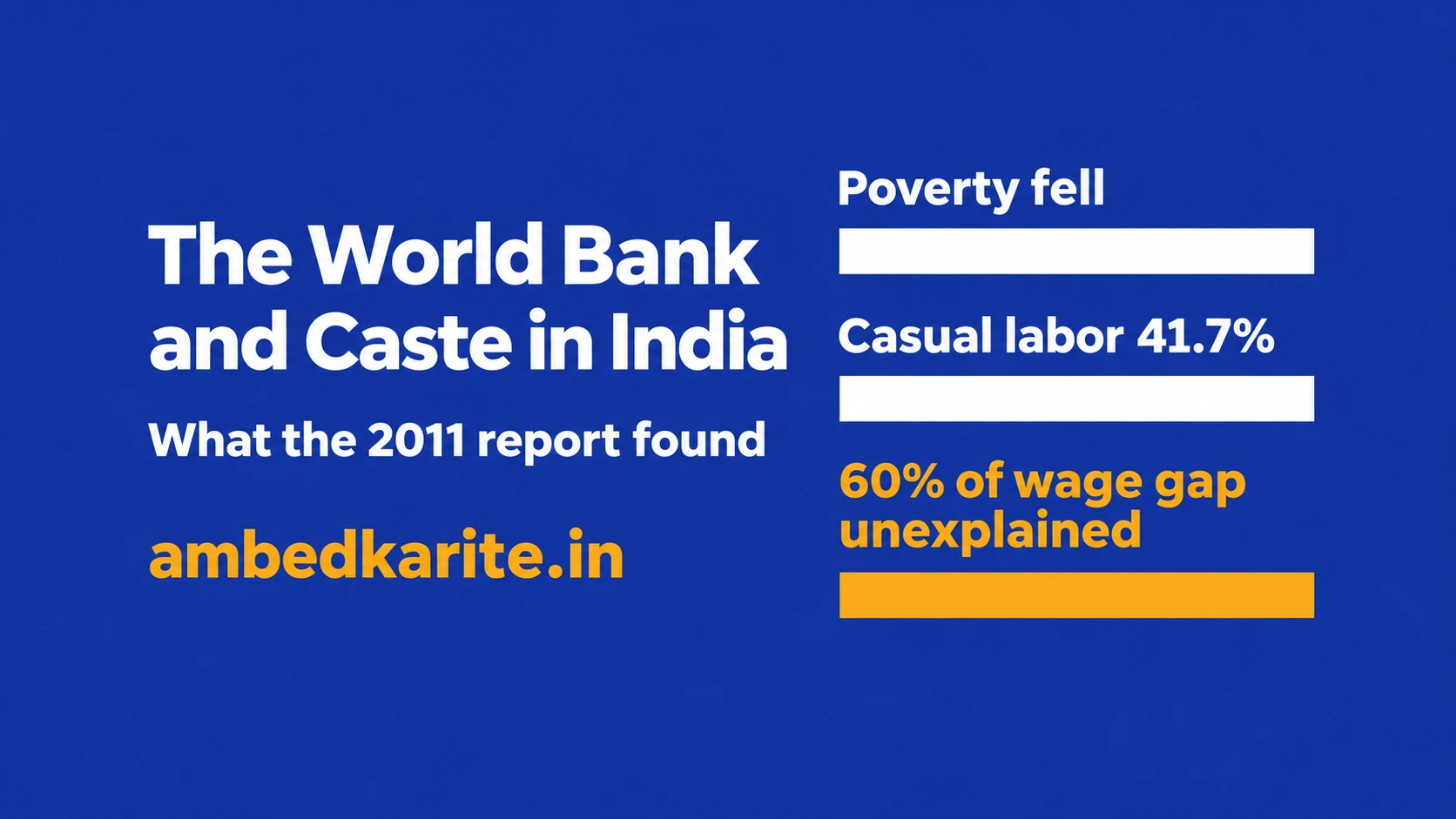
Research conducted by the World Bank, 2011-2012, is the most recent of its kind to be published publicly. Prior to this report the last study conducted by the World Bank on India was published in 1989 (World Bank 1989). Between 1983 and 2004 the poverty rate of members of the Scheduled Castes reduced from 58.4% to 37.9% respectively (PARI, 2012).
Men from the Dalit caste constituted the largest proportion of the casual labor force. The percentage reduced from 44.6% to 41.7% between periods studied by the World Bank in 2017. Approximately 60% of the wage difference between salaried members of the Dalit and general castes remains unexplained by human capital factors, also according to the World Bank’s 2017 report.
In 2005, 26% of upper caste households had 2 or 3 contacts in the formal sector, compared with 12% of households in the Scheduled Caste category. The brief states that it is not an official publication of the World Bank, and uses data from 1983 to 2005 (2017).
Figures like 44.6 and 41.7 percent mean little without a plain-language explanation of what they count. Blogging, taught in the Ambedkarite Educational Program, includes how to present numbers so readers can check them.
‘2025’ claim
According to Alt News, the World Bank’s ‘Spring’ brief for 2025 estimates India’s consumption Gini for the years 2022-2023 at 25.5. On 5th July 2025 the Press Information Bureau of India ranked the country fourth on the Gini coefficient for equity in consumption, after Slovakia, Slovenia and Belarus.
According to the same World Bank’s brief for 2025, between 2011 and 2023, 171 million people in India left extreme poverty.
India consumption Gini: what the number measures
When income inequality is measured using a country’s consumption, like in India, the figure is usually lower compared to that of income. As reported by Alt News, China’s consumption Gini is 35.7. Therefore, comparing the two figures would be misleading. As explained in The Tribune, typically, countries’ income figures are higher than their consumption figures.
The author of this article did not receive a response to these criticisms from the Indian government.
India Gini caste: what a national number hides
India’s national Gini coefficient averages caste based inequalities and, therefore, does not reflect the actual situation (The News Minute, 2025). Evidence suggests that even as poverty level of Scheduled Castes decreased, other members of the community continued to work in low-end jobs (World Bank, 2017; PARI, 2012).
If average wage difference across castes is high, and the national consumption Gini coefficient is low, then the two may be explained independently of one another (World Bank, 2017; Alt News, 2025). I could not locate any World Bank publicatiion which estimates India’s case based Gini coefficient.
What the IMF has published
The working paper ‘Inequality in Consumption in India’ by the IMF’s Sriram Balasubramanian, Rishabh Kumar and Prakash Loungani, published on February 26, 2021, is the only paper of the IMF which comes close to addressing the situation of Indians based on their case (IMF, 2021). Caste is mentioned in the paper only in relation to other personal attributes that individuals are unable to change (IMF, 2021). I also could not locate any other IMF report on this subject.
The 2027 census and caste data
On April 30, 2025, the Cabinet Committee on Political Affairs of India decided to include case in the 2027 census (PIB, 2026). Later, the Registrar General of India finalized 40 questions to be included in the census of which question 10 was on case (Millennium Post, 2026).
Population registers in India will be updated in February 2027 (PIB 2026). As analyzed by Civilsdaily 2026, this method of collecting data on caste remains open to interpretation and uncertainty.
World Bank caste India: sources compared
| Source | Date | What it covers | What it says about caste | Limits |
|---|---|---|---|---|
| Poverty and Social Exclusion in India (World Bank) | 2011, published 2012 | Scheduled Castes, Scheduled Tribes and women | Caste gaps in labor markets; Scheduled Caste poverty fell (PARI summary) | Data from 1983 to 2004–05; the overview brief is not a formal World Bank publication |
| Poverty and Social Exclusion in India: Overview brief | 2017 | Summary of the report | Casual labor 44.6 to 41.7 percent; 60 percent of the wage gap unexplained; 12 versus 26 percent formal contacts | Same data period |
| Spring 2025 Poverty and Equity Brief (World Bank) | April 2025 | India’s poverty and inequality | Consumption Gini 25.5 (2022 to 2023); no caste breakdown found | Read through press and fact-check reports; inequality may be underestimated |
| Press Information Bureau statement | July 5, 2025 | Government’s reading of the brief | India ranked fourth most equal | Criticized as comparing a consumption Gini with income Ginis; no government reply found |
| IMF Working Paper 2021/050 | February 26, 2021 | Consumption inequality by location, 2011 to 2012 | Caste mentioned only as an unchangeable characteristic | Abstract read; no IMF report on caste found |
| Census 2027, question 10 | Notified August 14, 2026 | Population count, February 2027 | Caste recorded as the respondent states it | Data not yet collected; reliability of the open-ended method is open |
Sources: World Bank, 2012 and 2017; PARI, 2012; Alt News, 2025; The Tribune, 2025; The News Minute, 2025; IMF, 2021; PIB, 2026; Millennium Post, 2026; Civilsdaily, 2026. These are each source’s own findings, and criticisms are marked as such.
World Bank, Caste and India
There are other relevant documents concerning caste in India released by the World Bank. One such document is a detailed case study for 2011 (World Bank 2017). Within this study it was found that while the level of poverty experienced by members of Scheduled Castes reduced, the gap in employment relative to other castes remained the same. Currently, the Indian government holds that India is the fourth most equal country at 2025 with a Gini coefficient of 25.5 (Alt News 2025). No evidence of a similar report by the IMF is available. The next population census in India, scheduled for February 2027 (PIB 2026), may prove more enlightening.
Readers who want to learn to write clear, sourced explainers on economic data can start with the Ambedkarite Educational Program, a lifetime-access course at ₹297 (about $4 USD) that covers blogging, website building, email marketing, AI tools and Google AI, with all future courses included. The free Movement page is another place to begin.
This article draws on the World Bank’s overview brief on social exclusion (read directly), summaries of the 2011 report, press and fact-check reports on the 2025 brief, the IMF working paper’s abstract, and government and press accounts of Census 2027. I did not open the World Bank’s 2025 brief or the Press Information Bureau release, and I did not find an Indian government reply. Positions are attributed to their sources.
Last updated: November 26, 2026
Frequently Asked Questions
Is India the fourth most equal country?
In July 2025 the Indian government released a report claiming India had a consumption Gini of 25.5, therefore dubbing the country the fourth most equal in the world. Alt News refuted this claim stating that you cannot compare consumption and income ginis of different countries.
What is India’s consumption Gini?
This measure of equity in household level consumption expenditures was reported to be 25.5 for the period 2022-23 by the Indian government, decreasing from 28.8 for the period 2011-12 (Alt News 2025).
Does India’s Gini’s report any information on caste based inequalities?
No, the average national Gini encompasses the entire population and therefore does not differentiate any particular sub-population. I was unable to find any data on the World Bank’s website which presents India’s Gini’s by case.
This information has been provided for your general knowledge and interest only. It is neither financial advice, nor legal advice.
Sources
- World Bank: Poverty and Social Exclusion in India, main report overview
- World Bank: Poverty and Social Exclusion in India, overview issue brief
- PARI: Poverty and Social Exclusion in India, summary
- Alt News: PIB’s claim that India is fourth most equal country citing World Bank data is misleading, July 2025
- The Tribune: India fourth in global equality, but it’s not a lived reality, 2025
- The News Minute: How equal is India? A ground reality that doesn’t match the statistics, 2025
- IMF: Inequality and Locational Determinants of the Distribution of Living Standards in India, Working Paper 2021/050
- PIB: Census 2027: India’s First Digital Enumeration Exercise, April 2026
- Millennium Post: Caste enters Census 2027 as Centre notifies 40 questions, August 2026
- Civilsdaily: Registrar General notifies 40-question Census schedule, August 2026