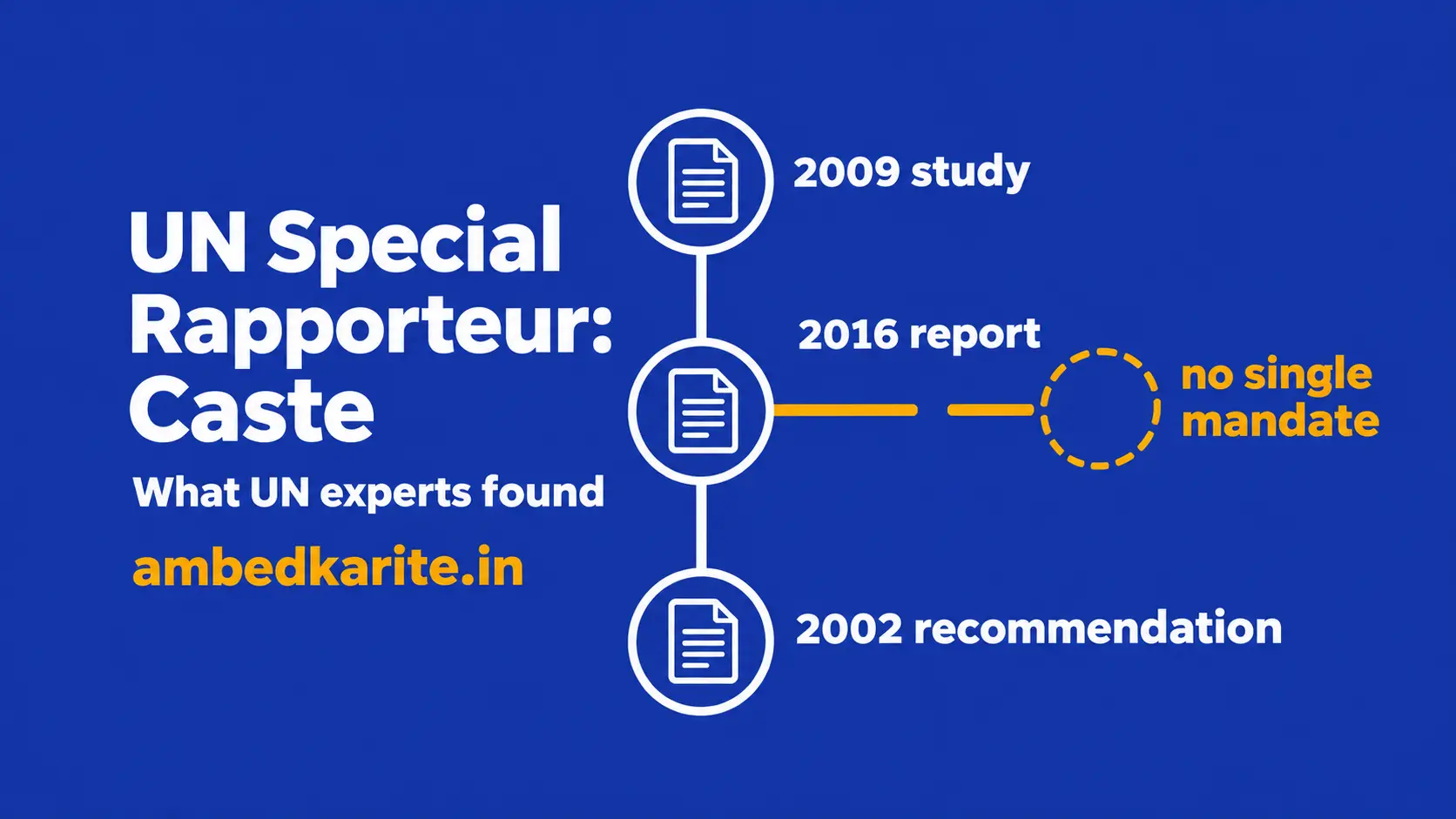
No UN Special Rapporteur caste mandate exists, but UN experts have studied caste since 2000 (International Dalit Solidarity Network, 2019). No UN special rapporteur mandate on caste currently exists, but since the year 2000 some UN experts have taken an interest in the issue (International Dalit Solidarity Network, 2019). Caste discrimination is defined by the UN as ‘discrimination based on work and descent’ (UN Human Rights Council, A/HRC/11/CRP.3, 2009). The first comprehensive report on caste discrimination prepared by the UN was released in 2016 and is known as the Rita Izsak report (A/HRC/31/56) (OHCHR, 2016). The UN guidlines on caste discrimination are draft guidelines and were never adopted by the Human Rights Council (UN Human Rights Council, A/HRC/11/CRP.3, 2009). In 2002 the Committee on the Elimination of Racial Discrimination (CERD) stated that the term ‘descent’ should be interpreted to include ‘caste’ (CERD, 2002). Caste, in this context, means a person’s or group of persons’ inherited status in the hierarchical social order. This information was prepared on 26 November 2026, using UN documentation.
Is there currently a UN special rapporteur on caste?
A UN special rapporteur is an independent expert appointed by the Human Rights Council to report on a theme or a country (OHCHR, 2024).
No special rapporteur has been appointed by the UN to look into caste discrimination in particular. Three documents exist on the subject: thematic reports (International Dalit Solidarity Network, 2019). In 2000 the UN Sub-Commission adopted a resolution which stated that discrimination on the basis of ‘work’ and ‘descent’ is prohibited under international human rights law (International Dalit Solidarity Network, 2019). The early uncrystallized version of this report was prepared by Asbjørn Eide and Yozo Yokota, while the final version was prepared by Yokota and Chin-Sung Chung (International Dalit Solidarity Network, 2019).
Discrimination based on work and descent: the 2009 study
The final report A/HRC/11/CRP.3 was published on 18 May 2009 by the UN Human Rights Council. According to this report, ‘caste’ refers to ‘any distinction, exclusion, or restriction made on the basis of inherited status’ (UN Human Rights Council, 2009). Factors mentioned in this definition include: occupation, family, community or social class, name, place of birth, residence, dialect and accent (UN Human Rights Council, 2009).
What the report found
On 15 March 2016, the UN Special Rapporteur on minority issues, Rita Izsák-Ndiaye, presented her report A/HRC/31/56 to the Human Rights Council (International Dalit Solidarity Network, 2016). The Office of the High Commissioner for Human Rights (OHCHR) called this the first ever comprehensive unit based report released by the UN on caste based discrimination (2016).
According to this report, an estimated 250 million people across the world have been manifold discriminated and suffered humiliation on the basis of their caste (OHCHR, 2016). Lower caste people are forced to carry out ‘polluting’ occupation such as cleansing and sweeping (OHCHR, 2016). Women and girls of lower caste are subjected to sexual violence including trafficking and forced marriage (OHCHR, 2016).
To combat this discrimination, awareness programs should be undertaken by national human rights commissions (OHCHR, 2016). Izsák-Ndiaye additionally recommended all other thematic mandate holders of the UN human rights council’s special procedures should also include ‘caste’ in their scope of work (International Dalit Solidarity Network, 2018).
UN documents carry symbols such as A/HRC/31/56, and a simple, searchable page that lists them helps readers find the original. Website building, which the Ambedkarite Educational Program teaches, covers how to build a reference page like that.
UN caste guidelines: what the 2009 principles ask of states
UN guidelines on castes ask states to enact laws to eliminate caste discrimination and implement affirmative action policies to address it (International Dalit Solidarity Network, 2019). These guidelines also allow national human rights commissions to take the initiative to address these issues (International Dalit Solidarity Network, 2019).
The Special Rapporteurs suggested that the Human Rights Council endorsed the Principles and Guidelines (UN Human Rights Council, 2009). An NGO stated that in the absence of endorsement by the Council, these Principles and Guidelines would have a recommendatory effect (IMADR, 2012). I was unable to locate the Council’s endorsement of these Principles and Guidelines.
CERD caste descent: the 2002 reading
The International Convention on the Elimination of All Forms of Racial Discrimination (ICERD) is the treaty that CERD monitors, and its definition of racial discrimination includes the word “descent” (International Dalit Solidarity Network, 2018).
In 2002, CERD approved General Recommendation 29 on the interpretation to be given to the term ‘descent’ in the convention (International Dalit Solidarity Network, 2018). They stated that in effect, caste based discrimination comes under the purview of the convention. CERD retained the 2007 version of this recommendation despite India’s objections (CERD, 2007).
India’s position and the objections
In July 2020, before the Human Rights Council, a representative of India stated that caste should not be compared with race (EFE, 2022). Previously, in 2001, prior to the Durban conference, India had taken the position that caste should be viewed as a domestic issue (EPW Engage, 2021). In 2016, the Indian government condemned the Izsák-Ndiaye report (Scroll, 2018).
An account in Round Table India states that during the discussion an Indian delegate refused to include caste in her report on the grounds that it was not related to a ‘minority’ (Round Table India, 2023). Dalit groups have previously stated that any kind of discrimination suffered by them is a human rights issue and should be addressed by UN bodies (ResearchGate, 2007).
More recent UN initiatives
In October 2022 the Human Rights Council appointed Ashwini K.P. of India as the Special Rapporteur on racism to replace Mr. E. Tendayi Achiume. EFE reported that Ms. K.P is the first non-African woman to hold this position (EFE, 2022).
In her first report to the Council, A/HRC/53/60 Ms. K.P. stated that she will particularly focus on people affected by ‘descent based discrimination’ including people affected by caste based discrimination (GICJ, 2023). In her later report A/HRC/59/62 Ms. K.P also mentioned caste affected communities (UN Human Rights Council, 2025). Between 2016 and the date of writing this report there have been no other independent reports focused on caste issued by the mandate holder.
UN special rapporteur caste reports compared
| Document | Who | Year | What it covers | Status and limits |
|---|---|---|---|---|
| Sub-Commission resolution 2000/4 | UN Sub-Commission | 2000 | Said discrimination based on work and descent is prohibited by international law | A Sub-Commission resolution, not a treaty |
| General Recommendation 29 | CERD | 2002 | Reads “descent” in the racial discrimination treaty as covering caste | A treaty-body interpretation; India disagrees |
| Working papers E/CN.4/Sub.2/2003/24 and 2004/31 | Asbjørn Eide and Yozo Yokota | 2003, 2004 | Early studies of discrimination based on work and descent | Preparatory |
| Final report A/HRC/11/CRP.3 | Yozo Yokota and Chin-Sung Chung | May 18, 2009 | Defines the term and sets out draft Principles and Guidelines | Draft; the Council was asked to adopt it, and this article found no record that it did |
Questions and Answers
Is there any UN special rapporteur on Caste?
As reported in this article, at the time of writing there is no UN special rapporteur to investigate Caste-based discrimination in particular.
What did the Rita Izsak caste report find?
It stated that over 250 million people around the world have been classified in a caste system and suffering from discrimination and exclusion. It also mentioned some forms of physical and sexual violence against women and suggested awareness programs to combat the situation (OHCHR, 2016).
Are the UN guidelines on caste discrimination binding?
No. They are ‘draft’ principles and guidelines. An NGO’s statement described them as voluntary standards. This article was unable to locate the UN Human Rights Council’s adoption of these guidelines (UN Human Rights Council, A/HRC/11/CRP.3, 2009; IMADR, 2012).
What is the position of CERD on caste and descent?
In 2002, the committee stated that in the context of the International Convention on the Elimination of All Forms of Racial Discrimination, the term ‘descent’ encompasses ‘caste’ and India expressed its objection to this interpretation (CERD, 2007).
Sources
- International Dalit Solidarity Network: Caste discrimination and human rights, compilation of UN references, May 2018
- International Dalit Solidarity Network: Inputs to the Ad Hoc Committee on Durban follow-up, 2019
- UN Human Rights Council: A/HRC/11/CRP.3, Final report of Yozo Yokota and Chin-Sung Chung, May 18, 2009
- OHCHR: Caste systems violate human rights and dignity of millions worldwide, March 21, 2016
- International Dalit Solidarity Network: UN expert urges states to combat caste discrimination, March 2016
- IMADR: Written statement to the Human Rights Council, 21st session, 2012
- UN Human Rights: CERD concluding observations on India, 2007
- UN Human Rights: CERD General Recommendation XXIX, 2002
- La Prensa Latina (EFE): Indian from marginalized Dalit community named UN envoy against racism, 2022
- EPW Engage: Caste and Race: Discrimination Based on Descent
- Scroll: Fighting India’s official denial, 2018
- Round Table India: India upholds Caste System at the UN
- ResearchGate: ‘Dalit Rights Are Human Rights’: Caste Discrimination, International Activism, and the Construction of a New Human Rights Issue
- Geneva International Centre for Justice: HRC53: Urgent Action Needed to Combat Racism and Discrimination, 2023
- UN Human Rights Council: A/HRC/59/62, Report of the Special Rapporteur on contemporary forms of racism, May 29, 2025