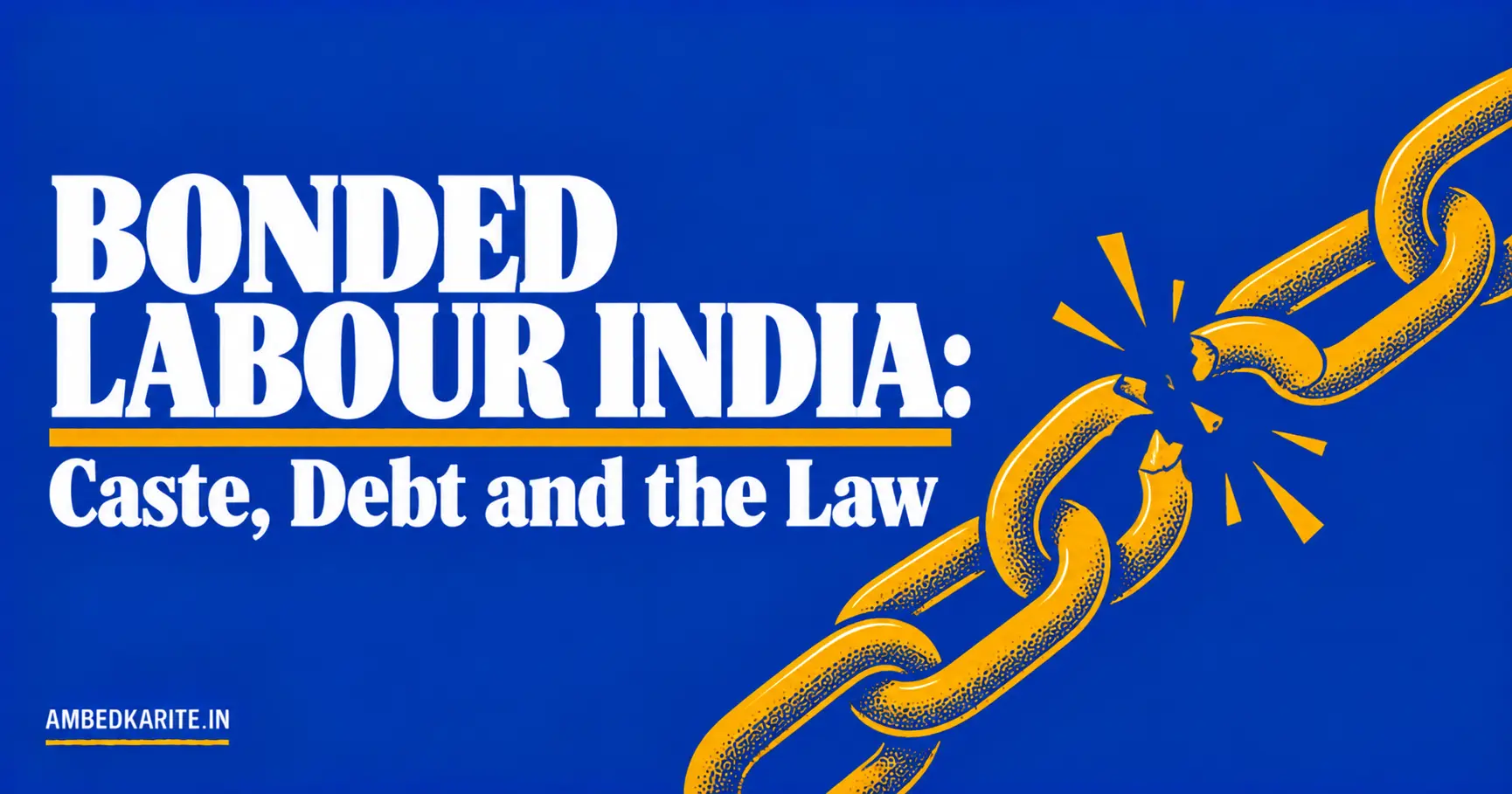
Bonded labor was first outlawed in India in 1976 with the enactment of the Bonded Labour System (Abolition) Act. Despite this, the system continues today. Bonded labor is often described as a form of modern-day slavery. It typically occurs in the context of the agricultural and service sectors. Particularly, it is pervasive in the brick kiln industry as well as in the sugarcane, cotton, and rice industries. Muhid, a derivative of debt, is often used to bond laborers and is usually passed on to families and future generations. Another example of bonded labor is found in the Dalit community in Central India, where the children of laborers are forced to work in place of their fathers in order to repay a generations-old debt.
What is bonded labor?
Bonded labor is described in the 1976 Act as when a debtor or a member of the debtor’s family works without wages or for an unreasonably low wage for a creditor to repay a debt. The Supreme Court of India has stated in the 1984 Bandhua Mukti Morcha case that not all cases of bonded labor require visible means of restraint. Economic compulsion and debt can be forms of coercion.
Caste and bonded labor
A report by the International Labor Organization (ILO) notes that the incidence of bonded labor in India is particularly high among Dalits and tribal populations, and that Dalits, Adivasis, and backward castes are over-represented (ISB Bharti Institute blog, quoting the ILO report). A civil society report to the UN states that in South Asia, Dalits comprise the large majority of the population in debt bondage (National Coalition for Abolition of Bonded Labour, UN Universal Periodic Review submission).
Indian study guides provide varying estimates. One study guide states that approximately 80 percent of bonded labor is comprised of Scheduled Castes (SCs), Scheduled Tribes (STs) and Other Backward Castes (OBCs), while another states that 84 percent of bonded labor is comprised of Dalits and OBCs (PMF IAS). These estimates are not based on any surveys, thus one should consider these as rough estimates. Social hierarchy places members of the lower castes and Scheduled Tribes at a higher risk of exploitation (Vajiram & Ravi, “Bonded Labour Act”). Our articles providing further information on Dalits, Adivasis/Scheduled Tribes, and casteism may be of interest to readers.
Where does it occur?
Bonded labor is found in the brick kilns of Bihar and the sugar cane fields of Maharashtra as well as in the stone quarries of Rajasthan (PMF IAS). Poverty and debt are the main causes (PMF IAS, citing the National Commission on Labour).
The law: Article 23 and the 1976 Act
Article 23 of the Constitution of India prohibits trafficking in human beings and forced labour, including beggar (Wikipedia, Constitution of India, Art. 23). The Bonded Labour System (Abolition) Act, 1976 (hereinafter “the Act”) is Act 19 of 1976. It came into effect on February 9, 1976 and was deemed to have come into force on October 25, 1975, with the earlier Ordinance (Wikipedia, “Bonded Labour System (Abolition) Act, 1976”).
The Act abolishes bonded labour and provides for the trial of debt-based forced labour (The Mooknayak). It is a progressive legislation to abolish the system and liberate the workers. It is in conformity with other laws of India and complements Article 17 and the Prevention of Atrocities Act.
Is the law implemented?
The evidence shows that the law remains mostly in the books. The numbers vary.
Estimates of modern slavery. The Global Slavery Index 2023 by the Walk Free Foundation suggests that approximately 11 million persons in India are in modern slavery, which is a wider category than bonded labour (Vajiram & Ravi).
Rehabilitation. The Lok Sabha was informed by the Government in March 2025 that 297,038 bonded labourers were rehabilitated between 1978 and 2025 (ISB Bharti Institute blog). However, a different source stated that 12,760 persons were rescued and rehabilitated between 2016 and 2021 (PMF IAS, citing a 2021 ministry reply).
Recognition. Based on testimonies of 950 rescued workers in 19 states, a study found evidence of widespread bonded labor, which is sustained by failure of enforcement mechanisms, and the key number is how many workers the state refuses to recognize as bonded (The Mooknayak, citing a study by the National Campaign Committee for Eradication of Bonded Labour, the Mehnatkash Association and the IDEAS office at O.P. Jindal Global University).
Please see the log for how I handled conflicting numbers.
Why it matters for global supply chains
There are new laws in the West to prevent supply chain forces labor.
| Country | Law | Main Rule |
|---|---|---|
| United Kingdom | Modern Slavery Act 2015, section 54 | Annual statement for organizations with an annual turnover of £36 million or above (Sedex) |
| Australia | Modern Slavery Act 2018 | Annual statement for organizations with an annual turnover of AUD 100 million or above (Sedex) |
| Canada | Fighting Against Forced Labour and Child Labour in Supply Chains Act | Annual reporting by certain entities, to come into force on January 1, 2024 (Skadden, 2024) |
| United States | Tariff Act 1930, section 307 | Prohibits the importation of goods made wholly or partly with forced labor (Ethical Trading Initiative) |
The US also has the Uyghur Forced Labor Prevention Act, which is to prevent goods related to forced labor in China’s Xinjiang region, and is not related to India (Segura, “The Global Spread of Modern Slavery Act Legislation”). The UK and Canadian reports invite companies to disclose the steps they take to ensure that their supply chains are free from modern slavery and forced labor (Public Safety Canada).
Readers in compliance will find in our Indian evidence who is most at risk and where. Our guide to caste discrimination in the workplace covers how employers should address caste in their policies and our worldwide comparison covers caste laws in other countries. (For communities documenting their history, skills in blogging, AI and email marketing have become essential. The Ambedkarite Educational Program has been developed to teach these skills.)
Bonded labour
Indian law is clear. Article 23 of the Indian Constitution and the Bonded Labour System (Abolition) Act, 1976, prohibit debt bonded labour. However, it is prevalent in brick kilns, sugarcane fields and stone quarries, and ILO and civil society reports state that Dalits and Adivasis are over-represented among the affected. Estimates and figures on rehabilitation and resettlement are inconsistent in different sources. US, UK, Canada and Australia based companies need to conduct some level of supply chain or import control/reporting in relation to modern slavery laws.
Frequently Asked Questions
What is bonded labour in India?
It is a form of forced labour in which a person works for little or no pay to repay a debt. It is banned by Article 23 of the Constitution and the Bonded Labour System (Abolition) Act, 1976.
Is bonded labour linked to caste?
Yes. An ILO report says the incidence is particularly severe among Dalits and indigenous peoples. A civil society submission to the UN says Dalits make up the majority of people subjected to domestic bonded labour in South Asia.
When was the Bonded Labour System (Abolition) Act passed?
It was enacted on February 9, 1976, and deemed to have come into force on October 25, 1975.
How many people are in bonded labour in India?
No reliable single figure exists. The Global Slavery Index 2023 estimates about 11 million people in modern slavery, which is a wider category than bonded labour.
Which laws require companies to check for forced labour in supply chains?
The UK Modern Slavery Act 2015, the Australian Modern Slavery Act 2018 and Canada’s 2024 Supply Chains Act require reporting. The US bans imports made with forced labour under section 307 of the Tariff Act of 1930.
Understanding caste is step one. Building digital independence is step two.
Ambedkarite communities around the world are using AI tools, blogging and email marketing to document their experiences, challenge discrimination and build platforms that cannot be silenced.
The Ambedkarite Educational Program teaches exactly these skills: AI tools, website building, email marketing, blogging and Google AI. Lifetime access is ₹297 (~$4 USD). All future courses are included free.
Or join the Movement free to start learning today.
SOURCES
- PMF IAS, “Bonded Labour in India”
- Vajiram & Ravi, “Bonded Labour Act, Status, Provisions, Reasons & Measures”
- ISB Bharti Institute, “Beyond Abolition: The Unjust Loophole Keeping Bonded Labour Alive in India,” October 2025
- The Mooknayak, “The Afterlife of Bondage”
- National Coalition for Abolition of Bonded Labour, UN Universal Periodic Review submission
- Wikipedia, “Bonded Labour System (Abolition) Act, 1976”
- Constitution of India, Article 23
- Sedex, “Modern Slavery in Supply Chains: A Guide for Businesses”
- Skadden, “UK Modern Slavery Act: The Future of Transparency in Supply Chains,” 2024
- Ethical Trading Initiative, “Modern slavery and transparency standards”
- Segura, “The Global Spread of Modern Slavery Act Legislation”
- Public Safety Canada, international reporting on modern slavery