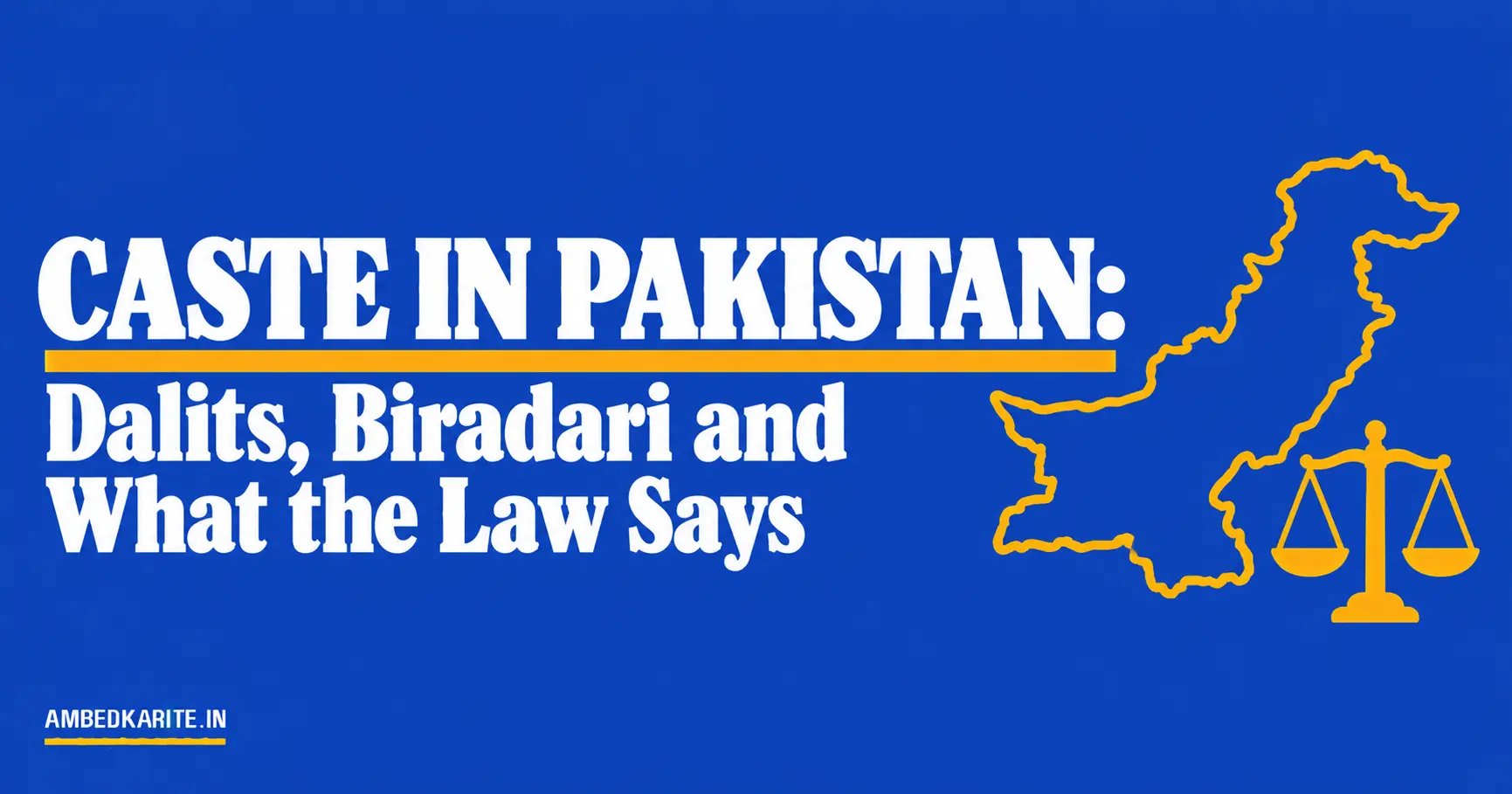
Caste is recognized officially by the state of Pakistan only for non-Muslim communities, which the state calls Scheduled Castes. Organizations for Dalits say that those communities face discrimination as non-Muslims as well as being at the bottom of the caste hierarchy (IDSN, “Pakistan”; Wikipedia, “Scheduled Castes in Pakistan”). This paper provides information on who the Dalits of Pakistan are, what reports say about bonded labour and quotas, what the legal framework is, and where the information gaps are. Most of the references provided are by advocacy organizations, and I point out their differences. A separate paper by us provides an overview of the concept of Dalits.
Who are the Dalits of Pakistan?
The Dalits of Pakistan are called Scheduled Castes similar to those in India; however, the latter in Pakistan do not have the rights accorded to their counterparts in India (at least) on paper (IDSN, “Pakistan”). Forty castes have been recognized as Scheduled Castes through an ordinance, and these consist of non-Muslim communities that are socio-economically disadvantaged (Wikipedia, “Scheduled Castes in Pakistan”). These communities are largely in Sindh and the Southern part of Punjab, and usually, live in separate colonies (IDSN; UK Parliament, Evidence on UK Aid to Pakistan). These communities in Sindh include the Kolhi, Bheel and Meghwar, named by a Dalit organization (Wikipedia, “Dalit Sujag Tehreek”).
As reported by the IDSN, the 2017 census stated that there were 849,614 registered Scheduled Castes living in Pakistan. However, researchers and Dalit activists state that the actual numbers are in the millions. Pakistan’s census does not break down its populations by caste like India’s, and the CERD Committee has asked for Pakistan to provide statistical data on Scheduled Castes (IDSN). See the log for the census data.
Caste system in Pakistan: double discrimination
According to the IDSN, Dalits in Pakistan face multiple levels of discrimination. First, as Pakistani citizens, they also face discrimination as religious minorities. Secondly, Pakistan’s Dalit population, who are mainly Hindus, are discriminated against by the Pakistan’s Muslim majority, as well as by upper-caste Hindus (IDSN). As stated by IDSN, a large number of Pakistan’s Dalits are from the Hindu and Christian minorities, and that some castes within the Muslim community also are in similarly neglected conditions (UK Parliament, written evidence). Our chapter on the Pasmanda Muslims explains various caste-like systems among Pakistan’s and India’s Muslims, as well as other South Asian countries.
Caste system Pakistan: bonded labour
There is widespread forced and bonded labour in agriculture and brickmaking in Pakistan, and the overwhelming majority of bonded labour is from Dalits and other marginalized communities (IDSN). A UN committee stated in 2016 that, although the Bonded Labour System (Abolition) Act, 1992 was enacted to eradicate bonded labour, it still exists in the brick kiln and textile industries, and among other Scheduled Castes (CERD concluding observations on Pakistan, 2016, via IDSN). Our guide to bonded labour in India and to caste in supply chains address related issues in the region.
Sanitation work
Many Dalits living in urban areas are sanitation workers (IDSN). A joint civil society submission to the UN review of Pakistan, states that a substantial number of sanitation workers are Hindus scheduled castes from the Sindh province and that Christians and other depressed castes are overrepresented in this sector as well (UPR Pakistan 2023, joint submission). The submission states this is a critical inter-section of caste and religion in hazardous sanitation work (UPR Pakistan 2023). Our manual scavenging guide covers similar practices in India.
The law and quotas
Pakistan’s Constitution has a general prohibition of discrimination, but IDSN says that it does not specifically address caste (IDSN, submission to CERD). In 2009, CERD expressed serious concerns about the situation of Scheduled Castes, and in 2016, it expressed concerns about their situation with respect to employment and education, and access to justice and their situation of bonded labour (IDSN, submission to CERD). I did not find a law that specifically prohibits caste discrimination in Pakistan. The CERD Committee refers to its General Recommendation 29 (2002), which states that caste is also considered as descent-based discrimination, to illustrate descent-based discrimination.
Quotas have moved backwards (IDSN). In 1998, a law that provided a 6 per cent quota for Scheduled Castes in government jobs was repealed and replaced by a 5 per cent quota for all minorities (IDSN; IDSN, submission to CERD). IDSN requests the reinstatement of the 6 per cent quota (IDSN, submission to CERD), and states that benefits of the minority quota did not reach Dalit women (IDSN, report to CEDAW, 2013).
Politics and data
IDSN’s submission to the UN review states that most reserved seats for non-Muslims are held by dominant-caste Hindus and Christians, thereby leaving the Scheduled Castes with insignificant representation (UPR Pakistan 2023). One Dalit organization, Dalit Sujag Tehreek, has campaigned to get Dalits to declare themselves as such in the census, and to seek affirmative representation (Wikipedia, “Dalit Sujag Tehreek”). I have not researched the other claims made by IDSN related to forced conversions and marriages, and this guide will not be covering them (IDSN, treaty bodies, “Pakistan”).
What the Pakistani government says
I also did not find the Pakistani government’s response to these claims in my sources, and therefore, this guide will not speak to that. Readers are encouraged to consult state reports to CERD.
Caste in Pakistan and neighboring countries
| Pakistan | Nepal | India | |
|---|---|---|---|
| Official term | Scheduled Castes (only non-Muslims) | Dalit (26 groups) | Scheduled Castes (Hindu, Sikh, Buddhist) |
| Caste-specific law | None found | 2011 Act | Atrocities Act, 1989 |
| Job quota | 5% for all minorities (Constitution, Article 40) | Reservation | |
| Data | 2017 census: 849,614 (disputed) | 2021 census: about 13.4-13.6% | Census |
Our guides to caste in Nepal and to caste in Sri Lanka and Bangladesh cover the rest of South Asia.
Takeaway
In Pakistan, discrimination against non-Muslim Scheduled Castes is officially recognized and is largely limited to the Sindh and southern Punjab provinces with 849,614 cases recognized in the 2017 census, and millions according to activists. The IDSN and UN committees report discrimination in employment and education, as well as the practice of bonded labor and the loss of a job quota (6% scrapped in 1998 and replaced by a 5% quota for all minorities). I could not find a specific law that bans caste-discrimination or a government response. The majority of the available literature is in the form of advocacy.
Frequently Asked Questions
Is there caste in Pakistan?
Yes. Pakistan officially recognises Scheduled Castes, which are non-Muslim communities, and rights groups report caste-based discrimination, bonded labour and exclusion.
Who are Dalits in Pakistan?
Mostly Hindu and Christian communities. The state calls them Scheduled Castes, and the 2017 census recorded 849,614, though activists say the true number is in the millions.
Does Pakistan have a law against caste discrimination?
The Constitution has a general ban on discrimination. I did not find a law that specifically prohibits caste discrimination.
What happened to the Scheduled Caste job quota?
A 6 per cent quota in government jobs was scrapped in 1998 and replaced by a 5 per cent quota for all minorities, according to IDSN.
What have UN bodies said about caste in Pakistan?
The CERD committee raised concerns in 2009 and 2016 about discrimination against Scheduled Castes in employment and education, limited access to justice and persistent bonded labour.
Understanding caste is step one. Building digital independence is step two.
Ambedkarite communities around the world are using AI tools, blogging and email marketing to document their experiences, challenge discrimination and build platforms that cannot be silenced.
The Ambedkarite Educational Program teaches exactly these skills: AI tools, website building, email marketing, blogging and Google AI. Lifetime access is ₹297 (~$4 USD). All future courses are included free.
Or join the Movement free to start learning today.
SOURCES
- IDSN, “Pakistan”
- IDSN, submission to the UN Committee on the Elimination of Racial Discrimination (CERD), 2024
- IDSN / UPR, Universal Periodic Review, Pakistan, 4th cycle, joint submission
- IDSN, “Treaty Bodies: Pakistan”
- IDSN, “Scheduled Caste Women in Pakistan,” alternative report to CEDAW, 2013
- UK Parliament, written evidence on UK aid to Pakistan (UAP0007)
- Wikipedia, “Scheduled castes in Pakistan”
- Wikipedia, “Dalit Sujag Tehreek”