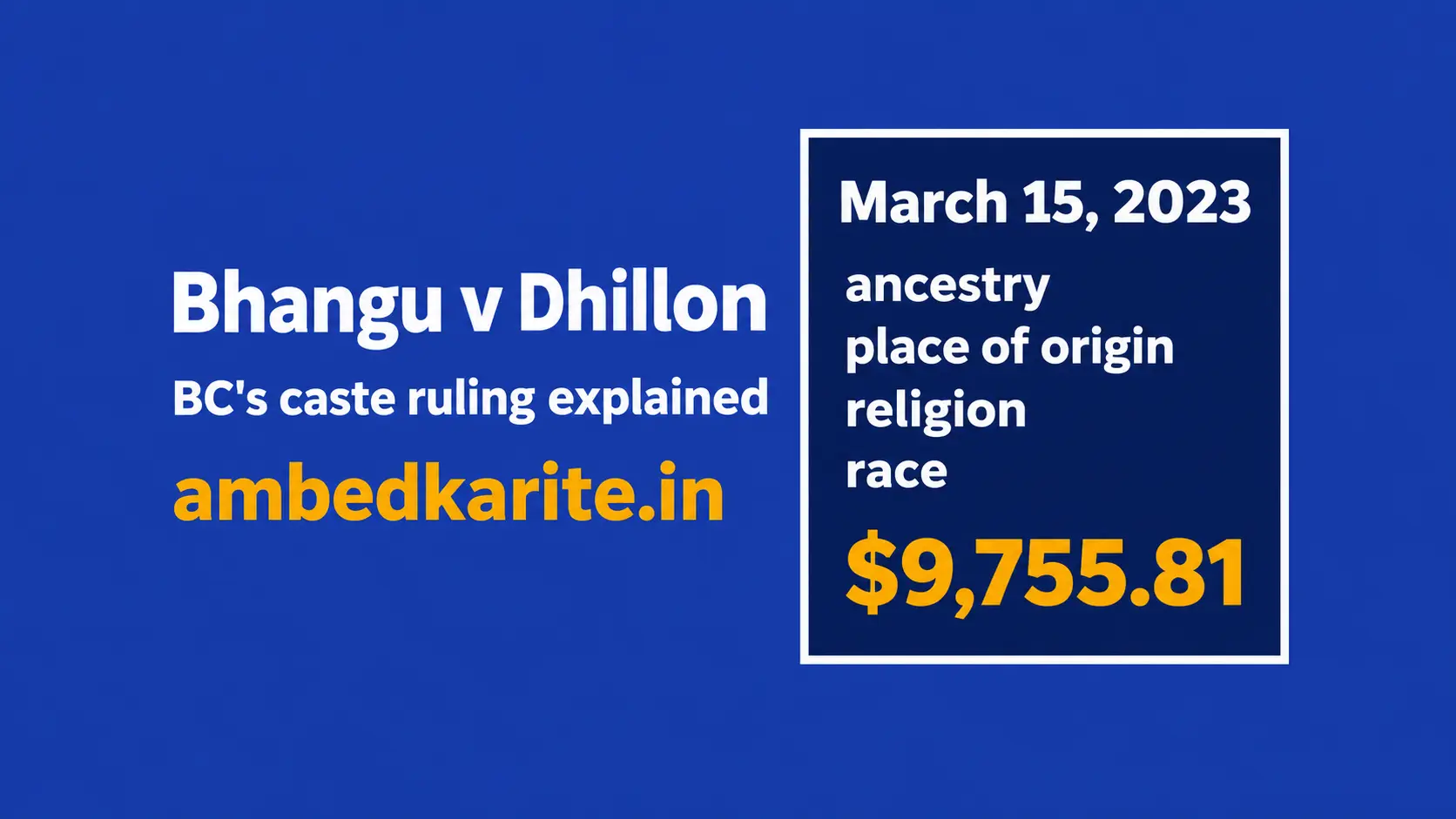
Bhangu v Dhillon is a March 15, 2023 decision of the British Columbia Human Rights Tribunal (BC Human Rights Tribunal, 2023). On March 15, 2023, the British Columbia Human Rights Tribunal (BC Human Rights Tribunal, 2023) released its decision in Bhangu v. Inderjit Dhillon and others. Lawyers refer to it as 2023 BCHRT 24. The case has been cited by the Ontario Human Rights Commission (OHRC, 2023). During a staff party in 2018, employees of a taxi company in British Columbia were subjected to a caste basedslur (CBC News, 2023). The Tribunal determined that two employees took part in the incident and awarded Mr. Bhangu $9,755.81 (CBC News, 2023). ‘Dalit’ refers to members of previously ‘untouchable’ castes. The use of this term to describe them is offensive and will not be included in this guide. This is general information and should not be construed as legal advice.
Bhangu v Dhillon: the case in brief
The tribunal’s decision calls the slur “the Slur” throughout, and this guide follows that approach and does not print it (BC Human Rights Tribunal, 2023).
The Bhangu Case: incident at the 2018 staff party
The complainant named three individuals in her lawsuit; two of them are brothers, the other is the company’s operations manager (BC Human Rights Tribunal, 2023). There was a previous altercation between the two brothers and the complainant over his short notification to the staff party (BC Human Rights Tribunal, 2023).
The Tribunal concluded that during the second altercation, which took place in the company’s lobby, the brothers repeated the slur using the complainant’s case (BC Human Rights Tribunal, 2023). The Tribunal was not convinced that the slur was used during the first altercation or during the first altercation that took place at the staff party (BC Human Rights Tribunal, 2023).
2023 BCHRT 24: three step test
In the case of the three step test, outlined in section 13 of the Code, it was the complainant’s responsibility to establish that he had been injured in her employment because of her membership in a protected group (BC Human Rights Tribunal, 2023).
The respondents failed to provide any evidence to justify their behavior (BC Human Rights Tribunal, 2023).
Fitting Caste into other Discriminatory Grounds
In this particular case, the Tribunal compared caste to race and concluded that, like race, membership in a particular caste is inherited and passed on through one’s ancestry (BC Human Rights Tribunal, 2023). Using Evidence provided by the complainant, the Tribunal was satisfied that the complainant’s ancestors also belonged to that particular caste (BC Human Rights Tribunal, 2023).
It located the complainant’s place of origin as Punjab, India and religious community as Hindu, based on his membership with the Ravidass Sabha (BC Human Rights Tribunal, 2023). It defined race as a social judgment whereby one social group negatively labels another (BC Human Rights Tribunal, 2023).
The Ontario Human Rights Commission has also adopted this definition of caste based discrimination (OHRC, 2023).
A Toronto employment-law firm circulated its summary of this ruling as a newsletter (Sherrard Kuzz, 2023). Building a list of readers who want that kind of update is covered in the email marketing lessons of the Ambedkarite Educational Program.
Caste slur tribunal: the evidence and the rejected defenses
The Tribunal accepted the expert report of Suraj Yengde explaining the meaning of the impugned word in the context of caste (BC Human Rights Tribunal, 2023). The Tribunal also accepted that people outside the complainant’s caste have used the word to insult and to express contempt for him (BC Human Rights Tribunal, 2023).
The Tribunal was of the view that it was irrelevant what the speaker’s caste was, as long as he was not a member of the caste to which the slur is directed (BC Human Rights Tribunal, 2023). The respondents relied on Falou v. Royal City Taxi Ltd. (BC Human Rights Tribunal, 2023) to support their position that use of the slur in this context is not discriminatory.
The Tribunal rejected this view since in the instant case the brothers repeated used the slur to derive pride from, and to involuntarily assign, a low social status to the complainant (BC Human Rights Tribunal, 2023).
What was not proven
The tribunal determined that in the case at hand, caste had no connection to the physical altercations which occurred between the parties (BC Human Rights Tribunal, 2023). Therefore, they determined that the applicant had failed to demonstrate that his brothers assigned him to a lower caste (BC Human Rights Tribunal, 2023).
With respect to the slur, the tribunal determined that the applicant suffered psychological harm because of it (BC Human Rights Tribunal, 2023). The complaint and claim of reprisal against the third respondent were also dismissed (BC Human Rights Tribunal, 2023).
The award of $9,755.81
The respondents estimated that appropriate compensation should be in the range of $10,000 to $15,000 (BC Human Rights Tribunal, 2023). The tribunal awarded $6,000 compensatory damage (BC Human Rights Tribunal, 2023).
The tribunal also awarded $3,755.81 to cover the cost of an expert report to the tune of $2,743 and the cost of translating the transcripts to be used as evidence to the proceeding at $1,012.81 (BC Human Rights Tribunal, 2023).
What this decision means
To the best of our knowledge, no appeal has been filed for this case. One legal source states that discrimination based on caste has now been recognized in British Columbia and Ontario, and likely other provinces as well (Sherrard Kuzz, 2023).
Bhangu v Dhillon: the decision at a glance
| Item | What the decision says | Source |
|---|---|---|
| Citation | Bhangu v. Inderjit Dhillon and others, 2023 BCHRT 24 (File CS-000932 / 18819) | BC Human Rights Tribunal, 2023 |
| Issued and heard | Issued March 15, 2023; hearing March 21 to 25, 2022, by videoconference | BC Human Rights Tribunal, 2023 |
| Tribunal member | Sonya Pighin | BC Human Rights Tribunal, 2023 |
| Complainant | Manoj Bhangu, a taxi driver, shareholder and board director | BC Human Rights Tribunal, 2023 |
| Respondents | Two co-workers who are brothers (found to have discriminated); a third respondent (complaint and retaliation claim dismissed) | BC Human Rights Tribunal, 2023 |
| Grounds found | Ancestry, place of origin, religion and race | BC Human Rights Tribunal, 2023 |
| Test applied | A protected characteristic; an adverse impact in employment; a connection between them (section 13) | BC Human Rights Tribunal, 2023 |
| Found | The brothers used a caste-based slur several times in the second altercation | BC Human Rights Tribunal, 2023 |
| Not proven | Slur in the first altercation or earlier; that the brothers saw him as an inferior caste; that caste was a factor in the physical injuries | BC Human Rights Tribunal, 2023 |
| Expert evidence | Suraj Yengde’s report, undisputed, on the slur’s caste meaning | BC Human Rights Tribunal, 2023 |
| Remedy | $6,000 for injury to dignity; $3,755.81 for expenses ($2,743 expert report; $1,012.81 transcript); total $9,755.81 | BC Human Rights Tribunal, 2023; CBC News, 2023 |
| Status | One province’s tribunal decision; no appeal or judicial review found in this article’s search | This article |
| Later commentary | Cited by the Ontario Human Rights Commission (2023); a 2025 Queen’s Law Journal article critiques its treatment of caste outside race | OHRC, 2023; Queen’s Law Journal, 2025 |
Sources: BC Human Rights Tribunal, 2023; CBC News, 2023; OHRC, 2023; Queen’s Law Journal, 2025. This is general information, not legal advice.
BHAUNG V. DHILLON
On March 15, 2023 the British Columbia Human Rights Tribunal released its decision in Bhangu v. Dhillon, 2023 BCHRT 24. In this case the Tribunal considered caste in conjunction with ancestry, origin, religion and race. The Tribunal also found that two of Bhangu’s co-workers used a caste slur during the incident for which he seeks redress. The Tribunal awarded Bhangu $9,755.81. Bhangu has not proven that his co-workers believed he was inferior to them or that caste had any connection with the altercations for which he seeks a remedy (2023 BCHRT 24). Readers are encouraged to review the decision for themselves.
Readers who want to learn to read tribunal decisions closely and write clear, sourced explainers can start with the Ambedkarite Educational Program, a lifetime-access course at ₹297 (about $4 USD) that covers blogging, website building, email marketing, AI tools and Google AI, with all future courses included. The free Movement page is another place to begin.
This article draws on the British Columbia tribunal’s decision (read in full through a copy on a third-party site), press reports of it, the Ontario Human Rights Commission’s 2023 position and two pieces of commentary. I did not print the slur, and I found no appeal or judicial review in my search. Each source’s claims are attributed to it.
Last updated: November 27, 2026
Frequently Asked Questions
What did the tribunal determine about the use of the caste slur?
They determined that during the second altercation, the brothers uses the slur on multiple occasions. The tribunal also accepted the expert report interpreting the slur to be derived from a caste. Lastly, they rejected the brother’s defense that using the slur constitutes no form of discrimination (BC Human Rights Tribunal, 2023).
What is the Bhangu case about?
It is about an incident that occurred at a 2018 staff party attended by employees of a taxi company. During the staff party, two of Bhangu’s co-workers allegedly shouted a slur that is derogatory to Bhangu’s caste (CBC News, 2023).
What is 2023 BCHRT 24?
This is the 24th decision made by the British Columbia Human Rights Tribunal in 2023 (BC Human Rights Tribunal, 2023).
Sources
- BC Human Rights Tribunal: Bhangu v. Inderjit Dhillon and others, 2023 BCHRT 24, March 15, 2023 (copy)
- CBC News: B.C. Human Rights Tribunal awards man more than $9K in case of caste-based discrimination, March 2023
- OHRC: OHRC’s Policy position on caste-based discrimination, October 26, 2023
- Sherrard Kuzz: What is Protected Under Human Rights Legislation? Veganism is not protected, caste is, 2023
- Queen’s Law Journal: The Case for Recognizing Caste as a Protected Ground, 2025