What is brahmophobia? A term pushed online, taken to the Supreme Court, and dismissed in 2026. Here’s what the verdict actually said.
Here’s a fun fact that ruins the whole “brahmophobia” panic 👇
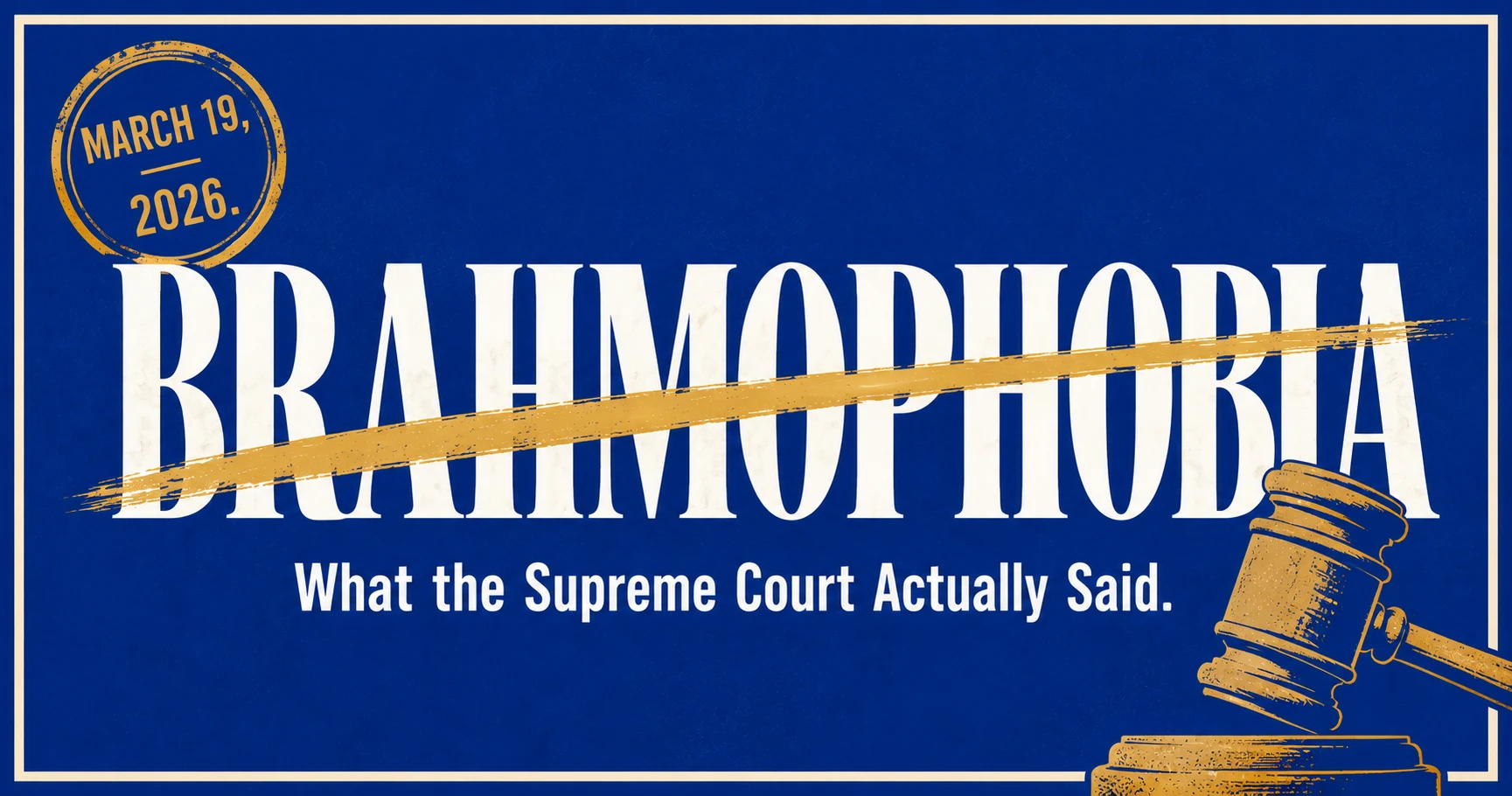
On March 19, 2026, the Supreme Court was asked to recognise “brahmophobia” as a punishable form of caste discrimination. The bench heard the petition for a few minutes. Then it asked one question that broke the entire argument: why should one community get special protection that no one else has?
The petitioner withdrew. But right-wing X is still spinning this as “court ignored brahmin pain.” So let’s talk about what is brahmophobia, who coined the term, and why the SC didn’t buy it.
What Is Brahmophobia According to Its Pushers?
The term comes from a 2024 book titled Brahmin Genocide: A Precursor to Hindu Extinction, published by Sapta Rishi Sansthan. So what is brahmophobia in their own words? The book’s authors define it as hatred, fear, contempt, or prejudice against brahmins, their religious symbols, practices, and beliefs.
The core claim is straightforward. They argue brahmins have faced systemic hate for centuries — colonial-era propaganda, post-Gandhi-assassination violence in 1948 Maharashtra, the Kashmiri Pandit exodus in 1990, and modern social media targeting. They say a separate law is needed, parallel to the SC/ST (Prevention of Atrocities) Act, 1989.
Petitioner Mahalingam Balaji took this case to the Supreme Court in Mahalingam Balaji v. Union of India (Diary No. 69172/2025). His plea asked for a lot. Criminal recognition of brahmophobia. A “Genocide Victims Solidarity Day” on January 19. School curriculum revisions. Disqualification of public officials who “engage in caste-based hate speech.” A white paper on brahmin discrimination.
That’s the steel-man. Now the receipts.
What the Brahmophobia Supreme Court Verdict Actually Said
The bench was Justice B.V. Nagarathna and Justice Ujjal Bhuyan. Two of the most respected names on the Court right now. They didn’t dismiss the idea that hate speech causes harm. They dismissed the idea of carving out a community-specific shield.
Here’s the line that mattered. Justice Nagarathna said hate speech against any community has no place in India, but it depends on education, intellectual development, tolerance, and patience. Once everyone follows fraternity, hate speech automatically ends.
Then she asked the question that exposed the strategy. Why should one specific community seek protection only for itself, and not for others?
The petitioner had no answer. So he sought withdrawal. The Court allowed it. The order recorded: the writ petition is dismissed as withdrawn.
What did the SC actually rule, then? It ruled that existing hate speech laws already cover every community equally. No new category needed. If a brahmin individual faces hate speech, they file under existing IPC/BNS provisions like everyone else. That’s already the law.
Where the Brahmophobia Argument Falls Apart
Four problems with the case the Court refused to entertain.
1. Hate Speech Laws Already Cover Everyone
The Bharatiya Nyaya Sanhita (BNS) replaced the IPC in July 2024. BNS sections like 196, 197, and 299 handle promoting enmity between groups, imputations against national integration, and deliberate insults to religious feelings. These sections don’t ask which caste the victim belongs to. They apply to everyone.
So if a brahmin individual faces a real targeted threat or slur, the law already exists. The Court literally said this in court — file specific instances at appropriate forums, not as a writ petition asking for a brand-new category.
2. The SC/ST Act Protects Documented Exclusion, Not Hurt Feelings
This is where the argument really collapses. The Scheduled Castes and Scheduled Tribes (Prevention of Atrocities) Act, 1989, isn’t a feelings law. It’s a response to centuries of documented material exclusion. Denial of temple entry. Denial of well water. Denial of school access. Forced labour. Separate plates in eating houses. Untouchability codified in religious texts and enforced by social violence.
Article 17 of the Constitution names this directly: “Untouchability is abolished.” That isn’t metaphor. It’s an admission of a system that ran for two thousand years against specific communities — and never against brahmins.
So the SC/ST Act and a hypothetical Brahmin Atrocities Act aren’t legal parallels. They would address two completely different historical realities. One is documented systemic exclusion. The other is hurt online discourse.
3. The Numbers Don’t Back a “Victim Community” Claim
The NCRB Crime in India 2023 report, released in September 2025, recorded over 57,000 cases of crimes against Scheduled Castes that year alone. Four states — Uttar Pradesh, Rajasthan, Madhya Pradesh, and Bihar — accounted for nearly two-thirds of all cases. The crime rate per lakh SC population was 28.6.
There is no NCRB category for “crimes against brahmins” because the systemic pattern doesn’t exist as a measurable category. Individual crimes against brahmin individuals get prosecuted under regular law, like crimes against any other citizen.
For perspective: the National Coalition for Strengthening SCs and STs (PoA) Act analysis shows over 60 per cent of SC/ST atrocity cases end in acquittal or discharge. So even with a dedicated law, the system fails Dalits and Adivasis daily.
That’s the actual problem in Indian jurisprudence. Not a missing brahmin shield.
4. The “Genocide” Claim Collapses Under Definitions
The book’s title — Brahmin Genocide: A Precursor to Hindu Extinction — uses a word with strict legal meaning. The UN Genocide Convention, 1948, defines genocide as acts committed with intent to destroy a national, ethnic, racial, or religious group, in whole or in part.
The 1948 Maharashtra anti-brahmin riots after Gandhi’s assassination were a real tragedy. But mainstream Indian historians characterise that violence as communal riots, not as legal genocide under the UN definition. They were wrong, condemnable, and prosecuted at the time.
The Kashmiri Pandit exodus of 1990 was driven by Pakistan-backed militancy in the Valley. It is recognised as ethnic cleansing by many. However, pinning that event on “anti-caste movements” in mainland India is a category error. The same anti-caste movements have stood with Kashmiri Pandits as displaced citizens, not against them.
Stretching the word “genocide” to cover online discourse and academic critique is the move that actually waters the word down.
What Is Brahmophobia in Constitutional Reality?
Here’s the short answer to what is brahmophobia: it’s a manufactured label that tries to flip the historical and legal record.
Article 14 of the Constitution guarantees equality before law. Article 15 prohibits discrimination on grounds of caste. Article 17 abolishes untouchability. Together, these articles already cover every Indian regardless of caste. The same articles also recognise that some groups need affirmative protection because they faced historical exclusion. That’s why Articles 15(4), 16(4), and 46 exist.
In the Constituent Assembly, Babasaheb didn’t draft Article 17 because dalits had hurt feelings. He drafted it because dalits had been denied water, education, temple entry, and dignity for centuries. He recorded the receipts. The CAD volumes from 1947–49 are public record. Nobody made the parallel case for brahmins because the parallel exclusion didn’t exist.
Babasaheb didn’t wait for permission to start Mooknayak in 1920. He launched his own newspaper because no upper-caste paper would print Bahujan voices. Today the platforms are X, YouTube, and Substack — and Bahujans still need their own infrastructure. That’s exactly what the Ambedkarite Educational Program trains people for.
Why “Brahmophobia” Keeps Trending
Here’s the playbook in four steps. First, name a fake phobia. Then demand legal recognition for it. After that, use that recognition to claim parity with SC/ST protections. Finally, argue that since “everyone is now protected,” the SC/ST Act is no longer special and should be diluted or repealed.
You can see this strategy moving across discourse. Right-wing accounts on X push #Brahmophobia daily. Books frame it as “early warning signs of genocide.” YouTube videos call court verdicts a “lecture on tolerance.” Each step is designed to manufacture moral parity between centuries of untouchability and modern online critique.
The Supreme Court bench saw through this. That’s why Justice Nagarathna asked the question she did. Protection for one community, or fraternity for all? The Constitution already chose fraternity in 1949.
The Takeaway
The SC didn’t ignore brahmin pain. It refused to invent a legal category for a community that already runs most of the legal, academic, media, and political systems. That’s not bias. That’s what neutrality actually looks like.
If a brahmin individual faces real hate speech, file an FIR under existing law. The Court literally pointed to that path. What the Court refused to do is rewrite the Constitution to dilute caste-based protections that exist for documented historical reasons.
That’s the answer to what is brahmophobia, in legal and constitutional terms.
Educate. Agitate. Organize.
Babasaheb gave us three words. Reading this blog is “Educate.” But what about Agitate and Organize?
Today X bans accounts that question caste narratives. Reels get shadow-banned. WhatsApp groups get reported and locked. So Bahujans need their own platforms — emails, blogs, websites, AI tools. The infrastructure has to be ours.
The Ambedkarite Educational Program is built for exactly this. ₹297 lifetime access. Includes Prompt Engineering, Google AI, Website Building, Email Marketing, Blogging & SEO, and Canva. All future courses added free.
Or join the Movement free to start with the email list.
Frequently Asked Questions
What is brahmophobia in simple terms? It’s a term coined in a 2024 book to describe alleged hate speech against brahmins. The Supreme Court declined to recognise it as a punishable category in March 2026, ruling that existing laws already cover hate speech against any community.
Did the Supreme Court rule against brahmins in the brahmophobia case? No. The Court ruled that existing hate speech laws already protect every community equally, including brahmins. It refused to create a community-specific shield because that would break the principle of fraternity.
Is anti-brahmin hate speech illegal in India? Yes. BNS sections like 196, 197, and 299 cover hate speech against any community, including brahmins. The Court pointed petitioners to these existing laws and to lower forums for specific instances.
How is brahmophobia different from the SC/ST Act? The SC/ST Act addresses documented historical and material exclusion — untouchability, denial of services, caste-based atrocities. It’s not about hurt feelings. The brahmophobia argument lacks the equivalent material record because brahmins were not historically excluded from temples, wells, or schools.
Who filed the mahalingam balaji case in the Supreme Court? Mahalingam Balaji filed it in person. The case title is Mahalingam Balaji v. Union of India, Diary No. 69172/2025. It was heard on March 19, 2026, by Justices B.V. Nagarathna and Ujjal Bhuyan.
Sources
- Mahalingam Balaji v. Union of India, Diary No. 69172/2025, Supreme Court of India, order dated March 19, 2026 — LiveLaw report
- The Wire — “Hate Speech Against Brahmins: What SC Said While Dismissing Plea,” March 23, 2026 — Read here
- The Tribune — “SC refuses to entertain PIL seeking action against ‘Brahmophobia,'” March 20, 2026 — Read here
- The Statesman — “SC declines to entertain plea on ‘Brahmophobia,'” March 20, 2026 — Read here
- Lawbeat — Full case title and order details — Read here
- NCRB Crime in India 2023 report, released September 2025 — NCRB official site
- The Week — “NDA government hails success, but NCRB data shows a troubling reality for SC/ST Act cases,” December 8, 2025 — Read here
- NCDHR (National Campaign on Dalit Human Rights) Report, March 2026 — PDF
- Constitution of India — Articles 14, 15, 17 — Official text, India Code
- Constituent Assembly Debates, 1947–49 — CADIndia archive (CLPR)
- Brahmin Genocide: A Precursor to Hindu Extinction, Sapta Rishi Sansthan, 2024 (opponent self-source — quoted to show their own words) — Brahmin Genocide site | Sapta Rishi petition page
- UN Convention on the Prevention and Punishment of the Crime of Genocide, 1948 — UN official text
What’s your take on brahmophobia meaning? Drop a comment below and share this article with someone who still believes the myth.