

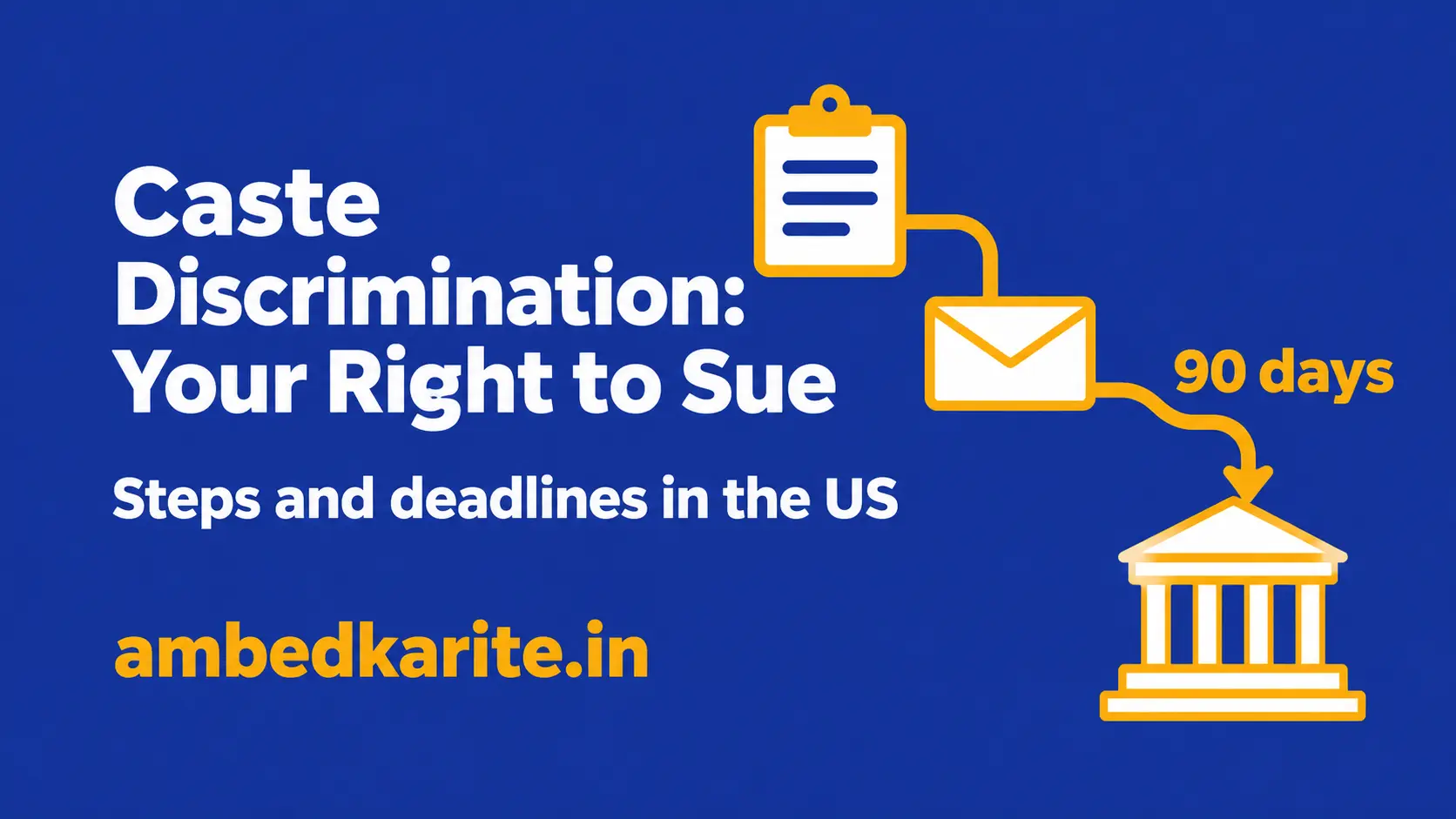
There are strict procedures for exercising the right to sue for claims based on caste discrimination. These begin with a written notice from the government (EEOC, After a Charge). To legally take action against an employer for caste discrimination, an employee must first file a charge with the Equal Employment Opportunity Commission (EEOC, How to File a Charge). A caste discrimination employment lawyer can assist in analyzing the specific facts of the case to identify the claims which may be asserted. A caste discrimination lawyer can also file a lawsuit on the employee’s behalf. Caste, in this context, means the inherent social class of a person. There are no specific federal laws that proscribe caste discrimination, and hence, claims are brought under other prohibitions (Harvard Law Review Forum, 2021). This information was last updated on November 23, 2026.
Process for exercising the right to sue
An employee has 180 days (or 300 days if permitted by state or local laws) from the date of the alleged discrimination to file a charge with the EEOC (EEOC, Filing a Charge). Once filed, the EEOC notifies the employer of the charge and may first attempt to mediate a solution (EEOC, After a Charge). If the EEOC decides that there is no basis to the claim, it issues a Dismissal and Notice of Rights which allows the employee to file a lawsuit (EEOC, After a Charge). If the EEOC decides there is basis to the claim and conciliation is unsuccessful, the EEOC may file a lawsuit (EEOC, After a Charge).
Conciliation is a settlement effort the EEOC runs after it finds reasonable cause to believe discrimination occurred (EEOC, After a Charge). Mediation is a voluntary settlement meeting led by a neutral person (EEOC, After a Charge).
After either notice, an employee has 90 days to file a lawsuit in court (EEOC, Conciliation and Litigation). An employee can request a notice 180 days after filing, even if the investigation is still ongoing (FindLaw, EEOC Charge Processing). This early notice is effectively the employee’s right to sue for caste discrimination.
What claims might an employee be able to bring without specifically naming caste?
To bring a claim for caste discrimination, an employee would have to name another protected trait, as Title VII does not specifically name caste. The employee could name other traits such as race, national origin or religion (Harvard Law Review Forum, 2021). Courts have not determined if caste is a trait of any of these (Elzweig, 2021).
A protected trait is a characteristic, such as race or religion, that the law bars employers from using in decisions (Title VII, 42 U.S.C. § 2000e-2).
Because Title VII of the Civil Rights Act of 1964 does not name caste, an employee may have to refer to other protected traits to bring a claim against an employer for caste discrimination (Harvard Law Review Forum, 2021). The employee could be forced to plead race, national origin or religion (Elzweig, 2021). Courts have yet to decide if any of these describe caste discrimination (Elzweig, 2021).
Most commonly, the employee would have to prove they are a member of a protected class, were qualified for the job, and suffered an adverse employment action (Elzweig, 2021). Proving an adverse employment action would not be difficult; however, proving membership in a protected class and distinguishing caste discrimination from other types of discrimination would be more difficult (Elzweig, 2021).
Caste discrimination right to sue: federal and California deadlines
A caste discrimination right to sue runs on two clocks, and they differ between federal and California law.
| Step | Federal (EEOC) | California (CRD) | Source |
|---|---|---|---|
| File the first charge | 180 days, or 300 days if state or local law also applies | 3 years | EEOC, Filing a Charge; California Civil Rights Department, Employment |
| Notice that opens the courthouse | Notice of Right to Sue, issued when the EEOC closes the charge, or on request after 180 days | Immediate right-to-sue notice on request, required before suing in employment cases | EEOC, After a Charge; FindLaw, EEOC Charge Processing; California Civil Rights Department, Complaint Process |
| Deadline to sue after the notice | 90 days | 1 year | EEOC, Conciliation and Litigation; California Civil Rights Department, Right-to-Sue Form |
| Traits that can support a claim | Race, color, religion, sex, national origin | Includes ancestry | Title VII, 42 U.S.C. § 2000e-2; Elzweig, 2021 |
What remedies a court can order
Caste discrimination cases allow employees to file lawsuits to seek legal remedies. Success on such claims may entitle an employee to several remedies. Employees may be awarded lost wages and future wages (EEOC, Remedies). Courts may also award the employee compensatory and punitive damages (EEOC, Damages). The total amount of compensatory and punitive damages combined may not exceed $50,000 to $300,000, depending on the employer’s size (SHRM, 2024).
Intentional discrimination means the employer acted because of a protected trait, not through a neutral rule (EEOC, Damages Guidance).
Courts may also award an employee prevailing party status which entitles the employee to attorneys’ fees and reimbursement for expert witnesses (EEOC, Remedies). The employer may also be ordered to take actions to prevent similar discrimination in the workplace (EEOC, Remedies).
Deadlines that can end a caste claim
The right to sue for cases of caste discrimination expires 90 days from the date of issue. Other courts have taken similar approaches to treating claims filed outside the 90 day period. The case of Doamekpor v. Central State University, demonstrates that in 2026, the Court of Appeals for the Sixth Circuit dismissed the plaintiff’s case filed 11 days after the 90 day period expired (Call the Right Attorney, 2026).
California provides employees the right to sue for civil remedies for three years from the time they file a complaint with the Civil Rights Department of California (California Civil Rights Department, Employment). Following the issuance of the right to sue, the employee has one year to file a lawsuit (California Civil Rights Department, Right-to-Sue Form).
Finding a caste discrimination lawyer
A caste discrimination employment lawyer is an employment lawyer who is willing to litigate national origin, race, religion or ancestry discrimination claims. Local bar associations offer referral services to lawyers. So do legal aid groups (AAUW, Find Legal Help).
Workers can check if an attorney is in good standing with the state bar to see if there have been any disciplinary actions taken against the attorney (Nolo, Finding an Employment Discrimination Lawyer). Caste discrimination attorneys can file the charges. The National Employment Lawyers Association has a list of member attorneys who represent workers, though they do not offer a referral service (NELA, Find-A-Lawyer). Some federal courts have Title VII forms that people can use if they do not have an attorney (U.S. District Court, N.D. Georgia).
Referral lists and legal aid options differ by state, which makes a clear, searchable resource page useful. The Ambedkarite Educational Program teaches website building and blogging for readers who want to build one.
Workers can check an attorney is in good standing with the state bar to see if there have been any disciplinary actions against the attorney (Nolo, Finding an Employment Discrimination Lawyer).
Free legal services are available to those with low income. Legal aid groups can also help workers compare the benefits of filing a caste discrimination claim under either federal or state law (SPLC, Where to Find Legal Help). This article does not endorse any attorneys or law firms.
What recent cases show
The employee in the Cisco case brought the case along with the California Civil Rights Department (Employment). Cisco denies the allegations (2020, CNN).
In November 2025, a case was filed in New Jersey against an IT company by a former employee (NRI Pulse 2025). The case mentions claims of caste bias, wage theft and labor exploitation. This article could not find a response from the defendants. This article could not find any ruling regarding Title VII and case discrimination. Caste is currently not a protected class under any federal law.
Reasons Few Workers Reach the Court
The term Dalit refers to people formerly known as ‘untouchables’. A 2018 Equality Labs survey states that 52% of Dalit respondents were worried about being identified (NPR, 2018). In the same survey, 67% of Dalit respondents reported being treated unfairly at their workplace (NPR, 2018). This survey utilized a self-selected volunteer sample (NPR, 2018). On the other hand, a 2024 survey by Carnegie’s of 1,206 Indian Americans reported 7% of respondents experienced caste discrimination at work and 31% experienced discrimination based on skin color (Carnegie Endowment, 2025).
Conclusion
From an employment discrimination perspective, a worker must first file a charge with the EEOC and exhaust the 90 day time period to file a lawsuit (EEOC, After a Charge). As of now, no federal law prohibits caste discrimination in employment. Therefore, a worker must plead some other protected class to take legal action against an employer. Caste discrimination at work could be incorporated under other employment discrimination laws with the assistance of a lawyer. Workers should keep in mind every time limitation, particularly the 180 day time period to file a charge, and the 90 day time period to file a lawsuit (EEOC, After a Charge). Courts have not ruled on Title VII and case discrimination. Therefore, until a ruling is made, it is difficult to ascertain the outcome of such cases (Elzweig, 2021).
This guide is a starting point, and many readers will want to share what they learn with others who face the same questions. The Ambedkarite Educational Program teaches blogging, website building, email marketing and AI tools for that kind of sharing, at ₹297 (about $4 USD) for lifetime access, with all future courses included. The free Movement page is another place to begin.
This article draws on EEOC and California Civil Rights Department process pages, EEOC guidance on damages, and two 2021 law-review articles on caste and Title VII. Lawyer-finding advice comes from bar and legal-help resources, and case and survey details come from the reports cited.
Last updated: November 23, 2026
Frequently Asked Questions
What is the caste discrimination right to sue?
It is the Notice of Right to Sue, the EEOC letter that lets a worker file a lawsuit in court, and the worker then has 90 days to do so (EEOC, Conciliation and Litigation). A worker can request it 180 days after filing a charge (FindLaw, EEOC Charge Processing).
How do I sue an employer over caste discrimination?
First file a charge with the EEOC, within 180 days or 300 days if state or local law also applies, then wait for the notice and file in court within 90 days (EEOC, Filing a Charge; EEOC, After a Charge). No federal law names caste, so claims rest on traits such as national origin, race or religion (Harvard Law Review Forum, 2021).
Do I need a caste discrimination employment lawyer?
California’s Civil Rights Department advises having an attorney file a lawsuit (California Civil Rights Department, Right-to-Sue Form). A caste discrimination employment lawyer can explain which claims fit your facts. This is general information, not legal advice.
Can a caste discrimination attorney file my lawsuit?
Yes. A caste discrimination attorney can file the court complaint after the notice arrives, within the 90-day window (EEOC, After a Charge).
Has a court decided that Title VII covers caste?
Not that this article could find. Scholars disagree, and courts have not settled whether caste fits an existing trait (Harvard Law Review Forum, 2021; Elzweig, 2021).
Sources
- EEOC: What You Can Expect After a Charge Is Filed
- EEOC: Conciliation and Litigation
- EEOC: How to File a Charge of Employment Discrimination
- EEOC: Filing a Charge fact sheet
- EEOC: Remedies for Employment Discrimination
- EEOC: Enforcement Guidance on Compensatory and Punitive Damages
- EEOC: Title VII of the Civil Rights Act of 1964
- FindLaw: EEOC Charge Processing
- SHRM: damages caps
- California Civil Rights Department: Employment discrimination
- California Civil Rights Department: Right-to-Sue form
- California Civil Rights Department: Complaint Process
- Harvard Law Review Forum: Title VII and Caste Discrimination, 2021
- University of Arkansas at Little Rock Law Review: Elzweig, 2021
- Call the Right Attorney: 2026 Sixth Circuit deadline case
- AAUW: Find Legal Help
- National Employment Lawyers Association: Find-A-Lawyer
- Nolo: Finding an Employment Discrimination Lawyer
- U.S. District Court, Northern District of Georgia: Title VII complaint form
- Southern Poverty Law Center: where to find legal help
- CNN
- NRI Pulse
- NPR
- Carnegie Endowment for International Peace