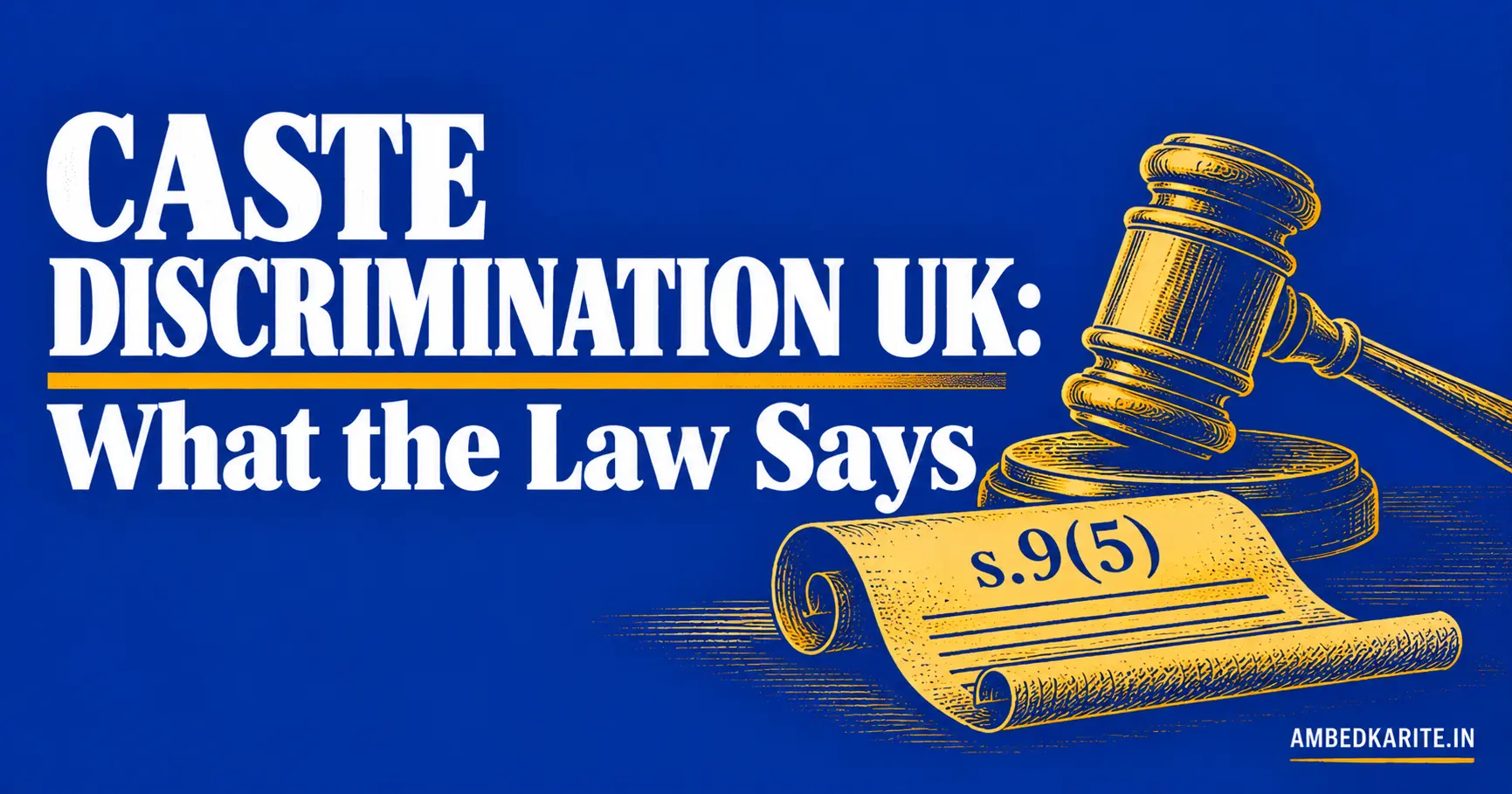
UK Law on Caste is rather unusual. The Equality Act 2010 contains a section on caste but it has never been brought into force. Caste is not explicitly outlawed in UK equality law (House of Commons Library, “The Equality Act 2010: caste discrimination”). Although it is not, the Employment Tribunal has found that caste could fall within race discrimination and be unlawful. This briefing explains how this is possible, why the Government changed its position and what this means for both employees and employers.
The Equality Act 2010 and Caste
The Equality Act 2010 protects people against race discrimination. “Race” includes colour and nationality and ethnic or national origins (Equality Act 2010, s.9). Confusion begins with s. 9(5).
When the Act was passed, s.9(5) provided a minister with the ability to make an order declaring caste to fall within race by order. This followed amendments to the Bill by the House of Lords (Michael Ford, Oxford Human Rights Hub, 2015). The Equality and Human Rights Commission had previously said that caste was already encompassed within the meaning of race (Lexology, “Is the United Nations’ International Labour Organisation about to force the UK government to change its legislation?”). Parliament added the amendment regardless.
In 2013, the words “may” changed to “must” in the Enterprise and Regulatory Reform Act (Lexology; Enterprise and Regulatory Reform Act 2013, section 97). This came into force on the 25th of June, 2013 (Lexology). Today, section 9(5)(a) states that a minister must by order make caste an aspect of race (legislation.gov.uk, Equality Act 2010, section 9). No such order has been made.
The Tirkey v Chandhok case
The only case to deal with caste directly is Tirkey v Chandhok. This involved a “low caste” woman from India who worked as a domestic worker in the UK from 2008 to 2012 (Dalit Solidarity Network UK, “Caste in the UK”).
The Employment Appeal Tribunal in 2014, presided over by Langstaff P, held that the phrase “ethnic origins” in section 9 of the Equality Act is broad enough to cover several instances of caste discrimination (Michael Ford, Oxford Human Rights Hub, 2015). The employers in this case contended that until a minister makes an order, Parliament could not have intended for caste to be covered. The tribunal rejected this argument (Michael Ford, Oxford Human Rights Hub).
A law journal article by Matias Rodriguez Burr details how current laws can already protect victims and that, just because Section 9(5) looks to future laws, it does not mean that caste has been excluded for now (Industrial Law Journal, 2017). The judgment is quite narrow. During the case, counsel for the claimant accepted that parts of the Equality Act 2010 do not cover all elements which could be considered ‘caste’ (Employment Cases Update, Chandhok & Anor v Tirkey). A claim must fit within the four corners of the existing law.
The 2017 consultation and the 2018 decision
The Government announced a consultation in September 2016 which was published in March 2017 and closed in September 2017 (House of Commons Library). It outlined two approaches. The first option was to require the Government to include caste in the Equality Act 2010. The second was to rely on the development of case law (CIPP, “The Equality Act 2010: caste discrimination”).
The Government responded to the consultation in July 2018 and decided not to legislate, and instead rely on the development of case law (House of Commons Library). It also indicated that it would remove the duty in Section 9 of the Equality Act 2010 (CIPP). At the time in Parliament, the Minister stated that a person claiming caste discrimination may use the existing remedy if they can show that their caste is related to their ethnic origin (Penny Mordaunt, July 23, 2018, as quoted by Dalit Solidarity Network UK).
The consultation received around 16,000 responses, and the Government concluded that extra-legal protection was not required (Dalit Solidarity Network UK). Wider responses from the Diaspora to this consultation are available in our post ‘Who are the Dalits?’
What has happened since?
The government said it would repeal the duty, but it hasn’t happened. The Equality Act text on legislation.gov.uk, updated to reflect changes in force up to and including 18 January 2026, says a minister “must” make caste an aspect of race (legislation.gov.uk). It is noted that no plans to repeal section 9(5) were public at that time (ThePrint, 2023).
In September 2024, a UN committee recommended that the UK bring section 9(5)(a) into force (Equality and Human Rights Commission, human rights tracker). The commission’s tracker notes that since then the UK government has taken no further action (Equality and Human Rights Commission). Earlier the UK government said it would seek to repeal section 9(5)(a) (Equality and Human Rights Commission).
In March 2025, Labour MP Warinder Juss asked in Parliament to make provisions to include caste in the Equality Act 2010, and to have a debate on section 9(5) (National Secular Society, March 2025). This was welcomed by CasteWatch UK. The Anti-Caste Discrimination Alliance noted that, without implementing the law, the government continued to fail the victims of Caste discrimination (National Secular Society). Last reported, caste was not included in the UK list of protected characteristics.
The two sides of the debate
Campaigners for change say case law isn’t sufficient. Dalit Solidarity Network UK states case law is insufficient since there is no guarantee the court will always interpret the Act to cover caste, and only one case has concerned it directly (Dalit Solidarity Network UK). The Equality and Human Rights Commission (EHRC) has stated it is important and desirable to give effect to section 9(5) to clarify the law (as quoted by Dalit Solidarity Network UK).
Campaigners for the status quo say existing laws are sufficient. This was the government’s view in 2018 (House of Commons Library). Those against a change to the law say that caste is nebulous and amorphous, which the consultation has touched on (ThePrint, 2023). There is consensus among all that caste-based discrimination should be illegal. Where there is a divergence of opinion is on the necessity for the Act to use the word “caste”.
(The Ambedkarite Educational Program teaches caste awareness, documentation, and advocacy skills.)
Takeaway
Currently, caste discrimination is not legally recognized in the UK. Under the Equality Act 2010, there is a duty on the government to amend the Act to include caste as a component of race. However, the government has not taken any steps to fulfill this duty. In the decision of Tirkey (2014), the Court of Appeal held that claims based on caste discrimination can be brought under the “ethnic origins” clause of the Act. Consequently, the government has taken a position to rely on this route. Members of the UN Committee, the Equality and Human Rights Commission, and campaign groups have taken the position to use this route to bring cases of caste discrimination. According to the last available report, the duty remains unrepealed.
Frequently Asked Questions
Is caste discrimination illegal in the UK?
Caste is not expressly named in the Equality Act 2010. However, a tribunal held in Tirkey v Chandhok (2014) that caste discrimination can be unlawful as race discrimination, where it relates to a person’s ethnic origins.
What is section 9(5) of the Equality Act?
It requires a minister to make an order that makes caste an aspect of race. It began as a power and became a duty in 2013. No order has been made.
Did the UK government decide not to ban caste discrimination?
In July 2018, the government decided not to legislate and to rely on case law instead. It said it would repeal the duty, but as of the last reliable report the duty is still in the Act.
Who is Castewatch UK?
It is a campaign group that calls for legal protection against caste discrimination. Its chair welcomed a call in Parliament in March 2025 for caste to be included in the Equality Act.
Understanding caste is step one. Building digital independence is step two.
Ambedkarite communities around the world are using AI tools, blogging and email marketing to document their experiences, challenge discrimination and build platforms that cannot be silenced.
The Ambedkarite Educational Program teaches exactly these skills: AI tools, website building, email marketing, blogging and Google AI. Lifetime access is ₹297 (~$4 USD). All future courses are included free.
Or join the Movement free to start learning today.
SOURCES
- legislation.gov.uk, Equality Act 2010, section 9
- legislation.gov.uk, Enterprise and Regulatory Reform Act 2013, section 97 notes
- House of Commons Library, “The Equality Act 2010: caste discrimination”
- GOV.UK, consultation response, July 2018
- Oxford Human Rights Hub, Michael Ford, May 2015
- Industrial Law Journal, Matias Rodriguez Burr, 2017
- Employment Cases Update, Chandhok & Anor v Tirkey
- Dalit Solidarity Network UK, “Caste in the UK”
- Equality and Human Rights Commission, human rights tracker
- Lexology, on section 9(5)
- CIPP, August 2018
- National Secular Society, March 2025
- ThePrint, 2023 (opinion)