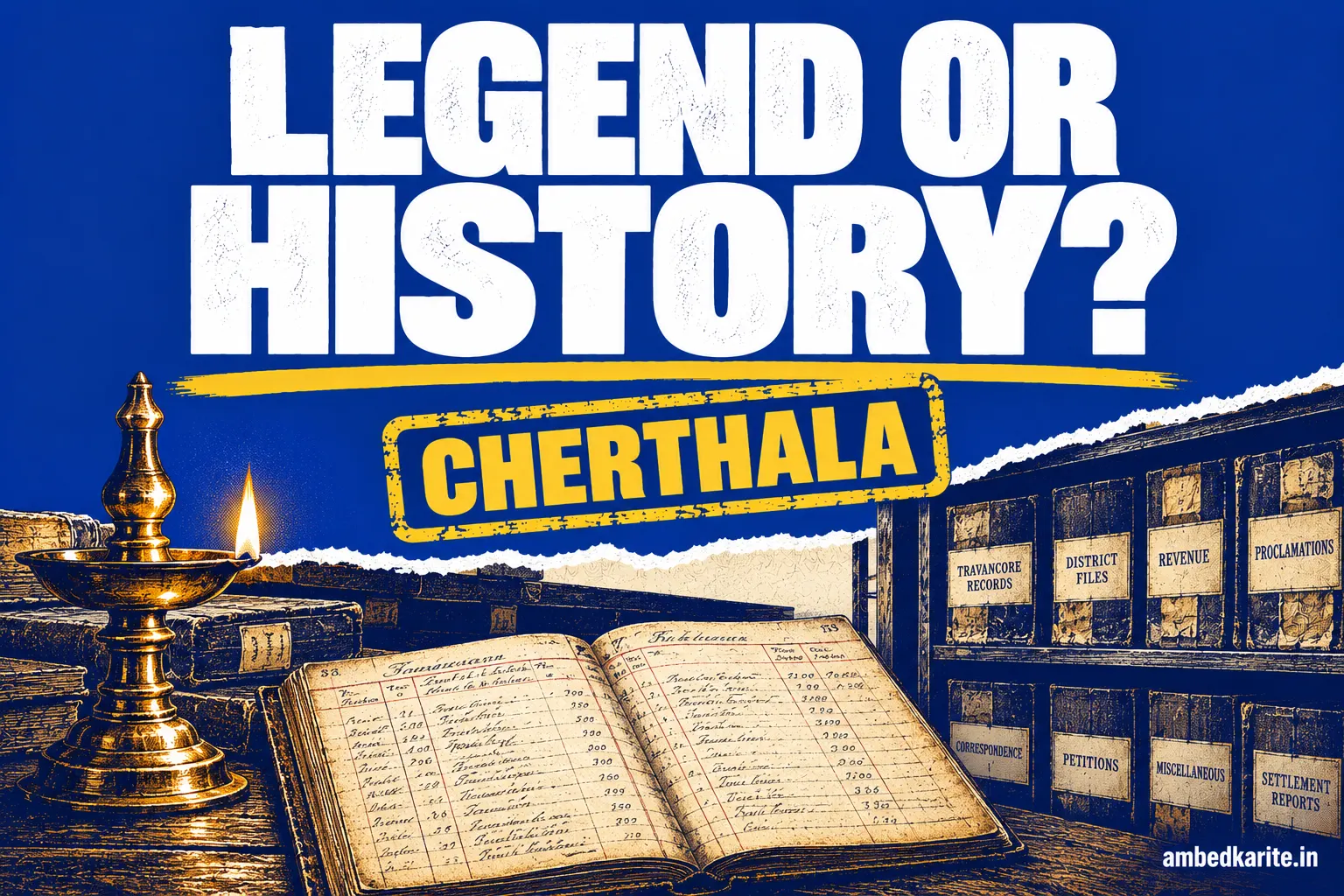
Nangeli legend versus the written record: oral tradition on one side and an empty archive shelf on the other | नांगेली की कहानी पर पोस्टर ग्राफिक: चेरतला की किंवदंती, मौखिक इतिहास और रिकॉर्ड क्या दिखाते हैं
The Nangeli legend is considered one of the most well known legends of Kerala. Here is what the sources say (where they differ is included below):
Content note: this post discusses a legend involving a fatal act of protest. No detail of the act is provided.
Nangeli is said to be a woman from Cherthala, Travancore, who is said to have protested against a tax in the early 1800s (Boing Boing, 2026). She is said to be present in no written history of Kerala or Travancore (Open magazine). In this post, each claim is classified as a documented, disputed or legendary claim. This post treats Nangeli’s legend as a legend and not as a hoax, and it has no intention to target a particular community.
In the legend, Nangeli is an Ezhava woman of Cherthala in what is now the Alappuzha district (Boing Boing, 2026; The News Minute opinion, 2023). It is said that she gave a mulakkaram tax protest with a deadly act of protest (Boing Boing, 2026). It is also said that the tax was later abolished and that Nangeli’s husband, Chirukandan, later met with a tragic end (Pillai in The Hindu, 2017; Deccan Chronicle).
Pillai’s article says the year was 1803 (Pillai in The Hindu, 2017). Other articles say the “early 19th century” (Boing Boing, 2026). A location in Cherthala called Mulachiparambu is also said to be related to the legend (The Mooknayak; Deccan Chronicle).
What is the origin of the Nangeli story?
It exists in the realm of oral tradition. Artist Murali T claims to have come across it in an abridged report in the in-house bank magazine of a native of Cherthala (summarized from Udayavani, BBC). He then created a series of paintings on her, and the Deccan Chronicle reports that an exhibition of his three paintings, held to celebrate Women’s Day at Mulachiparambu in Cherthala, received a positive response (Deccan Chronicle). He called her “the first feminist that Malayalis have seen” (Deccan Chronicle).
The story received more exposure in 2016, after it was covered by the BBC (Boing Boing, 2026). Artist Orijit Sen, who also retold the story in comic form, acknowledges that it is a disputed story, and that historians have yet to find sufficient corroborating evidence outside of the story to validate it (RAIOT). For Sen, it is important that the story exists and is still told, irrespective of the evidence (RAIOT).
Nangeli: written records
In the sources that I was able to access, there is no record of a contemporary document of Nangeli. She does not exist in written records (Open magazine). Travancore historian Malayinkeezhu Gopalakrishnan, too, has found no record of her in the Mathilakam Records (Open magazine). Sen says that for academics, there isn’t enough corroborating evidence for the events (RAIOT).
This is a reflection of the state of historical records. It does not definitively say that she is a myth.
What historians say about Nangeli
Who
View
Reasoning
Manu S. Pillai
The story has oral history value. Its meaning has evolved.
He says that in her time, a woman’s honor was hardly tied to covering her breasts. He interprets this as a protest against a regressive tax system (Pillai in The Hindu, 2017; Open magazine).
Malayinkeezhu Gopalakrishnan
Not in the records he checked.
Mathilakam Records (Open magazine).
Ajay S. Sekher and Maria Teresa Raju
Caste cannot be removed from this oral history.
Relatives of Nangeli still live near Cherthala and Ezhava figures invoked her (The News Minute opinion, 2023).
Orijit Sen
Disputed, but the telling is important.
No outside evidence exists and the story’s survival itself is the evidence (RAIOT).
Sheeba K. M.
The tax served to sustain the caste structure.
As told to the BBC (Udayavani)
Malavika Binny
Archives under-record Dalit women who took part in resistance.
Pillai answers Gopalakrishnan that oral history has value (Open magazine). Sekher and Raju disagree with Pillai’s reading. They say the argument that the story is only about class and economics erases caste (The News Minute opinion, 2023). The op-ed also says a gender consultant to the Kerala government argued in 2019 that the tax and Nangeli’s story were about economics (The News Minute opinion, 2023).
The op-ed adds another point. It claims that the name Nangeli was in use among Avarna families in the 19th century, and provides the example of a sister of the poet Mooloor S. Padmanabha Panicker (The News Minute opinion, 2023). I cannot confirm this.
The changing Nangeli narrative
As regards changing the narrative over time, Pillai states that in the present versions of the narrative, Nangeli fights for the honour of the household, meaning the right to cover her breast, but in her times, honour meant the area below the waist, and so on (Pillai in The Hindu, 2017). He says that the memory of Nangeli was shaped to fit the changing notions of right and wrong (Pillai in The Hindu, 2017).
Sekher and Raju identify a different issue with the narrative. They say that ignoring the caste aspect of the tax leads one to romanticise a past without the Caste system (The News Minute opinion, 2023). Two differing but insightful readings of the same legend lead in opposite directions, and readers can make their own assessment.
Nangeli, Breast Tax and Channar Revolt are three different things
The three are often linked, but rest on different evidence.
The Breast Tax (mulakkaram): meaning and nature of the tax is debatable. Read our post on the Breast Tax in Travancore.
The Channar Revolt: a documented revolt by Nadar women in south Travancore for the removal of a dress code. Read our post on the Channar Revolt.
Nangeli: an Ezhava legend from Cherthala, in Alappuzha district, with no contemporary record in these sources (Open magazine; The News Minute opinion, 2023).
Pillai notes that the riots over upper cloth in the 1850s were over the shawls reserved for the upper classes (Pillai, 2017). So the link between Nangeli and the Channar revolt is a modern one, made in retellings.
What we can say with confidence
Documented: The story is told. It came to wide notice with the 2016 BBC report and with the subsequent paintings (Boing Boing, 2016).
Disputed: Was she real? What was mulakkaram? What did her act mean?
Legend: The act, the date 1803, the claim that the tax was ended because of her.
Not found in these sources: A contemporary record that mentions her.
Why the Nangeli story matters whichever way the evidence falls
Binny says Dalit women risked their lives resisting but are rarely named in the archives. (2023). Thus absence from a record is not proof that a person didn’t exist. It is also not proof that she did. Honest appraisal means to hold both: No record found and a living tradition.
The Nangeli story is a legend in oral tradition, and the sources I could open show no document from her time (Open magazine; RAIOT). Historians disagree on what the story means, and both views deserve a hearing (Pillai in The Hindu, 2017; The News Minute opinion, 2023). Say what is known, name what is told, and keep the two apart.
Babasaheb gave us three words: Educate. Agitate. Organize.
Reading is Educate. Agitate and Organize start when you share a sourced page, not a screenshot.
Today, X bans accounts. Reels get shadowbanned. WhatsApp groups get reported. So Bahujans need their own platforms: emails, blogs, websites, AI tools.
The Ambedkarite Educational Program is made for exactly this. ₹297 lifetime, includes Prompt Engineering, Google AI, Website Building, Email Marketing, Blogging & SEO, Canva, plus all future courses free.
Who was Nangeli? In the legend, she was an Ezhava woman of Cherthala who protested a tax in the early 1800s. She is not in the written history of Travancore (Open magazine; Boing Boing, 2026).
Is the Nangeli story true? It is a legend in oral tradition. Sources I could open found no contemporary record, and historians disagree on what it means (Open magazine; RAIOT).
Where did Nangeli live? The legend places her in Cherthala, in Alappuzha district (The News Minute opinion, 2023).
Was Nangeli part of the Channar revolt? No source I read ties her to it directly. The Channar revolt was a documented struggle over dress rules, centred on southern Travancore (The News Minute, 2023).
Did the breast tax end because of Nangeli? Some versions of the legend say so. Historians dispute what the tax was, and no record shows it ended for this reason (Pillai in The Hindu, 2017; The News Minute, 2023).
Why is the place called Mulachiparambu? The name is tied to the legend of the woman said to have lived there (Deccan Chronicle; The Mooknayak).
“The Legend of Nangeli,” Open magazine (views of Manu S. Pillai and Malayinkeezhu Gopalakrishnan).
Opinion by Ajay S. Sekher and Maria Teresa Raju, The News Minute, 17 March 2023.
“A look at the history of the Channar Revolt,” The News Minute, 7 March 2023 (Malavika Binny).
Orijit Sen, introduction to a comic on the legend, RAIOT.
Report on a 3-day exhibition of paintings by T. Murali at Cherthala, Deccan Chronicle.
Summary of the 2016 BBC report (Murali T and Sheeba K. M.), Udayavani.
Summary of the legend and Pillai’s view, Boing Boing, 27 July 2026.
“Nangeli’s Sacrifice & Channar Revolt,” The Mooknayak.
Further reading (not read for this post): the 2016 BBC report by Divya Arya; The Hindu, March 2016, on the legend; the Mathilakam Records; Charles Allen, Coromandel (2017).
What’s your take? Drop a comment below and share this article with someone who still believes the myth.