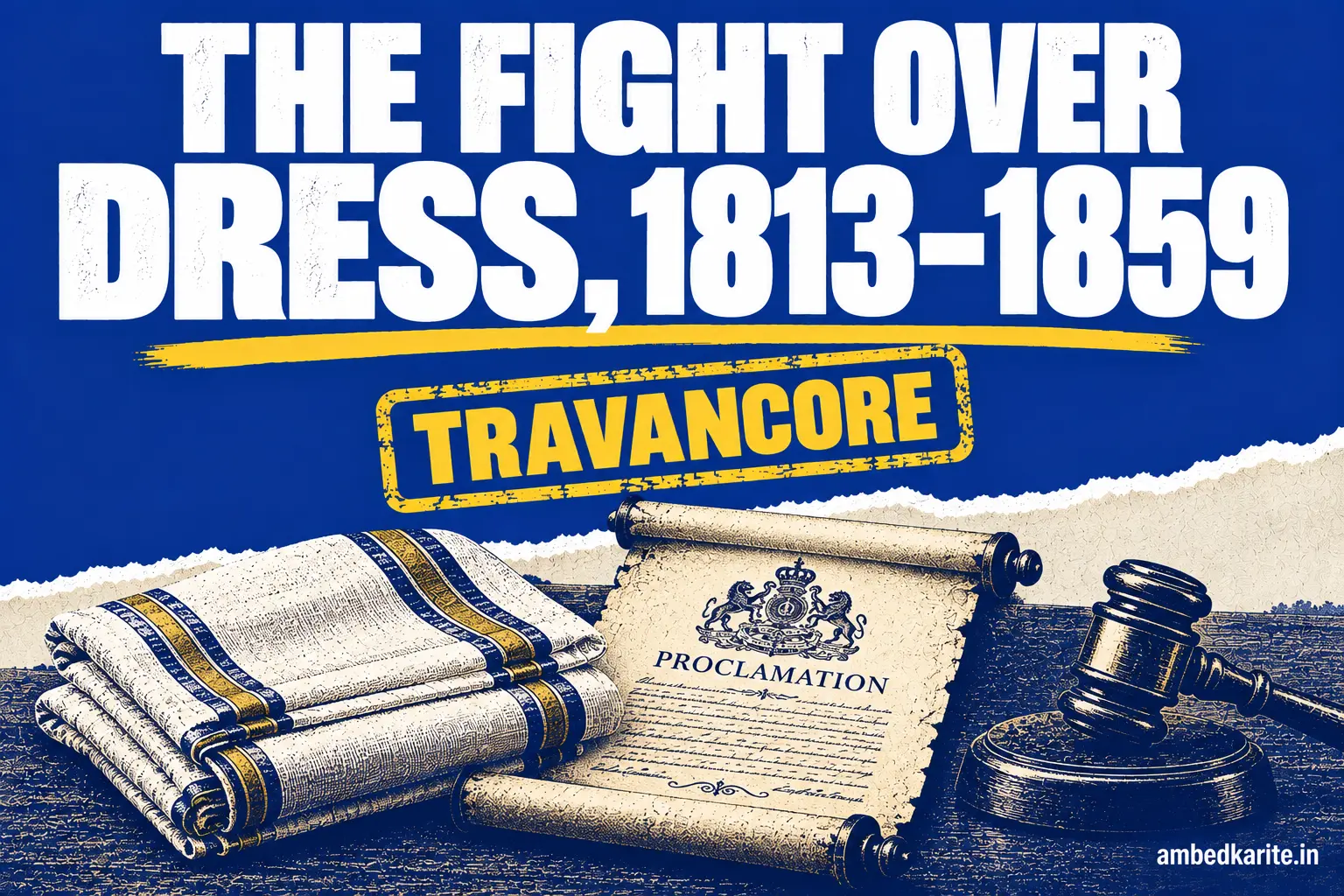
Poster-style graphic on the Channar revolt in Travancore: the 1813 to 1859 fight over dress | चन्नार विद्रोह पर पोस्टर ग्राफिक: त्रावणकोर में 1813 से 1859 तक पहनावे की लड़ाई
Coverage of the Channar revolt is brief, but intense. What follows is a summary of disputed or less documented information.
The Channar revolt is the name given to a long term struggle by women of depressed castes in Travancore (now south Kerala and south Tamil Nadu) for the right to cover their upper bodies (The News Minute, 2023). Dates for this revolt range from 1813 to 1859 (The Mooknayak). This post will treat each point of contention as disputed or settled. This report documents caste-related laws of a princely state, and this post is not an attack on any community whatsoever.
Also known as the Channar Lahala, Nadar Lahala, Maru Marakkal Samaram, and Thol Seelai Porattam, this was a long, drawn out movement mainly led by women of the Nadar (earlier known as Shanar) community, with some accounts including women of the Ezhava community (Huffpost India, 2016; The News Minute, 2023).
This was a movement to protest against laws that restricted covering of the upper body. This is different from a protest against the breast tax, where there are varying opinions, and which is explained in our post on the breast tax of Travancore.
Background: Caste-based dress rules in Travancore
As per a letter written on 16 July 1859, there have been ‘ancient laws of Travancore’ which determined the style of dress of different castes (British periodical of 1859, via NCSE archive). As per that letter, the cloth allotted to the Shanar and other ‘inferior’ classes was a coarse one, tied around the waist and worn alike by men and women (NCSE archive). The text in that archive is machine-read and may contain errors.
As per the textbook account, bare-chestedness was a sign of respect to the upper classes (Huffpost India, 2016). Women of the dominant castes wore a jacket and mundu, which according to them covered them too much and made it impossible to discern the caste of the woman (The News Minute, 2023).
The rules were not the same for all. Nair women could cover the chest in the presence of Brahmins, except before royalty or in a temple (The News Minute). The baseline is also disputed. Covering the breasts was not the norm in Kerala’s matrilineal society as per Manu S. Pillai (Open magazine). Thus the question was who had to cover before whom.
Channar Revolt Timeline
Event
Information
Source
Early 1800’s
Nadar women who converted to Christianity began wearing tailored blouses. British dewan, Colonel John Munro, permitted Christian women to cover. The king’s council revoked the order.
HuffPost India, 2016; The News Minute, 2023
May 1822
Nair men attacked Shanar women In public for wearing a cloth across the upper body.
HuffPost India, 2016 (quoting an NCERT-era textbook)
1820’s
Violence increased and schools and Churches were burnt.
The Travancore government directed Shanar women not to cover the upper body.
HuffPost India, 2016; The Mooknayak
1858
Violent unrest broke out in several places.
The Mooknayak
26 July 1859
Under pressure from Madras Governor Charles Trevelyan, the king issued a proclamation allowing women to cover the upper body.
The News Minute, 2023; The Mooknayak
October 1859
Shanar women were attacked and their upper clothes were forcibly removed at a marketplace. An order then allowed a jacket or covering “in any manner whatever,” but “not like the women of high caste.”
HuffPost India, 2016
To 1915-1916
According to one source, the discrimination continued.
The Mooknayak
Historian Rajan Gurukkal describes the struggle in stages.
The first Channar protest fizzled out once the police were called. The second, however, managed to gain the British Dewan to allow Christian and Nadar women to cover. The King’s council later revoked the Dewan’s order (The News Minute, 2023). By then, women of the oppressed Hindu castes also joined the protest (The News Minute, 2023).
Who led the Channar revolt?
Gurukkal says the social reformer Ayya Vaikunda Swami was the first to raise this issue and initiated the struggle by bringing and meeting women (The News Minute, 2023). Malavika Binny of Kannur University says there was a focus on male leadership and that Dalit women, who also participated, are rarely found in the records (The News Minute, 2023).
As per The Mooknayak, later challenges to the dress code were taken up by Ayyankali, the Dalit reformer (The Mooknayak). Binny is also quoted by The News Minute 2023) giving credit to Ayyankali.
Channar revolt: disputes and different views
Missionaries. The 1859 letter says that Shanars have always been encouraged to wear the upper cloth by Missionaries (NCSE archive). The textbook mentions Shanar converts wearing blouses under the influence of the missionaries (HuffPost India, 2016).
The British. A British dewan allowed Christian women to cover, and the king’s council reversed that (The News Minute, 2023). In 1859, the Madras Governor pressed the king to issue the proclamation (The News Minute, 2023). So, the British role was mixed.
Which 1859 instrument? The News Minute and The Mooknayak speak of a proclamation dated 26th July 1859 (The News Minute, 2023; The Mooknayak). The textbook account speaks of an order issued in October 1859, after an incident in the marketplace (HuffPost India, 2016). I could not resolve the difference.
Caste or Gender? Binny says the revolt was a struggle against Brahmanical patriarchy, and that now only the Brahmanical part is remembered and not the patriarchal part (The News Minute, 2023). Historians Stalin Rajangam and K.A. Manikumar asks why some accept and others avoid this part of history, and attribute it to identity and rights (The News Minute, 2023).
What the 1859 order won and lost
The order was a gain and it lifted a ban on covering upper body. The Mooknayak says women could then wear jackets like the Christian Nadars or coarse cloth around the upper body like the fisherwomen called Mukkavattigal (The Mooknayak). The order was conditional, it stated women could not dress like the women of “the high-caste” (HuffPost India, 2016).
Other sources say that Nadar women were also deprived of the right to the Nair shawl and were granted the kuppayam, a jacket, which is also worn by Syrian Christians and Mappilas (Feminism in India). Mooknayak says the code remained discriminatory until 1915-16 (The Mooknayak). Therefore, 1859 was a limited victory, not complete equality.
Why is the Channar revolt in the news?
The part of the text, “Caste Conflict and Change of Costume,” which talks about this struggle, was removed from a CBSE textbook in 2016 (HuffPost India, 2016). From 2006-07 to 2015, the NCERT textbook containing this part was used by the CBSE and 15 other state boards (HuffPost India, 2016). In March 2023, an event in Nagercoil celebrated the bicentenary of the struggle (The News Minute, 2023).
What we can say with confidence
Documented: Caste-specific dress codes, the 1822 attacks, the 1829 order, the July 1859 proclamation and the conditions on women’s dress.
Disputed: Who led it, the role of missionaries, the July and October proclamations.
Unsettled: The role of Ayyankali and others in the later phase, the date of the Munro order, which one source puts in 1813.
Takeaway
The Channar revolt was a long fight over who could cover the body, and the rules behind it are documented (HuffPost India, 2016; The News Minute, 2023). The 1859 order allowed covering with conditions, and the code stayed discriminatory for decades, according to one source (HuffPost India, 2016; The Mooknayak). Name the women, mark what is disputed, and don’t flatten the story.
Babasaheb gave us three words: Educate. Agitate. Organize.
Reading is Educate. Agitate and Organize start when you share a sourced page, not a screenshot.
Today, X bans accounts. Reels get shadowbanned. WhatsApp groups get reported. So Bahujans need their own platforms: emails, blogs, websites, AI tools.
The Ambedkarite Educational Program is made for exactly this. ₹297 lifetime, includes Prompt Engineering, Google AI, Website Building, Email Marketing, Blogging & SEO, Canva, plus all future courses free.
For another state-backed caste rule, see our post on Peshwa caste.
Frequently Asked Questions
What was the Channar revolt? It was a long struggle by oppressed-caste women in Travancore for the right to cover their upper bodies (The News Minute, 2023).
When did the Channar revolt happen? Sources date it from 1813 to 1859, with violence in the 1820s and in 1858–1859 (The Mooknayak; HuffPost India, 2016).
Why is it called the upper cloth revolt? Because it was a fight over the right to wear an upper cloth. A textbook called it the “Upper Cloth Movement” (HuffPost India, 2016).
What did the 1859 proclamation allow? It allowed women to cover the upper body, with a jacket or coarse cloth, but not “like the women of high caste” (The Mooknayak; HuffPost India, 2016).
Who led the Channar revolt? Gurukkal credits Ayya Vaikunda Swami with beginning it, and Binny stresses the many Dalit women who are rarely named (The News Minute, 2023).
Was the Channar revolt about the breast tax? The fight was about dress rules. What the breast tax really was is disputed (The News Minute, 2023).
Sources
“A look at the history of the Channar Revolt,” The News Minute, 7 March 2023 (Rajan Gurukkal, Malavika Binny, Stalin Rajangam and K. A. Manikumar).
“Nangeli’s Sacrifice & Channar Revolt,” The Mooknayak.
“Section on Nadar women’s struggle expunged from CBSE textbook,” HuffPost India, 20 December 2016 (textbook quotations).
“Dress code repression: Kerala’s history of breast tax for Avarna women” (Nair women and temple rules), The News Minute.
“The Legend of Nangeli” (Manu S. Pillai on the baseline custom), Open magazine.
“The Channar Revolt: The Fight For A Dignified Existence,” Feminism in India.
Further reading (not read for this post): Robin Jeffrey, The Decline of Nair Dominance; Samuel Mateer, Native Life in Travancore (1883); Nagam Aiya, Travancore State Manual; the Mathilakam Records.
What’s your take? Drop a comment below and share this article with someone who still believes the myth.